

FISH BALL PRODUCTION PROCESS – APPLICATIONS OF TAPIOCA STARCH AND CASSAVA STARCH IN FRIED FISH BALL MANUFACTURING
1. Introduction to Fried Fish Balls
Fried fish balls are popular processed seafood products in Vietnam and many international markets. They are manufactured from minced fish meat or surimi combined with starches, seasonings, and permitted food ingredients.
The mixture is processed, shaped into small round balls, heat-treated, and optionally pre-fried before freezing and packaging.
Thanks to their distinctive chewy texture, delicious flavor, and convenience, fish balls are widely distributed through supermarkets, restaurants, food service businesses, and frozen food retailers.
In industrial fish ball manufacturing, tapioca starch, also known as cassava starch, is an important ingredient. It contributes to product texture, binding properties, moisture retention, and production cost optimization.
Modified starches are also used in selected formulations to improve processing performance and product stability.
2. Main Ingredients Used in Fish Ball Production
High-quality fish balls require carefully selected raw materials that meet food safety and quality standards.
2.1. Fish Meat
Fish meat is the primary ingredient responsible for the flavor, nutritional value, and protein structure of fish balls.
Commonly used fish species include:
- Pangasius.
- Basa fish.
- Tilapia.
- White-fleshed marine fish.
- Other suitable fish species for surimi production.
Freshness, protein quality, and proper storage conditions are important factors in selecting fish raw materials.
2.2. Tapioca Starch (Cassava Starch)
Tapioca starch is widely used in seafood processing because of its thickening, binding, and gel-forming properties.
In fish ball manufacturing, tapioca starch helps improve texture, enhance product cohesion, retain moisture, and maintain product consistency.
2.3. Modified Starch
Modified starch is used to improve specific functional properties depending on the production process and desired product characteristics.
Common modified starch types used in food processing include:
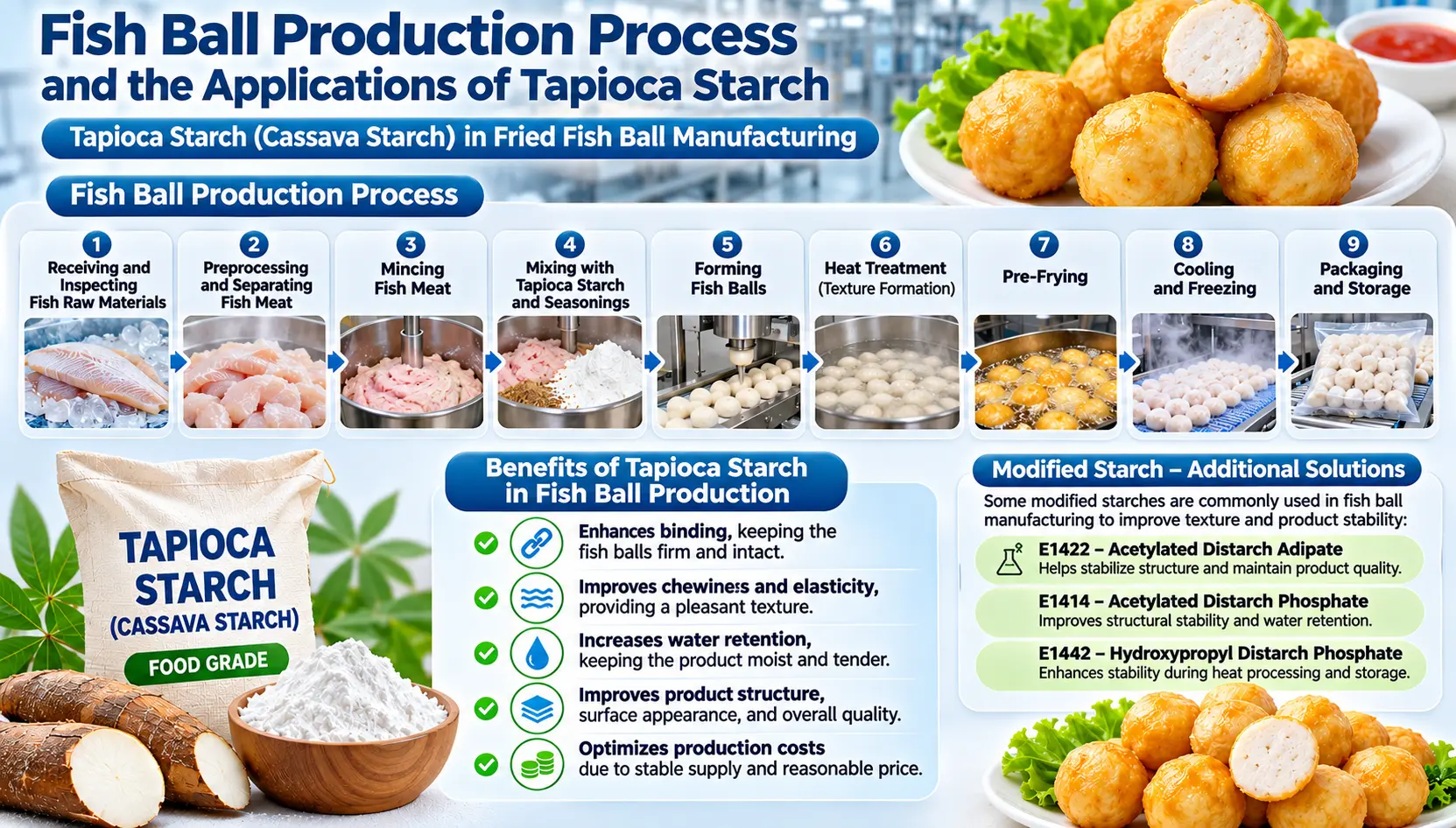
- E1422 – Acetylated Distarch Adipate.
- E1414 – Acetylated Distarch Phosphate.
- E1442 – Hydroxypropyl Distarch Phosphate.
The appropriate starch type should be selected based on its technical properties, intended application, and applicable food additive regulations.
2.4. Other Ingredients
Other ingredients commonly used include:
- Salt.
- Sugar.
- White pepper.
- Garlic and onion.
- Chilled water or ice.
- Seasonings.
- Permitted food additives.
3. Industrial Fish Ball Production Process
The industrial production of fried fish balls generally involves the following manufacturing stages.
Step 1: Raw Fish Receiving and Quality Inspection
Fresh or frozen fish is delivered to the processing facility.
The raw materials are inspected for freshness, color, odor, temperature, and overall quality.
Frozen fish must be thawed under controlled conditions to minimize quality deterioration.
Step 2: Fish Preparation and Meat Separation
The fish is cleaned and processed to remove heads, bones, skin, and other unwanted components.
The fish meat is separated, washed, and drained under hygienic conditions.
Some manufacturers use surimi as the main raw material instead of freshly separated fish meat.
Step 3: Fish Mince Preparation
The fish meat is transferred into industrial mincing or chopping equipment to produce a uniform fish paste.
Temperature control is important during this stage to preserve the functional properties of fish proteins.
Step 4: Mixing with Tapioca Starch and Seasonings
This is one of the most important stages in fish ball manufacturing.
The minced fish is mixed with tapioca starch, modified starch, salt, sugar, seasonings, and other ingredients according to the manufacturer’s formulation.
Tapioca starch provides several functional benefits:
- Improves binding properties.
- Enhances product texture and chewiness.
- Helps retain moisture.
- Reduces moisture loss during heat processing.
- Supports formulation cost optimization.
The starch concentration should be adjusted according to fish protein content, raw material quality, and the desired characteristics of the final product.
Step 5: Fish Ball Forming
After mixing, the fish paste is transferred to automatic fish ball forming machines.
The equipment produces uniformly shaped fish balls with consistent sizes and smooth surfaces.
Step 6: Heat Treatment and Texture Formation
The shaped fish balls undergo controlled heat treatment.
During this process, fish proteins form a gel structure while starch gelatinization contributes to the final product texture.
Processing temperatures and treatment times must be validated by the manufacturer to ensure product quality and food safety.
Step 7: Pre-Frying
Depending on the product formulation, fish balls may undergo preliminary frying in controlled cooking oil conditions.
This stage helps develop surface color, flavor, and the characteristic appearance of fried fish balls.
Some manufacturers produce non-fried frozen fish balls instead.
Step 8: Cooling and Freezing
After heat treatment, the fish balls are cooled and transferred to a suitable freezing system.
Rapid freezing helps preserve product quality and limits microbial growth when performed under validated processing and storage conditions.
Step 9: Packaging and Storage
The finished fish balls are packed in suitable food-grade packaging materials.
Products are checked for weight, labeling, packaging integrity, and quality specifications.
Frozen fish balls are stored under the temperature conditions and shelf-life specifications established by the manufacturer.
4. Applications of Tapioca Starch in Fried Fish Ball Manufacturing
Tapioca starch, also known as cassava starch, is an important ingredient in the food processing industry, especially in meat and seafood products.
Its functional properties make it suitable for various fish ball formulations.
4.1. Improving Binding Properties
When heated in the presence of water, tapioca starch gelatinizes and contributes to the formation of a cohesive structure.
This helps bind different ingredients together and improves the structural stability of fish balls.
4.2. Enhancing Chewiness and Elasticity
Chewy and elastic texture is one of the most desirable characteristics of high-quality fish balls.
Tapioca starch contributes to the gel structure and texture of the final product when combined with fish proteins.
The appropriate formulation can help manufacturers achieve the desired mouthfeel and product consistency.
4.3. Improving Water Retention
Tapioca starch absorbs and retains water during gelatinization.
This property helps reduce moisture loss during heat processing and supports a softer, more consistent product texture.
4.4. Improving Product Texture and Appearance
Properly selected tapioca starch can contribute to:
- Uniform internal structure.
- Improved texture.
- Better product consistency.
- Reduced structural defects.
- Improved sensory characteristics.
These benefits are particularly important for industrial fish ball manufacturers supplying supermarkets, restaurants, and export markets.
4.5. Optimizing Production Costs
Tapioca starch offers a competitive raw material option for seafood manufacturers.
Its availability and functional properties allow manufacturers to optimize formulations while maintaining the required product quality.
5. Role of Modified Starch in Fish Ball Manufacturing
In addition to native tapioca starch, modified starch is used in seafood processing to improve specific functional characteristics.
Depending on the starch type, modified starch may help:
- Improve water retention.
- Stabilize product texture.
- Reduce water separation during frozen storage.
- Improve heat-processing stability.
- Maintain product consistency during distribution.
Some commonly used modified starch types include:
E1422 – Acetylated Distarch Adipate
This starch can help improve texture stability and processing performance in suitable food formulations.
E1414 – Acetylated Distarch Phosphate
It can contribute to structural stability and water retention, depending on the application.
E1442 – Hydroxypropyl Distarch Phosphate
This modified starch is widely used in food applications requiring improved stability during heating and storage.
The selection of modified starch should be based on actual processing conditions, formulation trials, and applicable food additive regulations.
6. How to Choose Tapioca Starch for Fish Ball Production
Selecting the right tapioca starch supplier is essential for maintaining consistent product quality.
Manufacturers should evaluate the following criteria:
- Appropriate starch content.
- White color and natural odor.
- Suitable moisture content.
- Stable viscosity.
- Consistent gelatinization properties.
- Low levels of impurities.
- Clear product specifications and origin documentation.
- Compliance with food safety requirements.
Manufacturers should also conduct production trials to evaluate chewiness, elasticity, water retention, and product quality after freezing and reheating.
Tapioca starch, also known as cassava starch, plays an important role in industrial fried fish ball manufacturing.
Its binding, thickening, and gel-forming properties contribute to improved product texture, chewiness, moisture retention, and manufacturing efficiency.
Modified starches such as E1422, E1414, and E1442 can also provide additional functional benefits in suitable formulations.
Choosing a reliable tapioca starch and modified starch supplier helps seafood manufacturers maintain consistent raw material quality, optimize production costs, and improve the overall quality of their fish ball products.