
APPLICATIONS OF TAPIOCA STARCH (CASSAVA STARCH) IN VERMICELLI AND RICE NOODLE PRODUCTION – MANUFACTURING PROCESS AND BENEFITS
1. Introduction to Tapioca Starch in Vermicelli and Rice Noodle Production
Rice vermicelli and rice noodles are popular traditional food products in Vietnam and many Asian countries. To produce high-quality noodles with good elasticity, smooth texture, consistent color, and excellent cooking stability, selecting the right starch ingredients is essential.
In addition to rice flour and rice starch, tapioca starch, also known as cassava starch, is widely used in commercial vermicelli and rice noodle manufacturing.
Tapioca starch is valued for its thickening, binding, gel-forming, and texture-enhancing properties. When combined with rice flour or rice starch, it can improve noodle elasticity, reduce brittleness, and help maintain the structure of finished products.
The appropriate combination of rice starch and tapioca starch allows manufacturers to improve product quality, optimize production processes, and meet the growing demand for rice-based food products.
2. What Are the Applications of Tapioca Starch in Vermicelli and Rice Noodle Manufacturing?
2.1. Improving Noodle Elasticity and Chewiness
One of the most important characteristics of tapioca starch is its ability to develop an elastic and cohesive structure after gelatinization.
When blended with rice flour or rice starch, tapioca starch can:
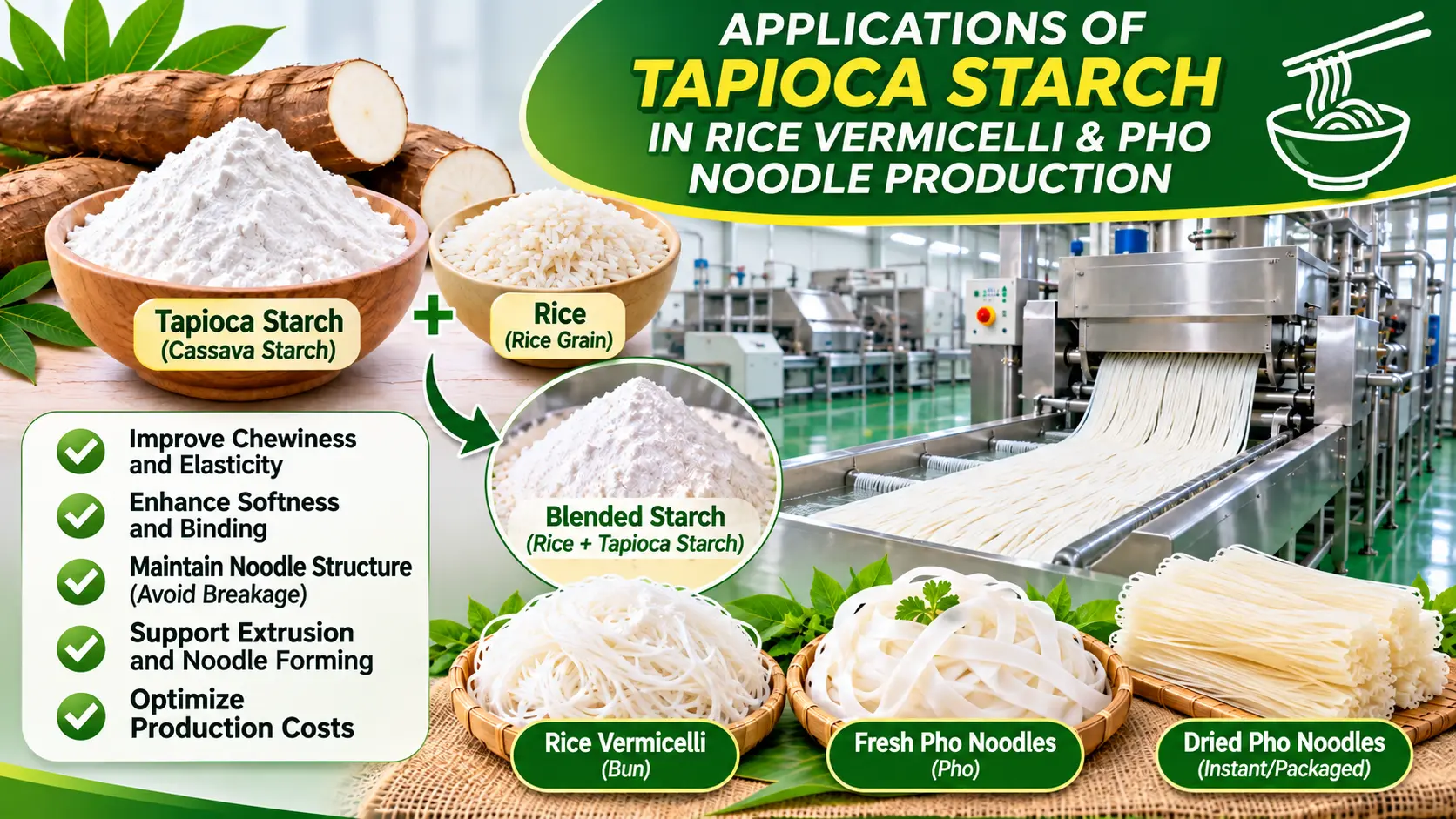
- Improve the elasticity of rice vermicelli and noodles.
- Enhance chewiness and mouthfeel.
- Reduce noodle breakage and brittleness.
- Help maintain noodle structure during cooking.
These properties are particularly important for manufacturers producing fresh, dried, and packaged rice noodles.
2.2. Enhancing Texture and Binding Properties
Tapioca starch has excellent gel-forming and binding capabilities.
When used at an appropriate ratio, it helps improve the cohesion of starch-based ingredients, resulting in a more uniform noodle structure.
This is especially beneficial for industrial noodle production, where product consistency is essential.
2.3. Reducing Noodle Breakage
During extrusion, shaping, steaming, and drying, rice noodles may become brittle or break if their structure is not sufficiently stable.
Tapioca starch helps improve the binding properties and elasticity of the noodle structure, potentially reducing breakage during manufacturing and handling.
2.4. Improving Appearance and Translucency
Tapioca starch is naturally white and can contribute to a relatively translucent appearance after gelatinization.
When properly formulated, it can help improve the visual quality and consistency of finished vermicelli and rice noodles.
2.5. Optimizing Manufacturing Costs
Depending on the product formulation and raw material prices, blending tapioca starch with rice flour or rice starch may help manufacturers optimize ingredient costs while maintaining the desired product characteristics.
3. Manufacturing Process of Vermicelli and Rice Noodles Using Tapioca Starch
The manufacturing process varies depending on the noodle type, production equipment, and factory technology. However, a typical industrial process includes the following stages.
Step 1: Raw Material Preparation
The main ingredients include:
- Rice flour or rice starch.
- Tapioca starch (cassava starch).
- Clean water.
- Approved food additives, if required.
Tapioca starch should meet appropriate standards for whiteness, purity, moisture content, and food safety.
Step 2: Ingredient Blending
Rice flour and tapioca starch are accurately weighed and blended according to the manufacturer’s formulation.
The blending ratio depends on the desired noodle texture, production technology, and final product specifications.
Proper blending ensures consistent quality across production batches.
Step 3: Water Mixing and Dough Preparation
Water is gradually added to the dry ingredients to achieve the required moisture level.
The mixing process should ensure uniform ingredient distribution and prevent the formation of lumps.
Step 4: Starch Gelatinization
The starch mixture undergoes controlled heating to allow the starch granules to absorb water and gelatinize.
This is a critical stage that influences the final texture, elasticity, and structural stability of the noodles.
Step 5: Extrusion and Noodle Shaping
The prepared starch mixture is transferred to an extrusion or noodle-forming system.
The equipment shapes the mixture into vermicelli or rice noodles according to the required dimensions.
Tapioca starch contributes to binding and structural stability during this stage.
Step 6: Steaming and Cooking
The shaped noodles are steamed or heat-treated to complete starch gelatinization and stabilize their structure.
Step 7: Cooling and Product Processing
After cooking, the noodles are cooled and may undergo washing or other processing steps depending on the manufacturer’s production technology.
This stage helps stabilize the noodle structure before packaging.
Step 8: Packaging and Storage
Finished vermicelli and rice noodles are packaged according to product specifications.
Depending on the product type, manufacturers may use refrigeration, drying, or other suitable preservation and packaging methods to achieve the required shelf life.
4. Natural Tapioca Starch vs. Modified Tapioca Starch in Rice Noodle Production
In addition to native tapioca starch, some manufacturers use modified starches to improve specific processing and product characteristics.
| Criteria | Native Tapioca Starch | Modified Tapioca Starch |
|---|---|---|
| Elasticity development | Good | Depends on modification type |
| Gel formation | Good | Can be customized |
| Heat stability | Depends on processing conditions | Can be improved |
| Freeze-thaw stability | More limited | Some types offer better stability |
| Applications | Traditional vermicelli and rice noodles | Industrial noodles requiring specific functional properties |
Some modified starches that may be evaluated for suitable food applications include:
- E1412: Distarch Phosphate.
- E1414: Acetylated Distarch Phosphate.
- E1422: Acetylated Distarch Adipate.
- E1442: Hydroxypropyl Distarch Phosphate.
The selection of modified starch should depend on the production process, finished product requirements, and food additive regulations in the target market.
Not all modified starches are suitable for every type of vermicelli or rice noodle.
5. How to Choose High-Quality Tapioca Starch for Vermicelli and Rice Noodle Production
Selecting the right tapioca starch supplier is essential for maintaining consistent product quality.
Manufacturers should consider the following factors:
- Whiteness: Natural white color and consistent appearance.
- Purity: High starch content and low impurity levels.
- Moisture Content: Meets technical specifications and storage requirements.
- Viscosity: Suitable for the intended formulation and production process.
- Gelatinization Properties: Supports the required noodle structure and texture.
- Food Safety: Appropriate quality documentation and certifications.
- Stable Supply: Consistent quality and reliable long-term supply capacity.
6. Tapioca Starch Price for Vermicelli and Rice Noodle Manufacturing
Tapioca starch prices depend on several market and technical factors, including:
- Country and region of origin.
- Whiteness and purity.
- Product specifications.
- Order quantity.
- Packaging requirements.
- Transportation and delivery terms.
For industrial vermicelli and rice noodle manufacturers, working directly with reliable suppliers and establishing long-term purchasing plans may help optimize raw material costs.
To receive an accurate quotation, buyers should provide their required specifications, purchasing volume, packaging preferences, and delivery location.
Tapioca starch, also known as cassava starch, is an important ingredient in the production of vermicelli and rice noodles.
Its excellent binding, gel-forming, and texture-enhancing properties make it a valuable raw material for improving noodle elasticity, chewiness, and structural stability.
By selecting the appropriate tapioca starch grade and optimizing the formulation and manufacturing process, food manufacturers can improve product quality, production efficiency, and competitiveness in domestic and international markets.
Contact us for consultation and competitive quotations for tapioca starch, cassava starch, and modified starch for vermicelli, rice noodle, and other food manufacturing applications.