

MODIFIED STARCH CLASSIFICATION – HEAT-RESISTANT AND NON-HEAT-RESISTANT MODIFIED STARCH
1. What Is Modified Starch?
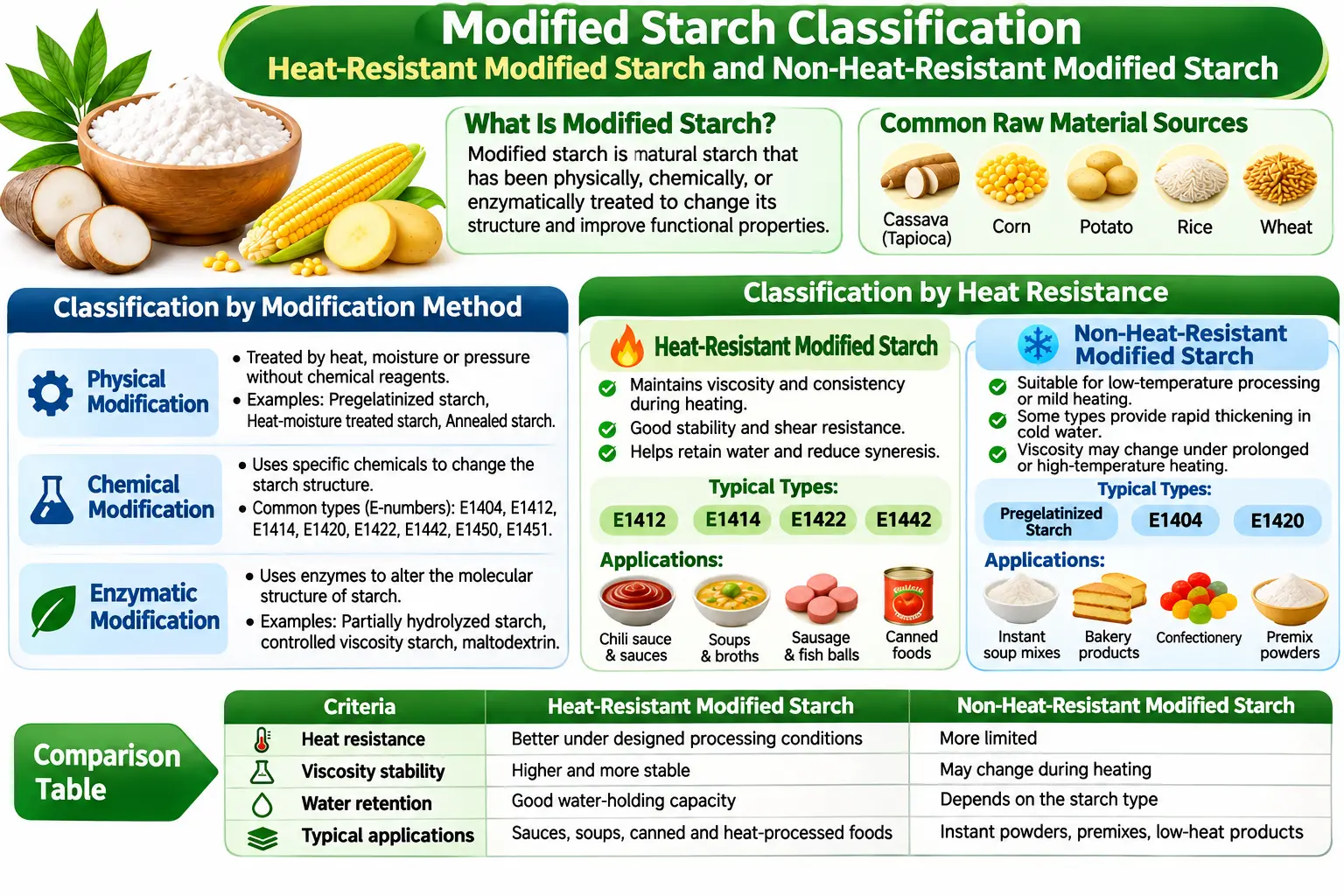
Modified starch is natural starch that has been physically, chemically, or enzymatically treated to improve or alter its functional properties.
Modified starch is commonly produced from various plant-based raw materials, including:
- Tapioca starch.
- Cassava starch.
- Corn starch.
- Potato starch.
- Rice starch.
- Wheat starch.
Compared with native starch, modified starch can offer improved thickening properties, viscosity stability, water retention, heat resistance, shear resistance, freeze-thaw stability, film-forming properties, and resistance to retrogradation.
Today, modified starch is widely used in food processing, sauce manufacturing, instant noodles, sausages, fish balls, confectionery, frozen foods, paper manufacturing, textile processing, and many other industrial applications.
2. Classification of Modified Starch
Modified starch can be classified according to its production method, chemical structure, and functional properties.
2.1. Classification by Modification Method
A. Physically Modified Starch
Physically modified starch is processed using physical treatments such as heat, moisture, pressure, or other physical technologies without necessarily introducing chemical reagents.
Common types include:
- Pregelatinized Starch.
- Heat Moisture Treated Starch.
- Annealed Starch.
Main characteristics:
- Modified water absorption properties.
- Improved hydration and dispersion in certain applications.
- Some types can provide instant thickening in cold water.
- Suitable for instant foods and premixed products.
B. Chemically Modified Starch
Chemically modified starch is produced through controlled chemical treatments that alter the molecular structure or introduce functional groups into starch molecules.
Common types include:
| E Number | Modified Starch Type | Main Characteristics |
|---|---|---|
| E1404 | Oxidized Starch | Low viscosity and film-forming properties |
| E1410 | Monostarch Phosphate | Phosphate-modified starch |
| E1412 | Distarch Phosphate | Cross-linked starch with improved stability |
| E1413 | Phosphated Distarch Phosphate | Cross-linked phosphate starch |
| E1414 | Acetylated Distarch Phosphate | Acetylated and cross-linked starch |
| E1420 | Acetylated Starch | Improved resistance to retrogradation |
| E1422 | Acetylated Distarch Adipate | Cross-linked and acetylated starch |
| E1440 | Hydroxypropyl Starch | Hydroxypropyl-modified starch |
| E1442 | Hydroxypropyl Distarch Phosphate | Cross-linked hydroxypropyl starch |
| E1450 | Starch Sodium Octenyl Succinate | Emulsifying starch |
| E1451 | Acetylated Oxidized Starch | Acetylated and oxidized starch |
C. Enzymatically Modified Starch
Enzymatically modified starch is produced using specific enzymes to change starch molecular structures and functional properties.
Examples of products obtained through enzymatic processing include:
- Partially hydrolyzed starch.
- Starch with controlled viscosity.
- Maltodextrin.
- Other functional carbohydrate derivatives.
These ingredients are used in confectionery, beverages, food processing, and industrial applications.
3. Classification of Modified Starch Based on Heat Resistance
In the food processing industry, modified starch is also commonly selected according to its ability to maintain viscosity and structural stability during heating.
For practical applications, modified starch can be divided into two broad groups:
- Heat-Resistant Modified Starch.
- Non-Heat-Resistant Modified Starch or Modified Starch with Limited Heat Resistance.
This is a functional and commercial classification rather than an official universal classification. Actual heat resistance depends on starch chemistry, manufacturing conditions, formulation, temperature, heating time, pH, and mechanical shear.
3.1. What Is Heat-Resistant Modified Starch?
Heat-resistant modified starch refers to starch products designed to maintain viscosity, consistency, and structural stability under suitable heating conditions.
Some specially modified starches can also maintain their functional properties during processing involving mechanical stirring, pressure, or acidic conditions.
Main characteristics:
- Improved stability under appropriate heating conditions.
- Better viscosity retention during cooking.
- Reduced breakdown of starch structure.
- Improved resistance to mechanical shear in suitable formulations.
- Better water retention and reduced syneresis in certain applications.
Common Modified Starch Types Used in Heat-Resistant Applications
E1412 – Distarch Phosphate
Distarch phosphate is a cross-linked phosphate starch.
Cross-linking improves the ability of starch granules to maintain their structure during heating and mechanical processing.
Applications:
- Sauces.
- Chili sauces.
- Tomato ketchup.
- Canned foods.
- Heat-processed food products.
E1414 – Acetylated Distarch Phosphate
This modified starch combines cross-linking and acetylation technologies.
Main characteristics:
- Improved heat stability.
- Better water retention.
- Improved viscosity stability.
- Enhanced stability in certain freeze-thaw applications.
Applications:
- Chili sauce.
- Industrial sauces.
- Processed foods.
- Soups and broths.
- Canned food products.
E1422 – Acetylated Distarch Adipate
E1422 is a cross-linked and acetylated starch designed to provide improved processing stability.
Main characteristics:
- Improved resistance to processing conditions.
- Good thickening properties.
- Improved water retention.
- Better stability in suitable food formulations.
Applications:
- Tomato ketchup.
- Chili sauce.
- Industrial sauces.
- Frozen foods.
- Bakery fillings.
- Processed food products.
E1442 – Hydroxypropyl Distarch Phosphate
E1442 combines phosphate cross-linking with hydroxypropyl modification.
Main characteristics:
- Improved viscosity stability during heating.
- Better water retention.
- Reduced starch retrogradation.
- Improved storage stability.
- Suitable for selected frozen and chilled food applications.
Applications:
- Soups.
- Sauces.
- Dairy products.
- Frozen foods.
- Bakery fillings.
- Ready-to-eat meals.
3.2. What Is Non-Heat-Resistant Modified Starch?
Non-heat-resistant modified starch is a commercial and functional term used for starch products that have limited viscosity or structural stability under prolonged or intensive heating conditions.
These starches may be suitable for products that do not require intensive heating after the starch has been added.
Main characteristics:
- Suitable for selected low-temperature processing applications.
- Some types provide rapid thickening in cold water.
- Viscosity may change during heating.
- Resistance to mechanical shear depends on the specific starch formulation.
Common Starch Types Considered for Applications Without High Heat Requirements
Pregelatinized Starch
Pregelatinized starch is produced by gelatinizing starch through physical processing and subsequently drying it.
Main characteristics:
- Provides thickening in cold water.
- Rapid water absorption.
- Easy to incorporate into premixed powders.
- Not all grades are suitable for prolonged heating.
Applications:
- Instant soup powders.
- Beverage mixes.
- Instant food products.
- Bakery mixes.
- Products requiring rapid thickening.
E1404 – Oxidized Starch
Oxidized starch is produced through controlled oxidation, which changes its molecular structure and functional properties.
Main characteristics:
- Relatively low viscosity.
- Good film-forming properties.
- Can provide binding functions.
- Heat resistance depends on the degree of oxidation and formulation.
Applications:
- Confectionery.
- Paper manufacturing.
- Textile processing.
- Selected food applications.
E1420 – Acetylated Starch
Acetylated starch is modified to improve certain functional properties, including resistance to retrogradation and paste stability.
However, its heat resistance cannot be determined solely from the E-number. The raw material, degree of modification, and processing conditions must also be considered.
Applications:
- Bakery products.
- Processed foods.
- Selected sauce formulations.
- Products requiring improved texture and water retention.
Important Note: E1404, E1420, and pregelatinized starch should not automatically be classified as non-heat-resistant starches. They may be selected for applications that do not require high heat resistance, but their actual performance depends on the specific commercial grade and processing conditions.
4. Comparison Between Heat-Resistant and Non-Heat-Resistant Modified Starch
| Criteria | Heat-Resistant Modified Starch | Non-Heat-Resistant or Limited Heat-Resistance Starch |
|---|---|---|
| Heat resistance | Better under designed processing conditions | More limited |
| Viscosity stability | Generally higher | May change during heating |
| Shear resistance | Often improved | Depends on the starch type |
| Water retention | Good in suitable formulations | Depends on the starch type |
| Applications | Sauces, soups, canned foods | Instant powders, premixes, low-heat products |
| Processing conditions | Heating processes | Low-temperature or mild-heating processes |
Note: This table provides general selection guidelines rather than fixed technical specifications for every modified starch product.
5. Applications of Heat-Resistant Modified Starch in the Food Industry
5.1. Chili Sauce and Sauce Manufacturing
Heat-resistant modified starch is widely used in chili sauce, tomato ketchup, and industrial sauce production.
Its main functions include:
- Improving viscosity.
- Providing a smooth texture.
- Stabilizing product consistency.
- Reducing water separation.
- Maintaining product quality during suitable heat-processing conditions.
Commonly considered types include E1412, E1414, E1422, and E1442.
5.2. Soup and Canned Food Manufacturing
Modified starch plays an important role in soup production, canned foods, and heat-sterilized food products.
It helps maintain product consistency and thickening properties during thermal processing.
5.3. Sausage, Fish Ball, and Surimi Manufacturing
Modified starch is used to improve water retention, binding properties, texture, and product consistency.
The appropriate starch type should be selected according to cooking temperature, processing conditions, and product formulation.
5.4. Bakery and Confectionery Manufacturing
Modified starch can improve texture, gel formation, viscosity, and product stability in bakery and confectionery applications.
5.5. Frozen Food Manufacturing
Certain modified starches, including E1414, E1422, and E1442, are used in frozen food formulations to improve water retention and stability during freezing and thawing.
6. How to Choose the Right Modified Starch
Selecting the right modified starch is essential for achieving the desired product quality and production efficiency.
Food manufacturers should consider the following factors:
1. Processing Temperature
Determine the maximum temperature that the product will experience during manufacturing.
2. Heating Time
Longer heating periods generally require better starch stability.
3. Product pH
Acidic products such as chili sauce, ketchup, and other sauces require starch grades suitable for the intended pH conditions.
4. Mechanical Shear
For products processed under high-speed mixing or homogenization, select starch with suitable shear resistance.
5. Final Product Requirements
Consider the required viscosity, clarity, glossiness, water retention, texture, and storage stability.
6. Storage Conditions
For frozen food products, evaluate starch stability throughout freezing and thawing cycles.
7. Reliable Modified Starch Suppliers
Choosing a reliable modified starch supplier is essential for maintaining product quality and ensuring stable production.
When evaluating suppliers, manufacturers should consider:
- Clear raw material origins.
- Certificates of Analysis (COA).
- Technical Data Sheets (TDS).
- Appropriate quality certifications.
- A wide range of modified starch products.
- Technical support for product selection.
- Sample availability for product testing.
- Competitive pricing and stable supply capacity.
A professional supplier should be able to recommend suitable modified starch grades based on the customer’s production process and final product requirements.
Manufacturers should also conduct practical testing to evaluate viscosity, thickening performance, heat stability, and compatibility with their formulations.
8. Conclusion
Modified starch is an important functional ingredient in the food processing and manufacturing industries.
Understanding the classification of modified starch according to heat resistance helps manufacturers select the appropriate ingredients for different production processes.
E1412, E1414, E1422, and E1442 are commonly considered for applications requiring improved stability during heating.
Meanwhile, pregelatinized starch and other modified starch types may be suitable for products requiring instant thickening or applications without intensive heating requirements.
However, the final selection should always be based on the technical specifications of each product and actual processing conditions.
Main SEO Keywords: Modified Starch Classification, Heat-Resistant Modified Starch, Non-Heat-Resistant Modified Starch.
Secondary SEO Keywords: Modified Tapioca Starch, Modified Cassava Starch, E1412 Modified Starch, E1414 Modified Starch, E1422 Modified Starch, E1442 Modified Starch, Food Grade Modified Starch, Modified Starch Supplier.
Meta Title: Modified Starch Classification – Heat-Resistant and Non-Heat-Resistant Starch
Meta Description: Learn about modified starch classification, heat-resistant and non-heat-resistant modified starch, E1412, E1414, E1422, E1442, and their applications in food processing.
Suggested URL: modified-starch-classification-heat-resistant