

BBQ CHARCOAL AND COCONUT SHELL CHARCOAL MANUFACTURING PROCESS – APPLICATIONS OF CASSAVA STARCH AND MODIFIED STARCH
1. Introduction to BBQ Charcoal and Coconut Shell Charcoal
BBQ charcoal is a widely used solid fuel for grilling and cooking in restaurants, hotels, resorts, outdoor kitchens, and household applications. It can be manufactured from various biomass materials, including hardwood, sawdust, bamboo, agricultural residues, and coconut shells.
Among these materials, coconut shell charcoal is highly valued because of its good heating performance, relatively long burning time, low ash content, and efficient utilization of agricultural by-products from the coconut processing industry.
One of the most popular products in the international market is BBQ charcoal briquettes. These products are manufactured by processing carbonized coconut shells into charcoal powder, mixing the powder with suitable binders, and pressing the mixture into different shapes.
Cassava starch, tapioca starch, and modified starch play an important role in this manufacturing process. They are commonly considered natural-based binding materials that help improve particle bonding, briquette strength, and product stability.
2. Raw Materials for BBQ Charcoal Manufacturing
The main raw materials used in BBQ charcoal and coconut shell charcoal production include:
2.1. Coconut Shells
Coconut shells are the primary raw material for coconut shell charcoal production. They are agricultural by-products obtained from coconut processing facilities.
Advantages of coconut shells include:
- Renewable biomass resource.
- Efficient utilization of agricultural waste.
- Suitable carbon content for charcoal production.
- Potential for producing high-quality charcoal.
- Applications in BBQ charcoal and activated carbon manufacturing.
2.2. Coconut Shell Charcoal Powder
After the carbonization process, coconut shell charcoal is crushed and ground into powder.
Charcoal powder is the main component of charcoal briquettes and determines many important product characteristics, including burning performance, heat generation, and ash content.
2.3. Cassava Starch and Tapioca Starch
Cassava starch, also known as tapioca starch, is widely used as a binder in charcoal briquette manufacturing.
When heated in water, cassava starch undergoes gelatinization and forms a viscous paste. This paste helps bind charcoal particles together and creates a uniform mixture suitable for briquette production.
2.4. Modified Starch
Modified starch is produced by treating native starch through physical, enzymatic, or chemical processes to improve specific functional properties.
In BBQ charcoal production, selected modified starch products may be evaluated for the following functions:
- Improving binding performance.
- Enhancing mixture stability.
- Improving forming characteristics.
- Reducing cracking and breakage during drying and transportation.
- Adjusting viscosity and water retention.
- Supporting consistent briquette quality.
The appropriate modified starch grade depends on the production technology, charcoal powder characteristics, and final product requirements.
3. Manufacturing Process of BBQ Charcoal from Coconut Shells
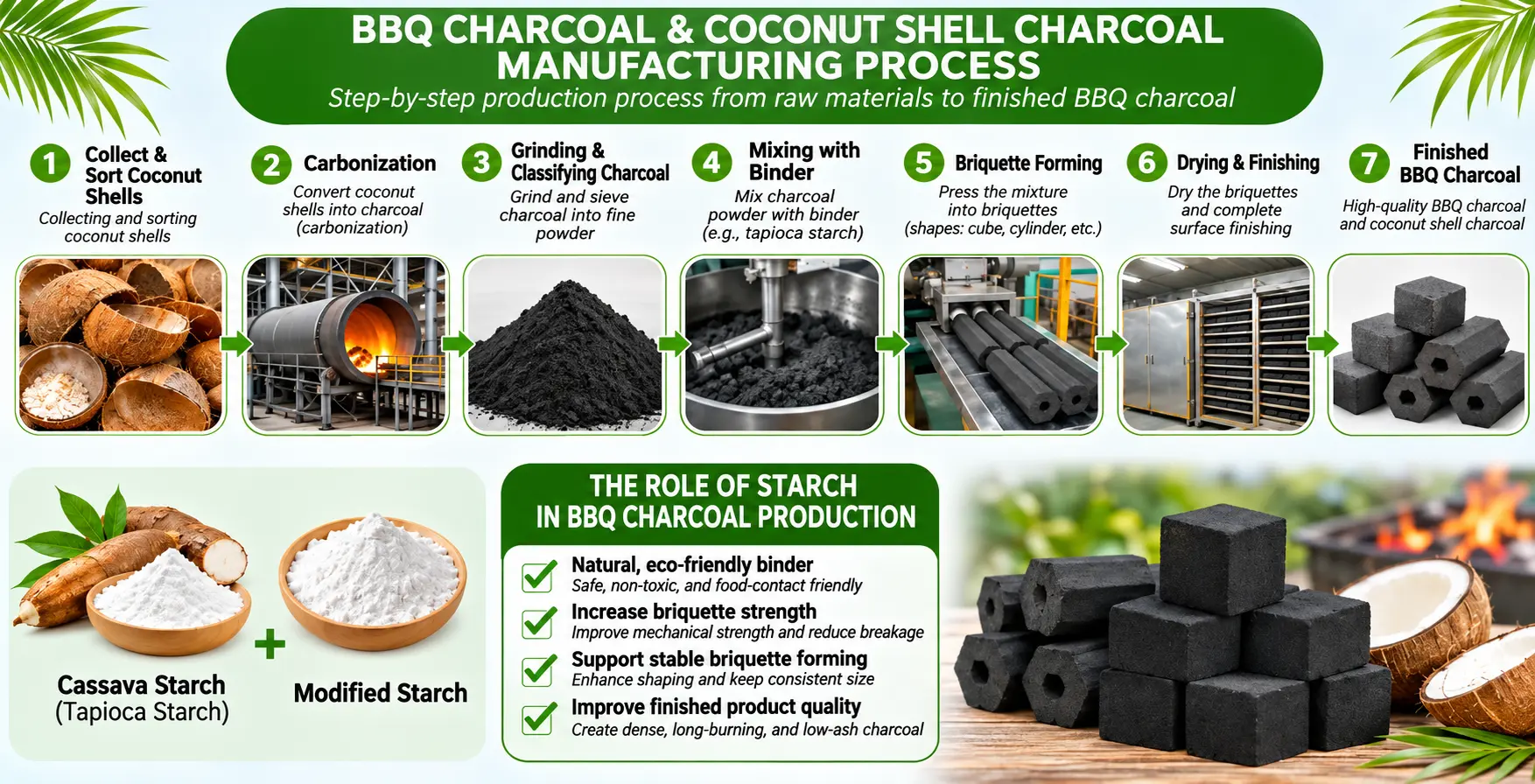
The production of coconut shell BBQ charcoal generally involves the following major stages.
Step 1: Coconut Shell Collection and Sorting
Coconut shells are collected from coconut processing factories and agricultural suppliers.
The raw materials are sorted to remove unwanted materials such as soil, sand, metals, and other contaminants.
Step 2: Raw Material Cleaning and Preparation
The coconut shells are cleaned and may be reduced in size to suit the industrial carbonization equipment.
Moisture content and raw material quality should be controlled before further processing.
Step 3: Coconut Shell Carbonization
Coconut shells undergo thermal treatment under oxygen-limited conditions to convert biomass into charcoal.
During carbonization, volatile components are released, and the remaining material becomes enriched in carbon.
Industrial carbonization systems require appropriate temperature control, exhaust gas treatment, and fire safety management.
Step 4: Charcoal Grinding and Classification
After carbonization, coconut shell charcoal is ground into powder and classified according to particle size.
Uniform particle size helps improve mixing efficiency and briquette forming performance.
Step 5: Binder Preparation and Mixing
Charcoal powder is mixed with a suitable binder.
Cassava starch, tapioca starch, or selected modified starch products may be used depending on the formulation.
After gelatinization, starch forms a binding network that connects charcoal particles and improves the cohesion of the mixture.
Step 6: BBQ Charcoal Briquette Forming
The prepared mixture is processed using industrial briquette-forming equipment.
Common BBQ charcoal briquette shapes include:
- Cube-shaped charcoal briquettes.
- Hexagonal charcoal briquettes.
- Round charcoal briquettes.
- Stick-shaped charcoal briquettes.
- Pillow-shaped charcoal briquettes.
Step 7: Drying and Product Stabilization
The formed briquettes undergo controlled drying to reduce moisture content and improve mechanical strength.
Appropriate drying conditions are important to minimize cracking, deformation, and product damage.
Step 8: Quality Inspection and Packaging
Finished charcoal briquettes are inspected according to important quality parameters, including:
- Moisture content.
- Ash content.
- Fixed carbon content.
- Calorific value.
- Burning duration.
- Mechanical strength.
- Smoke and odor characteristics during use.
After meeting the required specifications, the products are packaged and stored in dry conditions.
4. Applications of Cassava Starch in BBQ Charcoal Manufacturing
Cassava starch is an important binding material used in the production of charcoal briquettes.
Its ability to gelatinize and form a binding structure makes it suitable for connecting small charcoal particles and maintaining the shape of finished briquettes.
4.1. Improving Binding Performance
When heated in water, cassava starch gelatinizes and forms a viscous paste.
This paste helps connect charcoal particles, improving the cohesion of the mixture and reducing the risk of briquette breakage.
4.2. Enhancing Briquette Strength
Cassava starch helps form bonds between charcoal particles, contributing to the mechanical strength of briquettes after drying.
4.3. Supporting the Briquette Forming Process
The binding properties of cassava starch improve mixture uniformity and support consistent briquette forming.
4.4. Improving Finished Product Quality
Selecting suitable cassava starch and optimizing its usage can help manufacturers improve product durability, reduce transportation losses, and maintain consistent product quality.
5. Applications of Tapioca Starch in Coconut Shell Charcoal Production
Tapioca starch is another commercial name commonly used for cassava starch.
In coconut shell charcoal briquette manufacturing, tapioca starch is mainly used as a natural-based binder.
Its major benefits include:
- Connecting coconut shell charcoal particles.
- Supporting briquette formation.
- Improving product hardness and mechanical strength.
- Reducing breakage during packaging and transportation.
- Helping maintain product structure after drying.
The quality of tapioca starch directly influences its binding performance.
Manufacturers should therefore evaluate important specifications such as moisture content, starch purity, viscosity, whiteness, and gelatinization characteristics.
6. Applications of Modified Starch in BBQ Charcoal Manufacturing
In addition to native cassava starch, modified starch is another potential binding material for BBQ charcoal production.
Different modification technologies can provide different functional properties, making modified starch suitable for specific manufacturing requirements.
6.1. Improving Binding Properties
Selected modified starch products can provide suitable viscosity and binding characteristics for charcoal powder mixtures.
This may help improve the consistency and stability of the production process.
6.2. Enhancing Mechanical Strength
Depending on its functional properties, modified starch may improve briquette strength and help reduce cracking or breakage during drying and transportation.
6.3. Viscosity Control
Viscosity plays an important role in the preparation and forming of charcoal mixtures.
Modified starch can be evaluated to achieve suitable viscosity and improve mixture uniformity.
6.4. Optimizing Manufacturing Performance
Using an appropriate modified starch grade may help manufacturers achieve more consistent production results and meet different product specifications.
Not all modified starch products are suitable for charcoal briquette manufacturing. Practical testing is necessary to evaluate binding strength, moisture content, ash content, calorific value, burning duration, smoke, and odor.
7. How to Select the Right Starch for BBQ Charcoal Production
Choosing the right starch is important for achieving stable manufacturing performance and high-quality charcoal briquettes.
Manufacturers should consider the following factors:
| Specification | Importance |
|---|---|
| Starch content | Influences binding efficiency |
| Moisture content | Affects storage and mixing |
| Viscosity | Influences forming performance |
| Gelatinization properties | Determines binder formation |
| Product stability | Supports consistent production |
| Purity | Helps control unwanted impurities |
| Ash content | Important for finished charcoal quality |
In addition, manufacturers should evaluate how the binder affects calorific value, ignition characteristics, burning duration, smoke, odor, and final ash content.
8. Benefits of Using Cassava Starch in Coconut Shell Charcoal Briquettes
Cassava starch offers several potential advantages for charcoal briquette manufacturers:
- Plant-based raw material.
- Good binding performance when properly gelatinized.
- Suitable for various charcoal briquette formulations.
- Helps improve mechanical strength.
- Supports the utilization of agricultural by-products.
- Can be combined with selected modified starch products to optimize formulations.
However, binder concentration must be carefully controlled. Excessive starch may affect ash content, ignition characteristics, burning performance, and the overall quality of finished charcoal.
BBQ charcoal and coconut shell charcoal are valuable biomass-based fuel products with strong potential in domestic and international markets.
In the manufacturing of charcoal briquettes, cassava starch, tapioca starch, and modified starch play important roles as binding materials.
Selecting the appropriate starch grade, controlling raw material quality, and optimizing the formulation can help improve briquette strength, product consistency, and overall manufacturing efficiency.
BBQ charcoal manufacturers should conduct practical production trials to identify the most suitable binder for their raw materials, production equipment, and target product specifications.