

CANNED FOOD MANUFACTURING PROCESS – APPLICATIONS OF CASSAVA STARCH IN CANNED FOOD PRODUCTION
1. Overview of the Canned Food Manufacturing Industry
Canned food is an important segment of the modern food processing industry. Canning technology helps extend the shelf life of food products, control microbial growth, and maintain product quality during storage, transportation, and distribution.
Today, the canned food market includes a wide range of products, such as:
- Canned meat: pork, beef, chicken, and canned pâté.
- Canned fish: tuna, sardines, mackerel, and other seafood products.
- Canned vegetables: green peas, sweet corn, carrots, and mushrooms.
- Canned fruits: lychee, longan, pineapple, peaches, and jackfruit.
- Processed canned foods: soups, sauces, porridge, stewed beans, and ready-to-eat meals.
In the manufacturing process, cassava starch (tapioca starch) is used in selected formulations to improve viscosity, texture, consistency, and product stability.
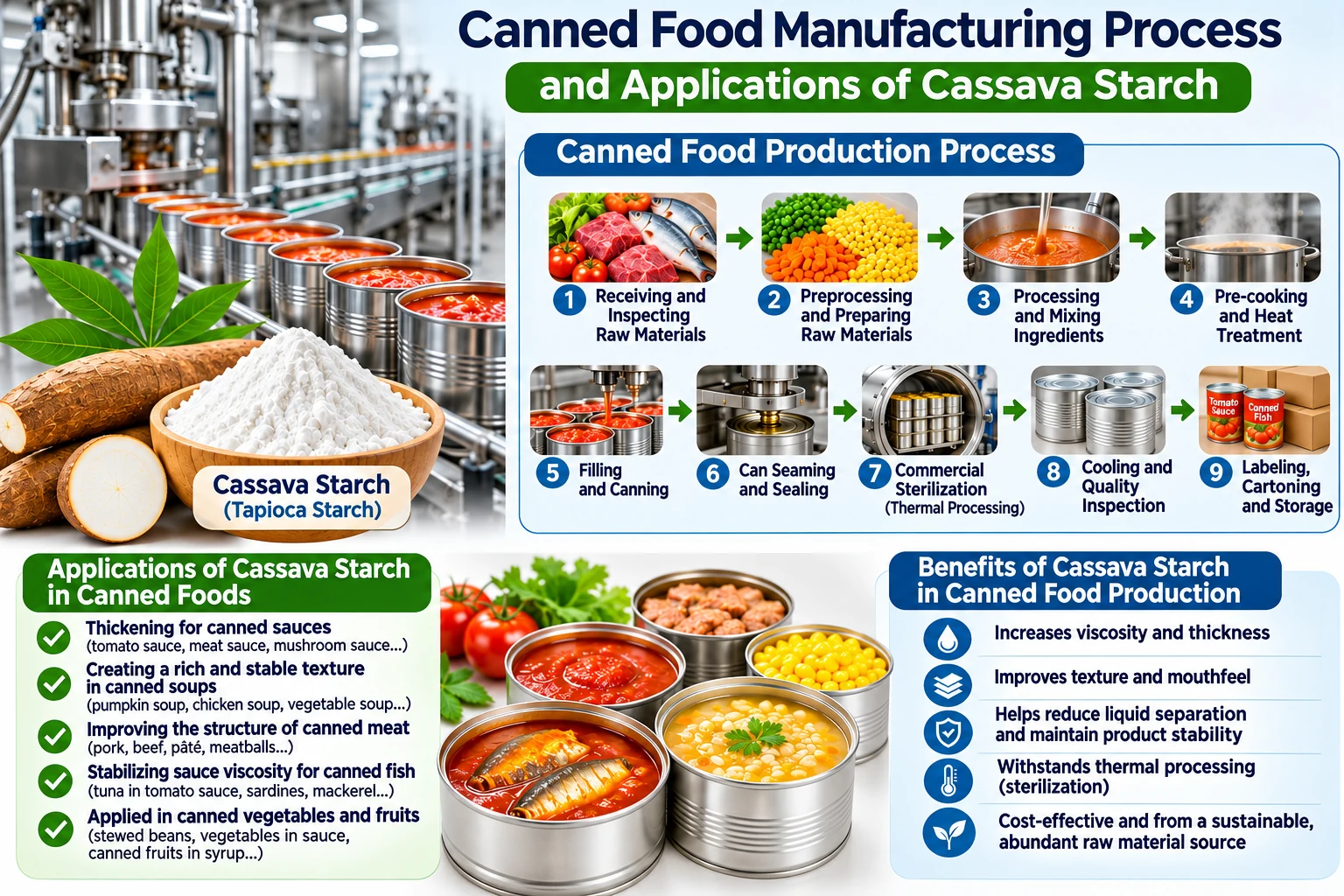
2. Canned Food Manufacturing Process
The canned food manufacturing process varies depending on the type of raw materials and finished products. However, a typical industrial production process includes the following stages.
Step 1: Raw Material Receiving and Quality Inspection
Raw materials are received, selected, and inspected before entering the production line.
For meat, fish, vegetables, and fruits, manufacturers need to evaluate:
- Freshness and raw material quality.
- Color, smell, and physical condition.
- Relevant microbiological and physicochemical parameters.
- Raw material origin and storage conditions.
Proper raw material inspection helps ensure product quality and food safety.
Step 2: Raw Material Cleaning and Preparation
Raw materials are washed, cleaned, and processed to remove impurities and unwanted components.
Depending on the product, this stage may include:
- Washing and sorting vegetables and fruits.
- Cleaning and cutting meat and fish.
- Removing bones, skin, and unwanted parts.
- Peeling, slicing, or dicing vegetables.
- Preparing ingredients according to product specifications.
This stage ensures consistent raw material quality before further processing.
Step 3: Ingredient Processing and Mixing
After preparation, ingredients are processed and mixed according to the specific product formulation.
Examples include:
- Canned meat is seasoned and mixed with other ingredients.
- Canned fish is prepared according to the product specifications.
- Canned vegetables may undergo blanching or other suitable thermal treatments.
- Canned soups are prepared by mixing ingredients with broth, seasonings, and functional components.
At this stage, manufacturers may use cassava starch, modified starch, and permitted food additives to adjust viscosity, texture, and product stability.
Step 4: Cooking and Preliminary Heat Treatment
Some canned food products require cooking or preliminary heat treatment before filling.
The main purposes include:
- Partially or fully cooking ingredients according to the formulation.
- Softening raw materials.
- Reducing air content in the product.
- Developing characteristic flavors and textures.
- Preparing the product for subsequent filling and thermal processing.
The processing conditions must be appropriate for each specific food product.
Step 5: Filling and Packaging
Processed ingredients are filled into metal cans, glass jars, or specialized heat-resistant packaging.
Depending on the product formulation, manufacturers may add:
- Sauces.
- Broth.
- Vegetable oils.
- Salt solutions or sugar syrups.
- Seasonings and flavoring ingredients.
The filling process must ensure accurate filling quantities, hygienic conditions, and appropriate headspace control.
Step 6: Can Seaming and Sealing
After filling, containers are hermetically sealed using suitable can-seaming or packaging equipment.
Packaging integrity is essential to prevent microbial contamination and product leakage during storage.
Manufacturers must inspect seam quality according to packaging specifications and established quality control procedures.
Step 7: Commercial Sterilization
Commercial sterilization is one of the most critical stages in canned food manufacturing.
Products undergo a validated thermal processing schedule designed to control spoilage microorganisms and microorganisms of public health significance.
For low-acid canned foods, commercial sterilization must be carefully designed and controlled, particularly with regard to the potential risk associated with Clostridium botulinum.
There is no universal time and temperature combination for all canned food products. Processing conditions must be established based on product characteristics, container size, viscosity, heat transfer properties, and equipment specifications.
Step 8: Cooling and Quality Inspection
After thermal processing, products are cooled under controlled conditions.
The finished products are then inspected for:
- Packaging integrity.
- Swelling, dents, or leakage.
- Product color and appearance.
- Viscosity and texture.
- Flavor and aroma.
- Required microbiological and physicochemical specifications.
Step 9: Labeling, Carton Packing, and Storage
Products that meet quality requirements are labeled, packed into cartons, and transferred to storage facilities.
Product labels should contain the required information, including product name, ingredients, net weight, manufacturing date, expiration date, storage instructions, and manufacturer details.
3. Applications of Cassava Starch in Canned Food Production
Cassava starch, also known as tapioca starch, is produced from cassava roots. It is widely used in the food processing industry due to its high starch content, light color, relatively neutral flavor, and excellent thickening properties after gelatinization.
In canned food production, cassava starch is used in selected formulations, especially in sauces, soups, processed meat products, and liquid or semi-liquid food systems.
3.1. Thickening Canned Sauces
One of the most common applications of cassava starch is thickening canned sauces.
When heated in the presence of water, cassava starch undergoes gelatinization, increasing viscosity and creating a thicker sauce texture.
Typical applications include:
- Canned tomato sauce.
- Beef sauce.
- Mushroom sauce.
- Seasoning sauces.
- Sauces for canned meat and fish.
Cassava starch helps manufacturers adjust sauce thickness according to product specifications.
3.2. Applications in Canned Soup Manufacturing
Cassava starch can be used as a thickening ingredient in various canned soup formulations.
Common applications include:
- Pumpkin soup.
- Mushroom soup.
- Sweet corn soup.
- Chicken soup.
- Vegetable soup.
- Seafood soup.
Starch helps improve viscosity, enhance mouthfeel, and support the uniform distribution of ingredients throughout the product.
3.3. Improving the Texture of Canned Meat
In certain canned meat formulations, cassava starch is used to support water binding and improve the texture of finished products.
Applications may include:
- Canned pork.
- Canned beef.
- Canned pâté.
- Canned meatballs.
- Processed meat products in sauce.
Starch helps adjust the consistency of the liquid phase, contributes to a uniform product structure, and may reduce liquid separation when properly formulated.
3.4. Stabilizing Canned Fish Products
In some canned fish products containing sauces, cassava starch can be used to adjust sauce viscosity.
Examples include:
- Tuna in tomato sauce.
- Sardines in tomato sauce.
- Mackerel in seasoned sauce.
- Canned fish in spicy sauce.
Cassava starch helps achieve the desired sauce thickness, improve sauce adherence to fish, and create a more consistent eating experience.
3.5. Applications in Canned Vegetables and Fruits
Cassava starch can also be used in selected canned vegetable and fruit products containing sauces, coating liquids, or liquid bases that require viscosity adjustment.
Applications include:
- Canned vegetables in sauce.
- Canned stewed beans.
- Canned fruit products with formulated liquid bases.
- Canned vegetable puree products.
The appropriate starch type should be selected based on product acidity and processing conditions.
4. Native Cassava Starch vs. Modified Cassava Starch in Canned Foods
Canned food manufacturers can choose between native cassava starch and modified cassava starch depending on the functional requirements of their products.
Native Cassava Starch
Native cassava starch provides thickening properties after gelatinization and offers a competitive ingredient cost.
Key advantages include:
- Light color.
- Neutral flavor.
- Good viscosity development.
- Suitable for many sauces and soups.
- Compatible with various food formulations.
However, native cassava starch may experience viscosity reduction or structural changes under high temperatures, acidic conditions, and prolonged mechanical processing.
Modified Cassava Starch
Modified cassava starch is processed using suitable physical, chemical, or enzymatic methods to improve one or more functional properties.
Some modified starch types that may be considered for canned food applications include:
- E1422: Acetylated distarch adipate.
- E1442: Hydroxypropyl distarch phosphate.
- E1414: Acetylated distarch phosphate.
- E1450: Starch sodium octenyl succinate.
Depending on the starch type, modified starch can provide improved heat stability, viscosity stability, acid tolerance, reduced syneresis, and better texture retention after processing.
The appropriate modified starch grade should be selected based on the formulation, processing conditions, food additive regulations, and target market requirements.
5. Factors to Consider When Selecting Cassava Starch for Canned Food Production
To select the appropriate starch ingredient, manufacturers should consider the following factors:
Heat Stability: Canned food products undergo thermal processing. Therefore, the selected starch should maintain suitable viscosity and texture under the required processing conditions.
Acid Stability: For tomato sauces and other acidic products, starch performance should be evaluated under the specific pH conditions.
Syneresis Resistance: The starch should help maintain product consistency and minimize liquid separation during storage.
Viscosity: The required viscosity depends on the product category, such as soups, sauces, canned meat, or canned fish.
Storage Stability: Finished products should maintain their quality after sterilization and throughout their intended shelf life.
Formulation Compatibility: Starch should be compatible with proteins, fats, salt, sugar, acids, and other formulation ingredients.
6. Benefits of Cassava Starch in the Canned Food Industry
The use of cassava starch in canned food manufacturing offers several functional benefits:
- Increases thickness and viscosity in sauces and soups.
- Improves product texture and mouthfeel.
- Supports water binding in selected formulations.
- Helps reduce liquid separation when the appropriate starch is selected.
- Allows manufacturers to adjust product consistency according to their requirements.
- Utilizes the abundant cassava starch supply available in Vietnam.
In particular, properly selected modified cassava starch can improve product stability under thermal processing and storage conditions.
Canned food manufacturing is an important food processing industry that requires strict control of raw material quality, production technology, and food safety.
Cassava starch plays an important functional role in many canned food formulations, including sauces, soups, canned meat, canned fish, and other processed food products.
Selecting the right type of native or modified cassava starch can help manufacturers optimize viscosity, texture, and product stability.
With its abundant cassava resources, Vietnam has significant potential to develop cassava starch production and supply for domestic and international food processing industries.