

COSMETICS MANUFACTURING PROCESS AND APPLICATIONS OF TAPIOCA STARCH, CASSAVA STARCH AND MODIFIED STARCH IN THE COSMETICS INDUSTRY
1. Overview of the Cosmetics Manufacturing Industry
The cosmetics industry has experienced significant growth due to increasing consumer demand for skincare, haircare, makeup and personal care products.
Manufacturing high-quality cosmetics requires carefully selected raw materials, optimized formulations and strict quality control throughout the production process.
In addition to commonly used ingredients such as purified water, vegetable oils, emulsifiers, preservatives and active skincare ingredients, tapioca starch (cassava starch) and modified starch are also used in various cosmetic formulations.
Due to their functional properties, certain starch ingredients can help absorb excess oil, improve product texture, enhance skin feel and provide formulation stability.
These ingredients can be used in selected cosmetic products, including face powders, body powders, dry shampoos, skincare products and powder-based cosmetics.
2. Industrial Cosmetics Manufacturing Process
The cosmetics manufacturing process varies depending on the product category, such as facial creams, lotions, facial cleansers, shampoos, lipsticks, makeup powders and facial masks.
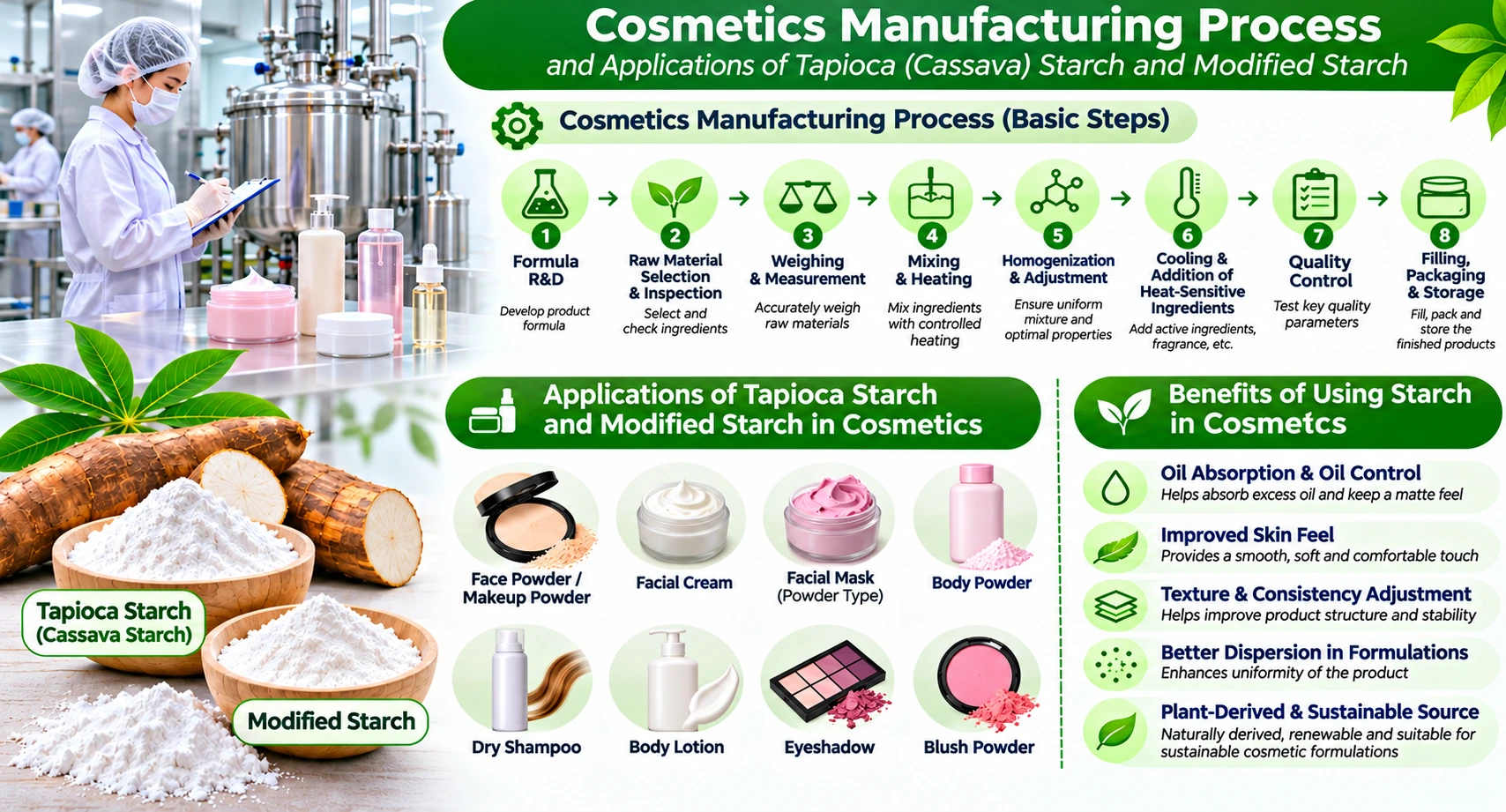
A typical industrial cosmetics manufacturing process includes the following stages.
Step 1: Research and Product Formulation Development
Product formulation is one of the most important stages in cosmetics manufacturing.
Manufacturers determine the ingredients, their proportions and the desired product characteristics.
Key considerations include:
- Cosmetic product category.
- Intended functions and performance.
- Main and supporting ingredients.
- pH level and viscosity.
- Texture and sensory properties.
- Product stability and shelf life.
- Safety and regulatory requirements.
At this stage, tapioca starch and modified starch may be evaluated as functional ingredients to improve texture, oil absorption and product sensory properties.
Step 2: Raw Material Selection and Quality Inspection
All raw materials must meet established quality specifications and formulation requirements.
Common cosmetic raw materials include:
- Purified water.
- Vegetable oils and mineral oils.
- Emulsifiers.
- Thickeners and stabilizers.
- Surfactants.
- Preservatives.
- Fragrances and colorants.
- Active skincare ingredients.
- Cosmetic-grade tapioca starch and modified starch.
For starch ingredients, manufacturers should evaluate moisture content, whiteness, particle size, purity, microbiological quality and potential contaminants according to approved specifications.
Step 3: Raw Material Weighing and Measurement
All ingredients are accurately weighed according to the approved formulation.
Precise weighing helps ensure:
- Consistent product quality between batches.
- Controlled viscosity and texture.
- Reduced formulation variations.
- Uniform distribution of functional ingredients.
Step 4: Mixing and Heating
Depending on the cosmetic product, ingredients are transferred into specialized mixing tanks.
For creams and lotions, the manufacturing process generally includes:
- Preparation of the water phase.
- Preparation of the oil phase.
- Heating the phases according to the formulation.
- Combining the phases using emulsification equipment.
- Homogenizing the mixture to achieve a uniform emulsion.
For powder cosmetics, dry ingredients are blended using specialized mixing equipment to achieve a homogeneous mixture.
Suitable modified starches may help improve product texture, while selected starch ingredients can provide oil-absorbing properties.
Step 5: Homogenization and Product Adjustment
After mixing, the formulation undergoes homogenization and quality adjustments.
Important parameters include:
- Viscosity.
- pH level.
- Texture and smoothness.
- Dispersion properties.
- Emulsion stability.
- Color and fragrance.
Depending on the formulation, manufacturers may use homogenizers, high-speed mixers or milling equipment.
Step 6: Cooling and Addition of Heat-Sensitive Ingredients
Certain skincare actives, fragrances and heat-sensitive ingredients are added during the cooling stage according to formulation requirements.
The mixture is continuously blended to ensure uniform ingredient distribution.
Step 7: Finished Product Quality Control
Before packaging, cosmetic products undergo quality inspections to verify that they meet established specifications.
Typical quality control parameters include:
- Appearance and color.
- Fragrance.
- pH value.
- Viscosity.
- Homogeneity.
- Physical stability.
- Microbiological limits.
- Product-specific safety requirements.
For starch-containing formulations, additional evaluations may include dispersion properties, skin feel and stability under different storage conditions.
Step 8: Filling, Packaging and Storage
Once the finished product meets quality requirements, it is filled into bottles, jars, tubes, containers or specialized packaging.
Packaging materials must be compatible with the cosmetic formulation and protect the product from external environmental factors.
The finished products are labeled, packed and stored under specified conditions.
3. Applications of Tapioca Starch in Cosmetics Manufacturing
Tapioca starch, also known as cassava starch, is extracted from cassava roots. It is a plant-derived ingredient primarily composed of carbohydrates.
Due to its fine powder characteristics and functional properties, tapioca starch can be used in selected cosmetic formulations.
3.1. Face Powder and Makeup Manufacturing
Tapioca starch can serve as a supporting ingredient in powder-based cosmetics.
Its potential functions include oil absorption and improving the smooth, soft feel of cosmetic powders.
Applications include:
- Face setting powder.
- Loose makeup powder.
- Body powder.
- Selected skincare powders.
3.2. Skincare Product Manufacturing
Tapioca starch can be incorporated into certain skincare formulations as an absorbent or texture-modifying ingredient.
Applications include:
- Powder facial masks.
- Powder-based skincare products.
- Selected moisturizing cream formulations.
- Skincare products designed to provide a dry-touch finish.
3.3. Personal Care Product Manufacturing
Due to its powder form, tapioca starch may be considered for various personal care applications.
Applications include:
- Body powders.
- Skin care powders.
- Oil-absorbing products.
- Selected personal hygiene products.
3.4. Haircare Product Manufacturing
Certain starch ingredients can be used in powder-based haircare formulations, particularly products designed to absorb excess oil.
Applications include:
- Powder dry shampoo.
- Hair styling powders.
- Products designed to reduce the greasy appearance of hair.
The actual performance depends on starch characteristics, particle size and the overall formulation.
4. Applications of Modified Starch in Cosmetics Manufacturing
Modified starch is produced by treating native starch through physical, enzymatic or chemical processes to improve or modify specific functional properties.
Compared with native starch, certain modified starches may offer improved dispersion, film-forming properties, stabilization or texture modification.
The selection of modified starch depends on its functional characteristics, technical specifications and suitability for cosmetic applications.
4.1. Oil Absorption in Cosmetic Products
Certain modified starches are designed to provide oil-absorbing properties and improve the sensory characteristics of cosmetic formulations.
Applications include:
- Oil-control face powders.
- Makeup powders.
- Skincare products for oily skin.
- Body care products.
4.2. Texture Modification and Formulation Improvement
Some modified starches can help improve the consistency, smoothness and sensory properties of cosmetic products.
Applications include:
- Facial creams.
- Body lotions.
- Moisturizing creams.
- Selected gel and cream formulations.
However, thickening and stabilizing performance depends on the starch type, modification method and formulation conditions. Not all modified starches provide these functions.
4.3. Powder-Based Cosmetic Manufacturing
Suitable modified starches may improve dispersion, powder texture and application properties.
Applications include:
- Face powder.
- Blush powder.
- Eyeshadow.
- Body powder.
- Powder facial masks.
4.4. Haircare Product Manufacturing
Certain starch derivatives have film-forming or sensory-modifying properties that may be useful in selected haircare formulations.
Applications include:
- Dry shampoo.
- Hair styling products.
- Powder-based haircare products.
- Hair volumizing products.
4.5. Plant-Based Cosmetic Formulations
Tapioca starch and selected cassava-derived modified starches can be considered for cosmetic formulations containing plant-derived ingredients.
These ingredients offer opportunities for manufacturers exploring renewable raw materials and more sustainable formulation strategies.
However, plant-derived ingredients are not automatically organic, environmentally friendly or suitable for every skin type. Such claims must be supported by appropriate evidence and documentation.
5. Cosmetic Products That May Use Tapioca Starch and Modified Starch
| Cosmetic product | Potential starch application |
|---|---|
| Face powder | Oil absorption and smooth texture |
| Makeup powder | Powder texture improvement |
| Body powder | Moisture and oil absorption |
| Dry shampoo | Absorption of excess hair oil |
| Powder facial mask | Base ingredient and texture adjustment |
| Facial cream | Texture modification, depending on starch type |
| Body lotion | Sensory property improvement |
| Body moisturizer | Surface feel modification |
| Eyeshadow | Supporting ingredient in powder formulations |
| Blush powder | Texture and formulation support |
6. How to Select Tapioca Starch and Modified Starch for Cosmetics
Selecting the right starch ingredient is essential for achieving consistent cosmetic product quality.
Manufacturers should work with suppliers who can provide clear technical specifications and appropriate quality documentation.
Important selection criteria include:
1. Purity
The starch must meet the required purity and contaminant specifications for its intended cosmetic application.
2. Moisture Content
Moisture levels should be controlled to minimize potential storage and quality issues.
3. Particle Size
Particle size influences powder smoothness, dispersion and sensory properties.
4. Whiteness and Appearance
These characteristics are particularly important in light-colored cosmetic powders.
5. Microbiological Quality
Microbiological specifications must meet the requirements established for cosmetic raw materials.
6. Oil Absorption Capacity
This is an important characteristic when selecting starch for face powders, body powders and dry shampoos.
7. Formulation Compatibility
The starch must be compatible with other ingredients in the cosmetic formulation.
8. Technical Documentation
Manufacturers should request relevant documents, including:
- Technical Data Sheet (TDS).
- Certificate of Analysis (COA).
- Safety Data Sheet (SDS).
- Ingredient and origin information.
- Manufacturing process information.
- Applicable quality and regulatory documentation.
Important note: Food-grade or industrial-grade cassava starch should not automatically be substituted for cosmetic-grade ingredients. Manufacturers must verify the quality grade, specifications, safety profile and regulatory suitability for the target market.
7. Trends in Starch Applications in the Cosmetics Industry
The cosmetics industry is increasingly exploring plant-derived ingredients, biodegradable materials and alternatives to certain synthetic raw materials.
Tapioca starch and modified starch offer potential applications in powder cosmetics, oil-absorbing products and selected personal care formulations.
Developing starch ingredients with suitable particle sizes, improved dispersion and desirable sensory properties may create new opportunities for cosmetic raw material manufacturers and suppliers.
Research into specialized starch derivatives is also contributing to the development of innovative cosmetic formulations.
Tapioca starch, cassava starch and modified starch are functional ingredients with potential applications in the cosmetics industry.
Depending on their characteristics, they can be incorporated into face powders, makeup products, body powders, dry shampoos, powder facial masks and selected skincare formulations.
Choosing the right starch type, maintaining raw material quality and conducting formulation compatibility testing are essential steps in developing high-quality cosmetic products.
Cosmetics manufacturers should work with reliable tapioca starch and modified starch suppliers who can provide consistent quality, traceable raw materials and complete technical documentation.