

CONFECTIONERY PRODUCTION PROCESS AND APPLICATIONS OF TAPIOCA STARCH AND CASSAVA STARCH IN CONFECTIONERY MANUFACTURING
1. Overview of the Confectionery Industry
The confectionery industry is an important sector of the global food processing industry. Products such as gummy candies, soft candies, biscuits, cookies, cakes, and snacks are widely consumed in domestic and international markets.
To manufacture high-quality confectionery products, manufacturers must carefully select raw materials and control processing conditions to achieve the desired texture, consistency, appearance, and flavor.
Among the ingredients used in confectionery manufacturing, tapioca starch, also known as cassava starch, plays an important role due to its thickening, binding, gelling, and water-retention properties.
Tapioca starch is widely used in gummy candies, soft candies, biscuits, cookies, bakery fillings, puffed snacks, and various processed food products.
In addition to native tapioca starch, modified starches such as E1412, E1414, E1422, and E1442 are used to improve product stability and processing performance.
2. Raw Materials Used in Confectionery Production
The selection of raw materials depends on the type of confectionery product and its desired characteristics.
Common ingredients include:
- Sucrose.
- Glucose syrup.
- Maltodextrin.
- Wheat flour.
- Tapioca starch.
- Cassava starch.
- Corn starch.
- Modified starch.
- Milk powder.
- Cocoa powder.
- Vegetable oils.
- Gelatin.
- Pectin.
- Food flavorings.
- Approved food colorings.
Tapioca starch is an important functional ingredient that helps manufacturers control viscosity, binding properties, and product texture.
3. Industrial Confectionery Production Process
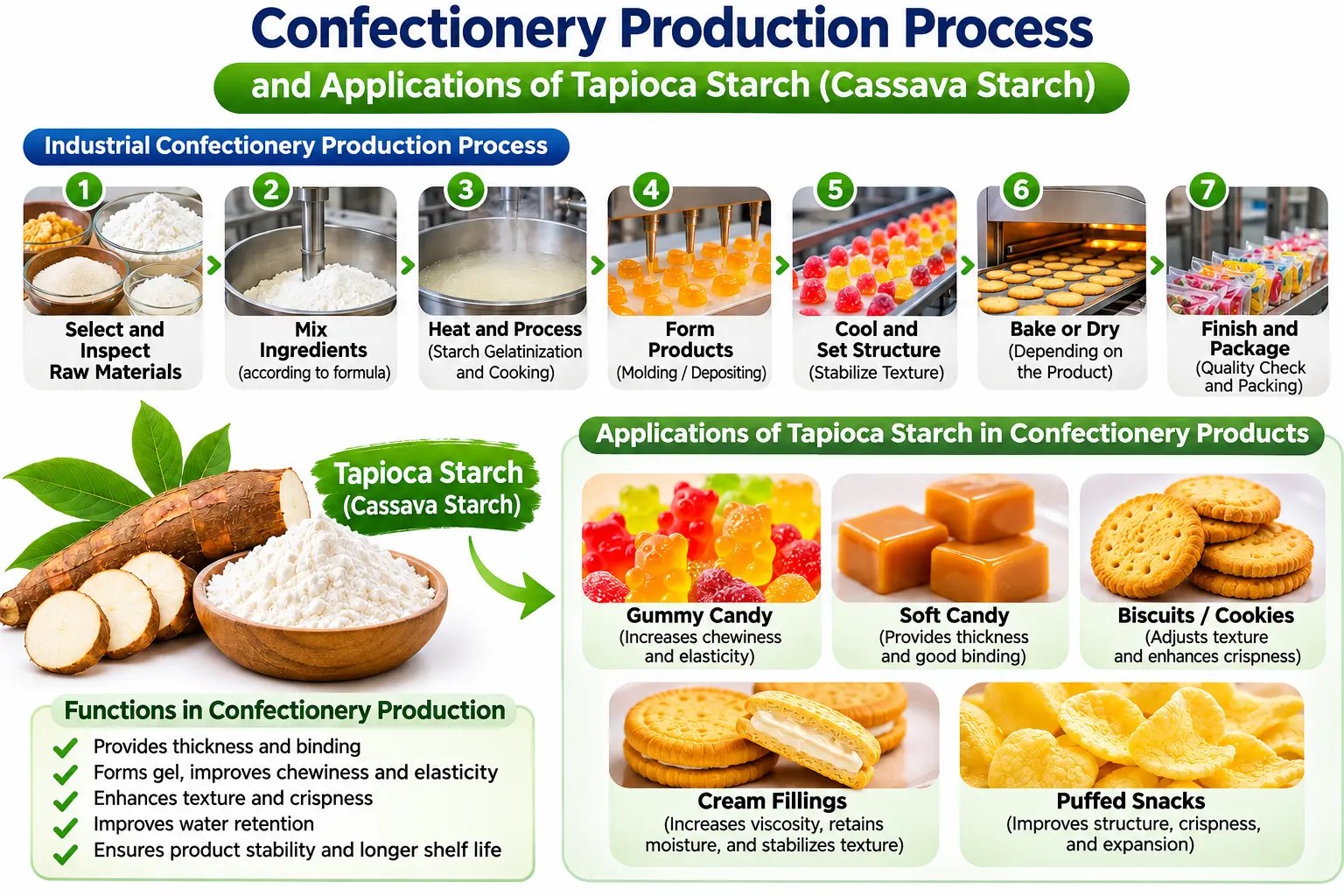
The confectionery manufacturing process varies depending on the product category. However, a typical industrial process includes the following stages.
Step 1: Raw Material Selection and Quality Inspection
All raw materials are inspected before entering the production line.
For tapioca starch, important quality parameters include:
- Moisture content.
- Whiteness.
- Fineness.
- Starch content.
- Viscosity.
- Microbiological quality.
- Food safety specifications.
Selecting high-quality ingredients helps ensure consistent product quality.
Step 2: Ingredient Mixing
Ingredients are accurately weighed according to the production formula.
Tapioca starch may be mixed with sugar, water, glucose syrup, milk powder, and other ingredients.
The mixing process ensures a homogeneous mixture and uniform ingredient distribution.
Step 3: Heating and Processing
The mixture is heated under controlled processing conditions.
When tapioca starch is heated in the presence of sufficient water, starch granules absorb water, swell, and undergo gelatinization.
This process helps:
- Increase viscosity.
- Improve thickening.
- Enhance binding properties.
- Develop gel structures.
- Improve product texture.
Starch gelatinization is particularly important in certain gummy candy, soft candy, and bakery filling formulations.
Step 4: Product Forming
After processing, the mixture is transferred to the forming stage.
Common forming methods include:
- Molding.
- Extrusion.
- Rolling and cutting.
- Depositing.
- Automated shaping.
For gummy candies, mixture viscosity and gel-forming properties influence the final product shape and consistency.
Step 5: Cooling and Texture Stabilization
After forming, products are cooled under controlled conditions.
Cooling helps develop the desired firmness, chewiness, elasticity, or softness.
Native tapioca starch and modified starch can contribute to texture development and product stability.
Step 6: Drying or Baking
Depending on the product, confectionery items may undergo drying or baking.
For biscuits and cookies, baking helps develop the characteristic structure, color, and flavor.
For certain candies, drying helps control moisture content and improve storage stability.
Step 7: Quality Inspection and Packaging
Finished products undergo quality inspection before packaging.
Packaging materials should provide suitable moisture protection and help maintain product quality throughout the intended shelf life.
4. Applications of Tapioca Starch in Confectionery Manufacturing
4.1. Tapioca Starch in Gummy Candy Production
Tapioca starch is used in certain gummy candy formulations to improve texture and chewiness.
Its main functions include:
- Improving chewiness.
- Enhancing elasticity.
- Increasing viscosity.
- Supporting water retention.
- Developing a uniform texture.
- Helping maintain product shape.
Tapioca starch can be combined with gelatin, pectin, or other gelling agents depending on the formulation.
4.2. Tapioca Starch in Soft Candy Production
In soft candy manufacturing, tapioca starch helps adjust viscosity and product structure.
Its benefits include:
- Improving binding properties.
- Increasing mixture thickness.
- Supporting texture development.
- Helping control softness.
- Improving mixture consistency.
4.3. Tapioca Starch in Biscuit and Cookie Production
Tapioca starch can be blended with wheat flour to modify the texture of biscuits and cookies.
Its functions include:
- Adjusting product structure.
- Improving crispness.
- Supporting a light texture.
- Modifying water absorption.
- Improving eating quality.
The appropriate starch inclusion level depends on the product formulation and manufacturing conditions.
4.4. Tapioca Starch in Bakery Filling Production
Tapioca starch and modified starch are commonly used in bakery fillings, including:
- Cream fillings.
- Fruit fillings.
- Sweet fillings.
- Industrial bakery fillings.
Their main functions include:
- Increasing viscosity.
- Improving water retention.
- Reducing water separation.
- Supporting texture stability.
- Creating a smooth consistency.
4.5. Tapioca Starch in Puffed Snacks
Tapioca starch is used in various puffed snack and cracker formulations.
Due to its gelatinization and structural properties, tapioca starch can contribute to:
- Improved crispness.
- Better expansion.
- Porous texture development.
- Improved sensory characteristics.
- Texture adjustment.
5. Applications of Modified Starch in the Confectionery Industry
In addition to native tapioca starch, modified starch is widely used in the food processing industry.
Modified starch is produced through physical, chemical, or enzymatic treatments to improve specific functional properties.
Common modified starch types include:
E1412 – Distarch Phosphate
This modified starch can improve paste stability and contribute to product structure.
E1414 – Acetylated Distarch Phosphate
E1414 can improve water retention, texture, and stability in suitable food formulations.
E1422 – Acetylated Distarch Adipate
E1422 provides improved stability and can help reduce water separation in certain applications.
E1442 – Hydroxypropyl Distarch Phosphate
E1442 is used to improve processing stability and texture characteristics in selected food products.
The selection of modified starch depends on product requirements, processing conditions, and applicable food additive regulations.
6. Benefits of Using Tapioca Starch in Confectionery Manufacturing
Raw Material Cost Optimization
Tapioca starch is widely produced in major cassava-growing countries, including Vietnam.
Using tapioca starch allows manufacturers to diversify their ingredient sources and evaluate cost-effective formulations.
Improved Product Texture
Tapioca starch provides thickening and gelling properties that can improve chewiness, softness, and crispness depending on the formulation.
Water Retention
In suitable applications, tapioca starch helps retain moisture and improve product consistency.
Wide Range of Applications
Tapioca starch can be used in gummy candies, soft candies, biscuits, cookies, puffed snacks, and bakery fillings.
Compatibility with Other Ingredients
Tapioca starch can be combined with sugar, gelatin, pectin, wheat flour, and other starches to develop various confectionery formulations.
7. How to Choose a Reliable Tapioca Starch Supplier
Selecting a reliable tapioca starch supplier is essential for maintaining consistent production quality.
Manufacturers should consider the following factors:
- Clear product origin.
- Consistent quality.
- Stable whiteness and fineness.
- Appropriate moisture content.
- Suitable viscosity.
- Relevant quality inspection reports.
- Food safety compliance.
- Reliable supply capacity.
- Competitive pricing.
- Technical support.
Working with a supplier offering both native tapioca starch and modified starch can help manufacturers meet different production requirements.
Tapioca starch, also known as cassava starch, is an important functional ingredient in the confectionery and bakery industry.
Due to its thickening, binding, gelling, and water-retention properties, tapioca starch is used in gummy candies, soft candies, biscuits, cookies, puffed snacks, and bakery fillings.
Furthermore, modified starches such as E1412, E1414, E1422, and E1442 provide manufacturers with additional options for improving processing performance and product stability.
Choosing the appropriate starch grade and a reliable supplier is essential for optimizing production costs, maintaining consistent product quality, and improving competitiveness in the confectionery industry.