

GUMMY CANDY MANUFACTURING PROCESS – APPLICATIONS OF TAPIOCA STARCH AND CASSAVA STARCH IN GUMMY CANDY PRODUCTION
1. Introduction to the Gummy Candy Manufacturing Industry
Gummy candy is one of the most popular confectionery products in the global food industry. With its soft, chewy, elastic texture and a wide variety of flavors, gummy candy is widely consumed in many markets.
To manufacture high-quality gummy candies, food manufacturers need to carefully select raw materials and control every stage of the production process.
Among the ingredients used in confectionery manufacturing, tapioca starch, cassava starch, modified tapioca starch, gelatin, and pectin play important roles in developing product texture, viscosity, moisture control, and stability.
In particular, tapioca starch is an important plant-based ingredient that can be used in selected gummy candy formulations to improve structure, adjust texture, and support manufacturing efficiency.
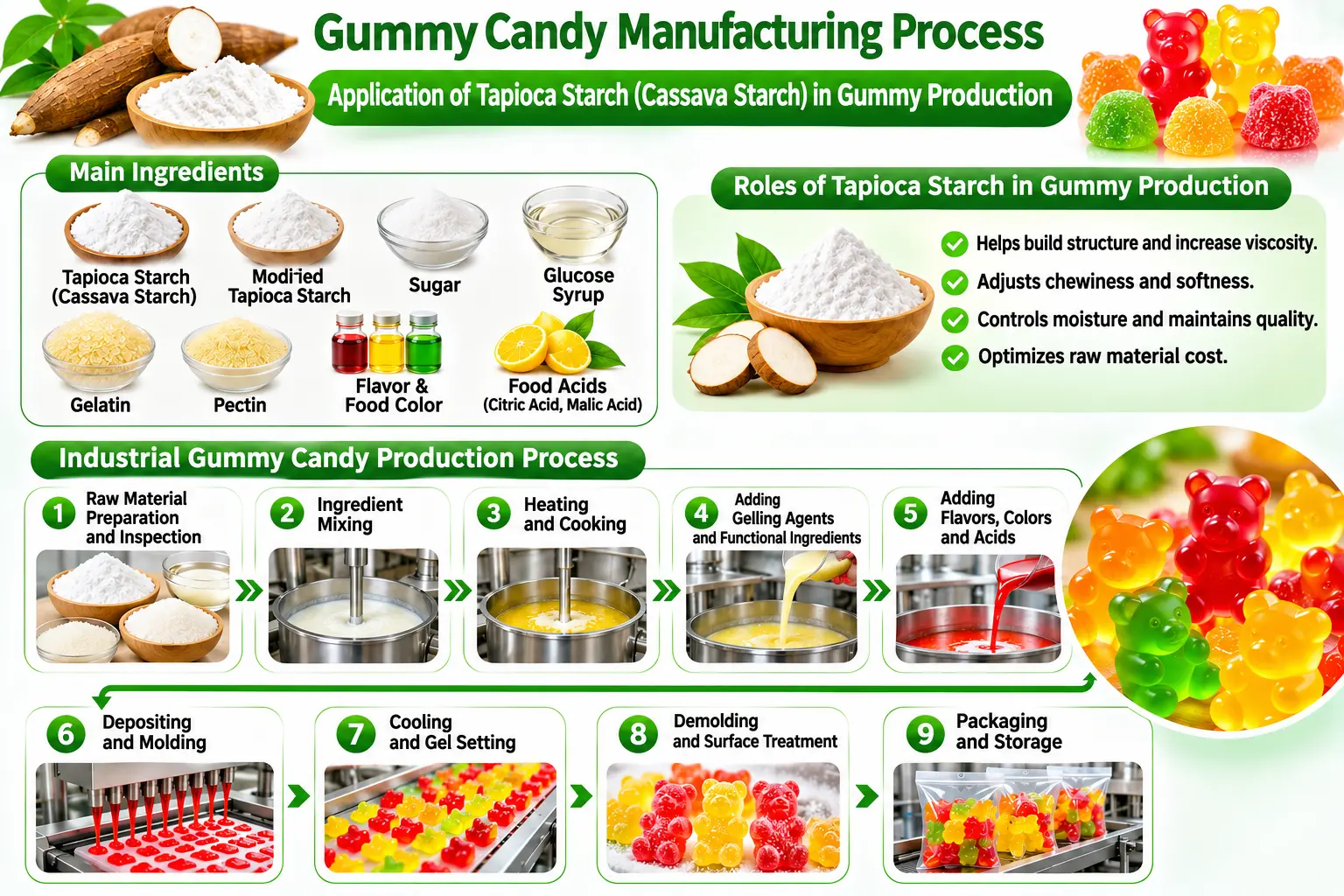
2. Main Ingredients Used in Gummy Candy Production
Industrial gummy candy production generally involves the following ingredients:
Sugar (Sucrose): Provides sweetness and contributes to the solid content and structure of gummy candy.
Glucose Syrup: Helps prevent sugar crystallization, improves chewiness, controls texture, and maintains product softness.
Tapioca Starch (Cassava Starch): Used to support texture development, increase viscosity, adjust firmness, and improve the mouthfeel of confectionery products.
Modified Tapioca Starch: Specially processed starch that can provide improved functional properties, depending on its modification type. It may help improve viscosity control, texture stability, and water management.
Gelatin: A widely used gelling agent that provides elasticity, softness, and the characteristic chewy texture of gummy candy.
Pectin: A plant-based gelling agent commonly used in fruit gummies and vegetarian gummy formulations. It generally produces a different texture from gelatin.
Flavors and Food Colors: Used to create attractive colors and distinctive fruit flavors.
Food Acids: Citric acid and malic acid are commonly used to adjust acidity and provide a pleasant sour taste.
3. Industrial Gummy Candy Manufacturing Process
The industrial gummy candy manufacturing process typically consists of the following steps:
Step 1: Raw Material Preparation and Inspection
All raw materials, including sugar, glucose syrup, tapioca starch, modified starch, gelatin, pectin, flavors, and food additives, are inspected before entering production.
Important quality parameters include:
- Raw material purity.
- Starch moisture content.
- Viscosity and functional properties.
- Gelling performance.
- Food safety specifications.
Using high-quality ingredients helps manufacturers maintain consistent product quality.
Step 2: Ingredient Mixing
Sugar and glucose syrup are mixed with water according to the product formulation.
Tapioca starch or modified tapioca starch may be dispersed separately in water before being incorporated into the production mixture, depending on the starch characteristics and manufacturing technology.
Gelatin and pectin are prepared separately according to their specific hydration and dissolution requirements.
Proper mixing ensures uniform ingredient distribution throughout the production system.
Step 3: Heating and Cooking
The prepared mixture is transferred to an industrial cooking system.
During this stage:
- Sugar and glucose syrup dissolve completely.
- Moisture content is adjusted.
- Starch gelatinization takes place when applicable.
- The mixture reaches the required viscosity and soluble solids concentration.
Cooking temperature and time depend on the formulation, gelling system, and production equipment.
This stage is particularly important because it directly affects the final gummy candy texture and quality.
Step 4: Adding Gelling Agents and Functional Ingredients
Once the mixture reaches the required processing conditions, gelatin, pectin, or other functional ingredients are incorporated according to the formulation.
Modified tapioca starch may be combined with gelatin or pectin to adjust viscosity, improve structural stability, and modify the final texture.
Temperature control during this stage is important to maintain the functional properties of the gelling agents.
Step 5: Adding Flavors, Colors, and Acids
Food flavors, colors, and food acids such as citric acid or malic acid are added to create the desired product characteristics.
Common gummy candy varieties include:
- Fruit-flavored gummy candy.
- Strawberry, orange, and grape gummies.
- Lemon-flavored gummies.
- Multicolored gummy candies.
- Fruit-filled gummy candies.
The acidity level must be carefully controlled to ensure the desired flavor and gelling performance.
Step 6: Gummy Candy Depositing and Molding
The prepared gummy mixture is transferred to a depositing system and poured into molds.
Common molding technologies include:
- Starch mogul molding.
- Silicone molds.
- Metal or specialized confectionery molds.
Gummy candies can be manufactured in various shapes, including bears, fruits, animals, round pieces, and customized designs.
Step 7: Cooling and Gel Setting
After depositing, gummy candies are cooled under controlled temperature and humidity conditions.
This process allows the gelling system to develop a stable structure, providing the desired firmness, elasticity, and chewy texture.
Cooling time depends on the product size, formulation, and type of gelling agent used.
Step 8: Demolding and Surface Treatment
Once the gummy candies have achieved the required structure, they are removed from the molds.
Depending on the product formulation, additional treatments may include:
- Fine sugar coating.
- Food-grade oil coating to reduce stickiness.
- Glazing to improve surface appearance.
- Additional drying or moisture conditioning.
Step 9: Packaging and Storage
Finished gummy candies undergo quality inspection before being packed in suitable food-grade packaging materials.
Important quality control parameters include:
- Appearance and color.
- Chewiness and elasticity.
- Moisture content.
- Flavor.
- Product weight.
- Microbiological and food safety specifications.
Proper packaging and storage conditions help maintain product quality and shelf life.
4. Applications of Tapioca Starch in Gummy Candy Manufacturing
Tapioca starch, also known as cassava starch, is extracted from cassava roots and widely used in the food processing industry.
Due to its thickening, water-binding, and gelatinization properties, tapioca starch can be incorporated into selected gummy candy formulations.
4.1. Supporting Texture Development
When heated in the presence of water, tapioca starch undergoes gelatinization.
This process increases viscosity and forms a starch-based structure that can contribute to the firmness and texture of gummy candy.
4.2. Adjusting Chewiness and Softness
Depending on the formulation and application rate, tapioca starch can help adjust the softness, firmness, and chewiness of confectionery products.
This allows manufacturers to develop different gummy candy textures.
4.3. Moisture Management
Tapioca starch interacts with water within the product system and contributes to texture development.
Selecting the appropriate starch type and formulation can help manufacturers manage moisture distribution and maintain product consistency during storage.
4.4. Optimizing Raw Material Costs
Tapioca starch is widely available in Vietnam and other Southeast Asian countries.
Its use in suitable confectionery formulations can help manufacturers diversify their raw materials and optimize production costs.
5. Applications of Modified Tapioca Starch in Gummy Candy Production
In addition to native tapioca starch, modified tapioca starch is another important ingredient for confectionery manufacturers.
Modified starch is processed through physical, enzymatic, or chemical methods to improve specific functional properties compared with native starch.
Its applications may include:
Improving Texture Stability: Certain modified starches help maintain viscosity and product structure during processing.
Enhancing Water Management: Selected modified starches can help control water distribution and reduce syneresis in suitable formulations.
Adjusting Chewiness and Softness: Different starch types provide different textural characteristics, allowing manufacturers to customize their products.
Supporting Product Quality: Modified tapioca starch can improve structural consistency during heating, cooling, and storage, depending on its functional characteristics.
It is important to note that not all modified starch types are suitable for gummy candy production. Manufacturers should select starch products according to their functional specifications and processing requirements.
6. Native Tapioca Starch vs. Modified Tapioca Starch
Choosing between native and modified tapioca starch depends on the production technology and desired product characteristics.
| Criteria | Native Tapioca Starch | Modified Tapioca Starch |
|---|---|---|
| Source | Cassava roots | Modified tapioca starch |
| Gelatinization | Yes | Depends on starch type |
| Heat stability | Depends on processing conditions | May be improved |
| Viscosity control | Standard functional properties | Can provide tailored functionality |
| Applications | Texture development | Texture and product stability |
| Selection | Based on formulation | Based on specific application |
For gummy candy manufacturers, laboratory trials and pilot production are recommended to identify the most suitable starch type.
7. How to Choose a Reliable Tapioca Starch Supplier for the Confectionery Industry
Selecting a reliable tapioca starch supplier is important for confectionery manufacturers.
Businesses should consider the following factors:
- Consistent product quality.
- Clear raw material origin.
- Detailed technical specifications.
- Quality certifications and food safety documentation.
- Competitive pricing.
- Stable supply capacity.
- Technical support and application testing.
A professional supplier should be able to recommend suitable native or modified tapioca starch products according to the customer’s manufacturing requirements.
Tapioca starch, cassava starch, and modified tapioca starch are valuable functional ingredients with potential applications in the confectionery industry, particularly in gummy candy formulations requiring texture adjustment, viscosity control, and structural stability.
When properly selected and combined with suitable gelling agents such as gelatin or pectin, tapioca starch can help manufacturers develop high-quality gummy candy products while optimizing production efficiency and raw material costs.
Manufacturers are encouraged to conduct formulation trials to determine the most appropriate starch type and usage level for each gummy candy product.