

What Is Modified Starch? Production Process, Types and Industrial Applications
1. What Is Modified Starch?
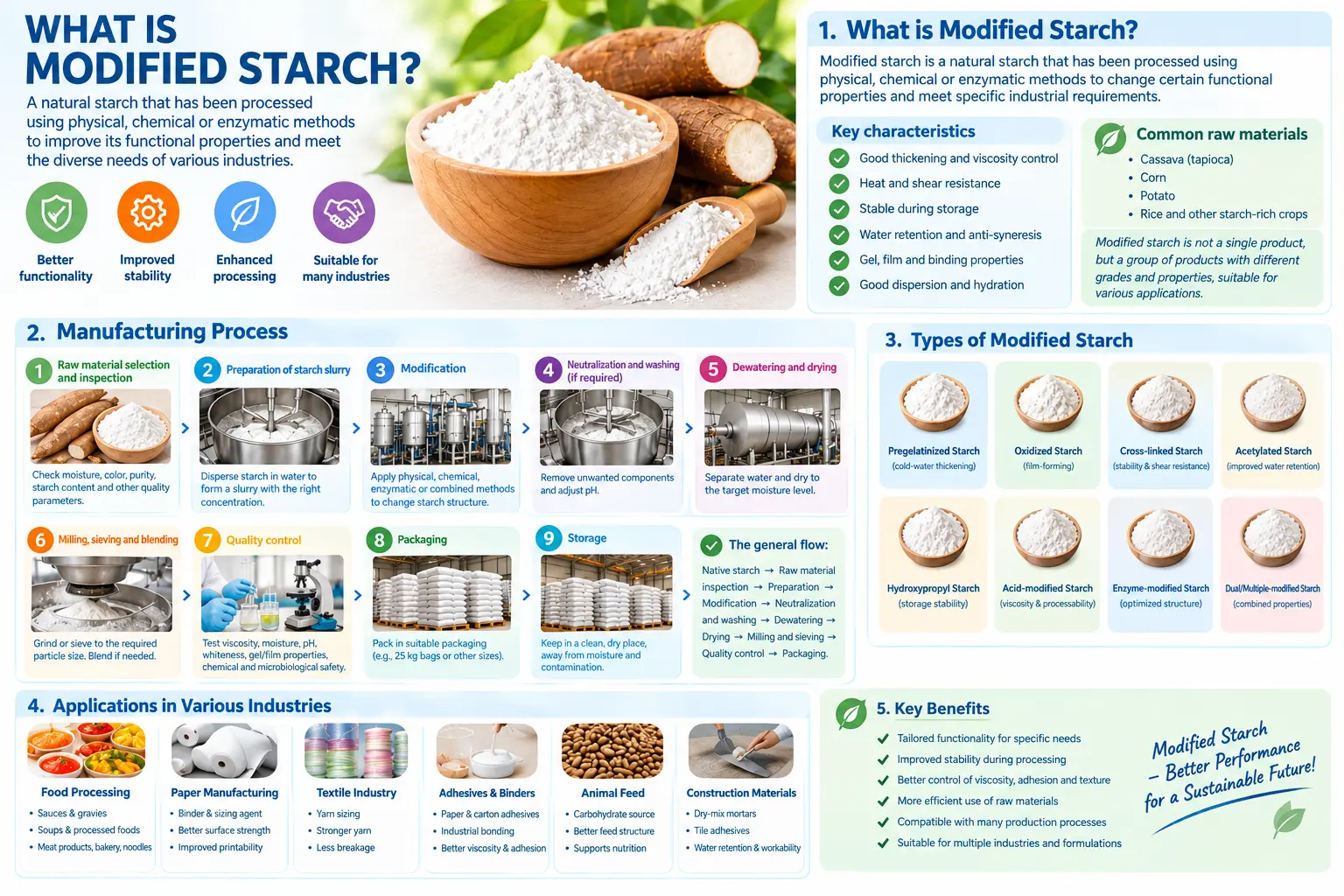
Modified starch is a natural starch that has been processed using physical, chemical, or enzymatic methods to change certain functional properties and meet specific industrial requirements.
Modified starch can be produced from various botanical sources, including cassava, corn, potatoes, rice, and other starch-rich crops. Among these raw materials, cassava starch is widely used in industrial applications because of its thickening, film-forming, and binding properties.
Compared with native starch, modified starch can be designed to improve one or more functional characteristics, including:
- Viscosity control and thickening performance.
- Resistance to heat, stirring, and certain processing conditions.
- Stability during storage.
- Water retention and resistance to syneresis.
- Gel formation, film formation, and binding performance.
- Dispersion, hydration, or gelatinization behavior.
The properties of each modified starch depend on its raw material, modification method, manufacturing conditions, and intended application.
Modified starch is widely used in the food processing, paper manufacturing, textile, adhesive, animal feed, construction materials, and other industrial sectors.
Important: Modified starch is a broad product category rather than a single material. Different grades have different technical properties and application requirements.
2. Raw Materials Used to Produce Modified Starch
The selection of raw materials plays an important role in determining the functional properties, quality, and cost of the final product.
2.1. Cassava Starch
Cassava starch, also known as tapioca starch, is a widely used raw material for producing modified starch for food and industrial applications.
Its potential advantages include:
- Good thickening performance.
- Relatively white color and neutral flavor.
- Compatibility with various modification technologies.
- Suitability for selected thickening, binding, and film-forming applications.
2.2. Corn Starch
Corn starch is commonly used in food processing, paper manufacturing, and other industrial applications.
The properties of modified corn starch depend on the corn variety, amylose and amylopectin content, and modification method.
2.3. Potato Starch
Potato starch is known for its strong thickening properties and is used in applications requiring specific viscosity and texture characteristics.
2.4. Other Starch Sources
Rice starch and starches from other botanical sources may also be used, depending on product specifications, manufacturing technology, and customer requirements.
3. Modified Starch Manufacturing Process
The manufacturing process varies according to the starch type, modification technology, and desired functional properties. A typical industrial process may involve the following stages.
Step 1: Raw Material Selection and Inspection
Native starch is inspected for relevant quality parameters, such as moisture content, color, purity, starch content, and other product-specific requirements.
Only materials that meet the required specifications proceed to the next stage.
Step 2: Starch Preparation
Depending on the manufacturing technology, the starch may be dispersed in water to prepare a slurry with an appropriate concentration.
Dry-processing and certain physical modification methods may use different preparation procedures.
Step 3: Starch Modification
This is the key stage of the process because it determines the functional properties of the final product.
Common modification methods include:
Physical modification: Heat, moisture, mechanical forces, or other physical treatments are used to change starch functionality.
Chemical modification: Controlled chemical reactions alter the starch structure. Common approaches include oxidation, esterification, and etherification.
Enzymatic modification: Selected enzymes are used to modify starch molecules and adjust their functional properties.
Combined modification: Two or more methods may be used to achieve a specific combination of performance characteristics.
Processing conditions must be carefully controlled according to the product formulation, starch source, and applicable quality standards.
Step 4: Neutralization and Washing, Where Required
In certain chemical modification processes, the starch may require neutralization, washing, or further treatment to remove unwanted residual components.
This stage helps the manufacturer meet the quality and safety requirements associated with the intended application.
Step 5: Dewatering and Drying
After modification, the material may be dewatered using suitable filtration or separation equipment and then dried to the target moisture level.
Drying conditions must be selected carefully to avoid undesirable changes in starch functionality.
Step 6: Milling, Sieving, and Blending
The dried material is milled or sieved to achieve the required particle size.
Blending may be performed when appropriate to meet specific product specifications.
Step 7: Quality Control
The finished modified starch is tested against relevant product specifications, which may include:
- Moisture content.
- Viscosity and thickening performance.
- pH.
- Whiteness and appearance.
- Gel-forming or film-forming properties.
- Stability under intended processing conditions.
- Chemical, microbiological, and safety parameters relevant to the application.
Step 8: Packaging and Storage
After passing quality control, the product is packed in suitable commercial packaging. A 25 kg bag is one possible packaging option, although other sizes may be available depending on the supplier and customer requirements.
Modified starch should be stored in a clean, dry environment, protected from moisture and contamination.
General manufacturing flow:
Native Starch → Raw Material Inspection → Starch Preparation → Modification → Neutralization and Washing, Where Required → Dewatering → Drying → Milling and Sieving → Quality Control → Packaging.
4. What Are the Main Types of Modified Starch?
Modified starch can be classified according to its manufacturing method, functional characteristics, or intended application.
4.1. Pregelatinized Starch
Pregelatinized starch is processed so that it can develop viscosity when dispersed in cold water without requiring the full heating process normally needed for native starch.
Key characteristics may include:
- Cold-water thickening, depending on the grade.
- Convenient preparation in applications requiring rapid hydration.
- Suitability for instant foods, dry mixes, and selected industrial applications.
4.2. Oxidized Starch
Oxidized starch is produced through controlled oxidation, which changes the molecular structure and certain functional properties of starch.
Depending on the grade, it may offer:
- Useful film-forming properties.
- Adjusted viscosity and processing characteristics.
- Applications in paper manufacturing, textiles, adhesives, and selected food products permitted by applicable regulations.
4.3. Cross-Linked Starch
Cross-linked starch is modified to introduce links between parts of the starch structure, helping improve stability under certain processing conditions.
Potential benefits include:
- Improved resistance to mechanical agitation.
- Better stability under selected heating conditions.
- Suitability for systems requiring greater functional stability.
Cross-linked starch is used in processed foods and industrial applications where stability is important.
4.4. Acetylated Starch
Acetylated starch is produced by introducing acetyl groups into the starch structure through a suitable chemical modification process.
Depending on the grade, it may:
- Improve structural stability.
- Reduce certain forms of starch retrogradation.
- Improve water retention and texture in suitable applications.
Acetylated starch is used in selected food products and specialized industrial applications.
4.5. Hydroxypropyl Starch
Hydroxypropyl starch is produced through a chemical modification process that introduces hydroxypropyl groups into the starch structure.
Its potential functional benefits include:
- Improved stability during storage.
- Reduced syneresis in certain systems.
- Adjusted texture and structural properties in suitable food applications.
4.6. Acid-Modified Starch
Acid-modified starch is treated under controlled acidic conditions to adjust its molecular structure and functional properties, including viscosity, film formation, and processability.
Depending on the grade, applications may include paper manufacturing, adhesives, textiles, and other industrial processes.
4.7. Enzyme-Modified Starch
Enzyme-modified starch is produced by treating starch with selected enzymes to change its molecular structure and functional characteristics.
Depending on the enzyme and processing conditions, the resulting product may have adjusted viscosity, solubility, or structural properties.
4.8. Dual-Modified and Multiple-Modified Starch
Dual-modified starch is processed using two modification methods, while multiple-modified starch may involve more than two methods.
The objective is to combine desirable functional characteristics in a single product.
For example, a particular grade may be designed to improve processing stability while reducing syneresis under specified conditions.
Note: Commercial product names, additive codes, and permitted applications may vary by country. Product selection should be based on technical documentation and the regulations applicable to the target market.
5. Industrial Applications of Modified Starch
5.1. Food Processing Industry
Modified starch is widely used to control viscosity, texture, and stability in various food products.
Common applications include:
- Sauces and gravies.
- Soups and processed foods.
- Frozen food products.
- Processed meat products.
- Bakery fillings and fruit preparations.
- Selected bakery, noodle, and instant food products.
The selected grade must meet formulation requirements, processing conditions, food-labeling requirements, and applicable food safety regulations.
5.2. Paper Manufacturing Industry
In paper manufacturing, modified starch can serve as a binder, surface-sizing agent, or processing aid.
Depending on the grade and application, it may help:
- Improve paper surface strength.
- Support printability.
- Improve coating adhesion.
- Support the retention of certain components during manufacturing.
5.3. Textile Industry
Modified starch is used in textile sizing to improve yarn strength and reduce yarn breakage during weaving.
Selected grades may also be used in fabric finishing and other suitable textile-processing operations.
5.4. Adhesives and Industrial Binders
Certain modified starch grades are used in paper adhesives, corrugated board adhesives, packaging materials, and other industrial bonding systems.
Important performance parameters may include viscosity, bonding strength, drying time, and compatibility with other formulation ingredients.
5.5. Animal Feed Industry
Starch can serve as a carbohydrate source and a functional ingredient in selected animal feed formulations.
The use of modified starch should be based on feed formulation requirements, product characteristics, and applicable regulations.
5.6. Construction and Industrial Materials
Selected modified starch grades are used as additives in dry-mix mortars, tile adhesives, and specialized construction materials.
Depending on the formulation, starch may help adjust water retention, consistency, and workability.
6. Benefits of Using Modified Starch
Choosing the appropriate modified starch can provide several potential benefits for manufacturers:
- Tailored functionality for specific product requirements.
- Improved stability during manufacturing.
- Better control of viscosity, adhesion, and texture.
- More efficient use of raw materials.
- Compatibility with a wide range of production processes and formulations.
Actual performance depends on the starch grade, dosage, operating conditions, and compatibility with other ingredients.
7. How to Choose the Right Modified Starch
Industrial buyers should consider several factors when selecting a modified starch supplier and product.
Starch source: Cassava, corn, potato, or another botanical source.
Intended application: Food processing, paper manufacturing, textiles, industrial adhesives, or construction materials.
Technical specifications: Viscosity, moisture content, pH, film-forming properties, water retention, and stability.
Processing conditions: Temperature, processing time, mechanical agitation, and storage requirements.
Quality standards: Technical data sheets, relevant certifications, and regulatory requirements in the target market.
Cost and supply reliability: Evaluate product quality, actual application costs, and the consistency of supply.
For industrial applications, requesting product samples and conducting production trials are important steps before placing large-volume orders.
Modified starch is an important raw material in modern manufacturing because its functional properties can be tailored to meet different industrial requirements.
From pregelatinized and oxidized starch to cross-linked starch and specialized modified starch grades, each product offers distinct characteristics and application possibilities.
Selecting the right modified starch can help improve product quality, optimize manufacturing performance, and manage raw material costs.
If your business is looking for modified starch made from cassava, corn, or other starch sources, choose a supplier that can provide clear technical specifications, product samples, and solutions tailored to your application.
Contact us to learn more about modified starch products, request product information, and discuss suitable raw material solutions for your business.