
Modified Starch E1412: What Is Distarch Phosphate? Manufacturing Process, Applications and Price Guide
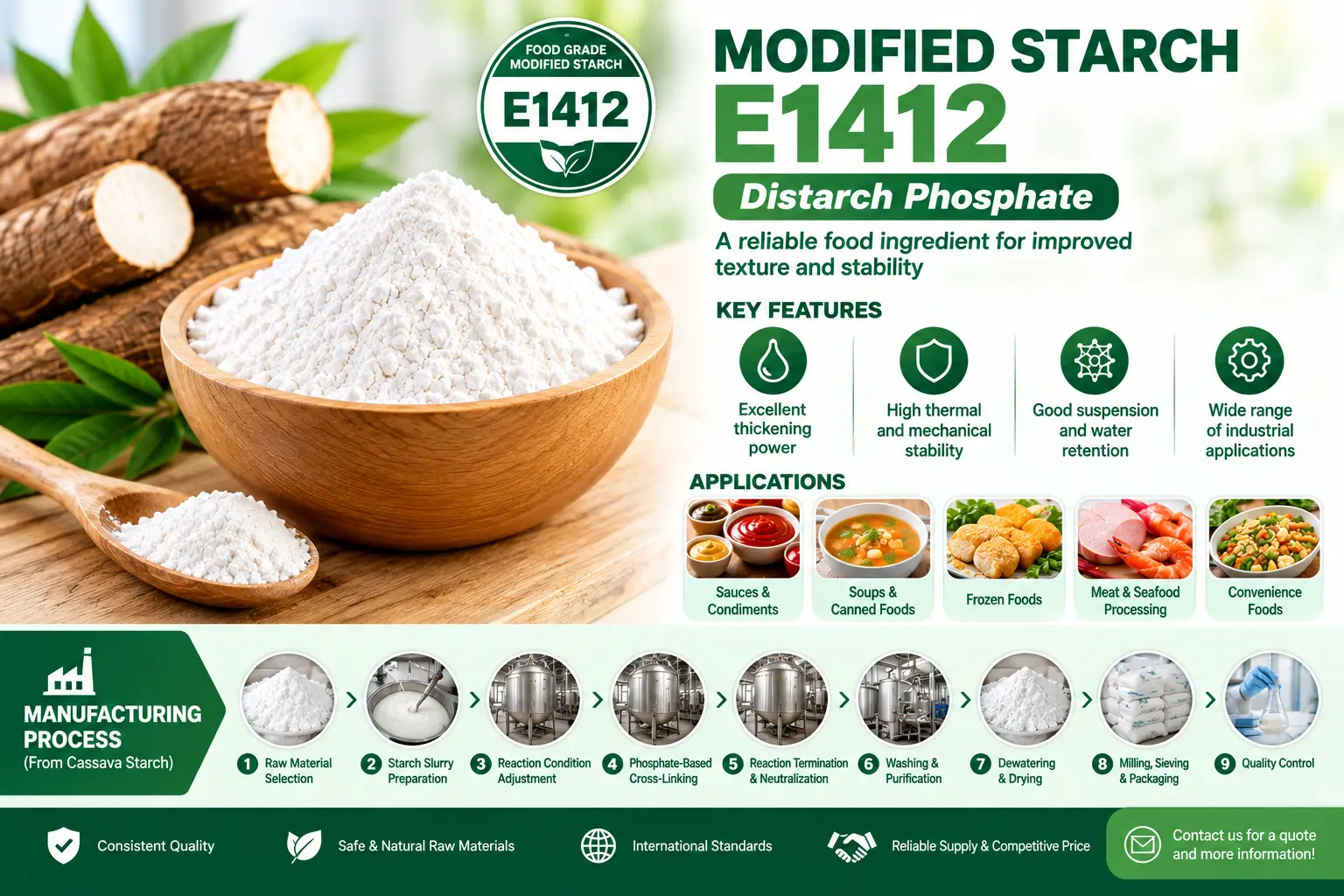
Modified starch E1412, also known as Distarch Phosphate, is a chemically modified starch used to improve the functional properties of starch in food processing. It is particularly valued for its ability to support viscosity, improve structural stability and maintain product consistency under suitable processing conditions.
E1412 can be manufactured from different botanical starch sources, including cassava, corn and potato starch. With Vietnam’s established cassava starch industry, cassava-based modified starch represents an interesting opportunity for food ingredient suppliers, manufacturers, importers and exporters.
This article explains what E1412 is, how it is manufactured, where it is used and which factors determine its market price.
1. What Is Modified Starch E1412?
E1412 is the food additive code for Distarch Phosphate.
It is produced through a cross-linking modification process involving suitable phosphate-based reagents. Cross-linking creates connections between starch molecular chains, helping the starch maintain its functional properties under certain processing conditions.
Common starch sources for E1412 include:
- Cassava starch, also known as tapioca starch.
- Corn starch.
- Potato starch.
- Other suitable botanical starches.
Cassava starch is an important raw material in Vietnam because of its established supply chain, versatility and suitability for various industrial starch applications.
What Does the Code E1412 Mean?
The E-number system is used to identify food additives in relevant regulatory and commercial contexts.
- E: Identifies the additive within the E-number system.
- 1412: The specific code assigned to Distarch Phosphate.
The letter E is not a chemical element symbol. E1412 is an identification code for a particular food additive.
Manufacturers and buyers should use the product’s technical documentation to verify its identity, raw material source, specifications and regulatory status.
2. Key Functional Properties of E1412
Modified starch E1412 is used to improve starch performance in selected food formulations.
2.1. Viscosity and Texture Support
E1412 can help provide thickness and maintain the texture of sauces, soups and other processed food products.
Its actual viscosity performance depends on the starch source, modification process, formulation and processing conditions.
2.2. Improved Processing Stability
Cross-linking can improve starch resistance to certain processing stresses, including heat and mechanical mixing.
The level of resistance depends on the product grade and the conditions under which it is used.
2.3. Product Consistency
In suitable formulations, E1412 can help maintain a more consistent structure during processing and storage.
Food manufacturers should conduct application tests to confirm the required texture and stability.
2.4. Versatile Food Ingredient Applications
Depending on the grade and applicable food regulations, E1412 may be used in different processed food categories.
Not all E1412 products have identical functional properties. Buyers should evaluate the technical specifications and intended application before purchasing.
3. Applications of Modified Starch E1412
3.1. Sauces and Condiments
E1412 can be used in selected sauces, gravies, ketchup-style products and other thickened condiments.
It supports viscosity and texture and may help maintain product consistency during processing.
3.2. Soups and Canned Foods
In suitable formulations, E1412 can help provide thickness and structural stability in soups, prepared meals and canned food products.
The appropriate starch grade depends on the thermal processing conditions and the composition of the finished product.
3.3. Frozen Foods
Modified starches are used in certain frozen food formulations to help maintain texture during processing and storage.
Performance depends on the freezing and thawing conditions, recipe composition and processing method.
3.4. Meat and Seafood Processing
E1412 may be considered for selected processed meat, seafood and composite food products where starch functionality is required.
Its suitability and permitted use levels must be verified for each food category and target market.
3.5. Convenience Foods
E1412 may be used in selected ready-to-eat meals, prepared foods and food fillings.
Manufacturers should evaluate its performance through formulation trials before scaling up production.
4. Manufacturing Process of E1412 from Cassava Starch
The industrial manufacturing process requires appropriate equipment, process controls and quality assurance systems.
A general production process includes the following stages.
Step 1: Raw Material Selection
The process begins with suitable native starch, such as cassava, corn or potato starch.
Incoming raw materials may be evaluated for:
- Moisture content.
- Appearance and color.
- Starch content.
- Foreign matter.
- Microbiological quality and relevant safety parameters.
Consistent raw material quality is important for achieving reliable finished-product performance.
Step 2: Starch Slurry Preparation
The starch is dispersed in water to form a slurry with a concentration suitable for the production process.
Parameters such as slurry concentration, temperature, pH and mixing uniformity are controlled.
Step 3: Reaction Condition Adjustment
The slurry is adjusted to the required conditions for the validated modification process.
Depending on the technology used, relevant parameters may include pH, temperature, reaction time and reagent ratios.
Step 4: Phosphate-Based Cross-Linking
This is the key stage in producing Distarch Phosphate.
The starch is treated with an appropriate phosphate-based reagent under controlled conditions to create cross-links between starch molecules.
The selected reagents, processing conditions and permitted limits must comply with the applicable food additive regulations and manufacturing requirements.
Step 5: Reaction Termination and Neutralization
Once the required modification has been achieved, the reaction is stopped and the material is adjusted to suitable conditions for further processing.
This stage helps control the product’s chemical characteristics before purification.
Step 6: Washing and Purification
The modified starch is washed to remove unwanted soluble components and residual processing chemicals as required by the validated process.
Purification must be sufficient to meet the applicable product specifications and food safety requirements.
Step 7: Dewatering and Drying
The purified starch is dewatered using suitable equipment and then dried to the target moisture level.
Drying conditions should be controlled to minimize undesirable changes in the starch’s functional properties.
Step 8: Milling, Sieving and Packaging
The dried product may be milled and sieved to achieve the required particle size and uniformity.
The finished E1412 is then packed in suitable moisture-resistant packaging to protect product quality during storage and transportation.
Step 9: Finished Product Quality Control
Before release, the product should be tested against its approved specifications.
Relevant quality parameters may include:
- Moisture content.
- Appearance and color.
- Viscosity and pasting properties.
- Functional stability under intended processing conditions.
- Relevant phosphate-related chemical parameters.
- Microbiological and food safety parameters.
- Compliance with applicable food additive requirements.
Depending on the destination market, buyers may request a Certificate of Analysis (COA), Technical Data Sheet (TDS), Safety Data Sheet (SDS) and other supporting documentation.
Important: Actual manufacturing processes vary by starch source, production technology and regulatory requirements. This is a general process overview, not a validated industrial manufacturing instruction.
5. Modified Starch E1412 Price Guide
The price of modified starch E1412 varies depending on raw material source, product specifications, order volume, manufacturer and delivery terms.
The main factors affecting the price include:
- Starch source: Cassava, corn or potato.
- Technical specifications: Moisture, viscosity, color and functional performance.
- Quality requirements: Food safety standards, certifications and technical documentation.
- Order quantity: Industrial bulk orders may receive different pricing from small orders.
- Packaging: Common industrial packaging includes 25 kg bags, subject to supplier specifications.
- Delivery terms: EXW, FOB, CIF or domestic delivery.
- Destination market: Vietnam or an export destination.
E1412 Quotation Information
| Item | Details |
|---|---|
| Product name | Modified Starch E1412 |
| Technical name | Distarch Phosphate |
| Raw material | Cassava, corn, potato or another suitable starch |
| Packaging | Commonly quoted in 25 kg bags |
| Order quantity | According to buyer requirements |
| Price | Quoted based on specifications and order volume |
| Delivery terms | EXW, FOB, CIF or agreed domestic delivery |
| Documents | COA, TDS, SDS and other relevant documents, as applicable |
Price disclaimer: This table provides quotation information rather than a verified current market price. An actual price must be confirmed by the manufacturer or supplier at the time of purchase.
For export orders, buyers should request pricing in USD per metric ton and confirm the minimum order quantity, loading port, destination port, payment terms and quotation validity period.
How to Request an Accurate E1412 Quotation
To receive a suitable quotation, buyers should provide:
- Preferred starch source: cassava, corn or another source.
- Intended application: sauces, canned foods, frozen foods or other products.
- Required quantity: samples, hundreds of kilograms or several metric tons.
- Delivery location or destination port.
- Required specifications, certifications and technical documents.
Providing these details helps suppliers prepare a quotation that matches the buyer’s requirements.
6. How to Choose an E1412 Supplier
Selecting a reliable supplier is important for manufacturers and international buyers.
Consistent Product Quality
Choose suppliers that provide clear specifications and maintain consistency between production batches.
Complete Technical Documentation
Request relevant COA, TDS, SDS and information about the raw material source.
Reliable Supply Capacity
Evaluate the supplier’s ability to meet order volumes, packaging requirements and delivery schedules.
Application Support
Technical support and product trials can help manufacturers determine whether a particular E1412 grade is suitable for their formulation.
Regulatory Compliance
Verify that the product meets the food additive requirements of the destination market and the intended food category.
7. Where to Buy Modified Starch E1412
Food manufacturers, ingredient distributors and international trading companies should source E1412 from manufacturers or distributors that can demonstrate product quality and supply reliability.
Before placing a large order, buyers should consider requesting samples to evaluate viscosity, texture, processing stability and compatibility with their existing formulations.
For import and export transactions, the product specifications, packaging, delivery terms and required documents should be agreed upon before the sales contract is finalized.
8. Frequently Asked Questions About E1412
Is E1412 the same as modified cassava starch?
Not necessarily. E1412 identifies Distarch Phosphate, which can be produced from different suitable starch sources. Buyers should verify the source on the supplier’s product documentation.
Is E1412 used in food products?
E1412 is used as a food additive in applications permitted by the relevant regulations. Its use must comply with the requirements applicable to the product category and destination market.
What is the price of E1412 per metric ton?
The price depends on the starch source, product specifications, order volume, supplier and delivery terms. Buyers should request a quotation for their specific requirements.
Can E1412 be exported internationally?
E1412 can be traded internationally when the product complies with the destination country’s import requirements, food safety regulations, labeling rules and documentation requirements.
What is the difference between E1412 and other modified starches?
Different modified starch codes represent different treatments or functional characteristics. E1412 is Distarch Phosphate, produced through phosphate-based cross-linking. The appropriate grade depends on the required functionality and processing conditions.
Modified starch E1412, also known as Distarch Phosphate, is an important functional ingredient for selected food processing applications.
Its ability to support viscosity, texture and structural stability makes it relevant to sauces, soups, canned foods, frozen foods and other suitable formulations.
For manufacturers, distributors and international trading companies, selecting the correct grade, verifying technical documentation and obtaining a quotation based on actual delivery requirements are essential steps toward a successful purchase.
Request a Quotation for Modified Starch E1412
For bulk purchasing, import or export inquiries, please provide your required quantity, application, product specifications and delivery destination.
Contact us for product information, technical documentation and a customized quotation.
Company: [Company Name]
Email: [Email Address]
Phone: [Phone Number]
Website: [Website URL]