

E1414 Modified Starch: Production Process, Applications, Specifications and Price Guide
E1414 modified starch, also known as Acetylated Distarch Phosphate, is a chemically modified starch used in food manufacturing to improve texture, viscosity, and product stability.
It is produced by combining phosphate cross-linking with acetylation. These modifications help improve the functional properties of native starch and make it suitable for various food-processing applications.
E1414 is commonly used in sauces, ketchup, chili sauce, canned foods, processed meat products, soups, and other industrial food formulations.
For food manufacturers, E1414 modified starch can be a valuable functional ingredient for achieving consistent product texture and meeting specific processing requirements.
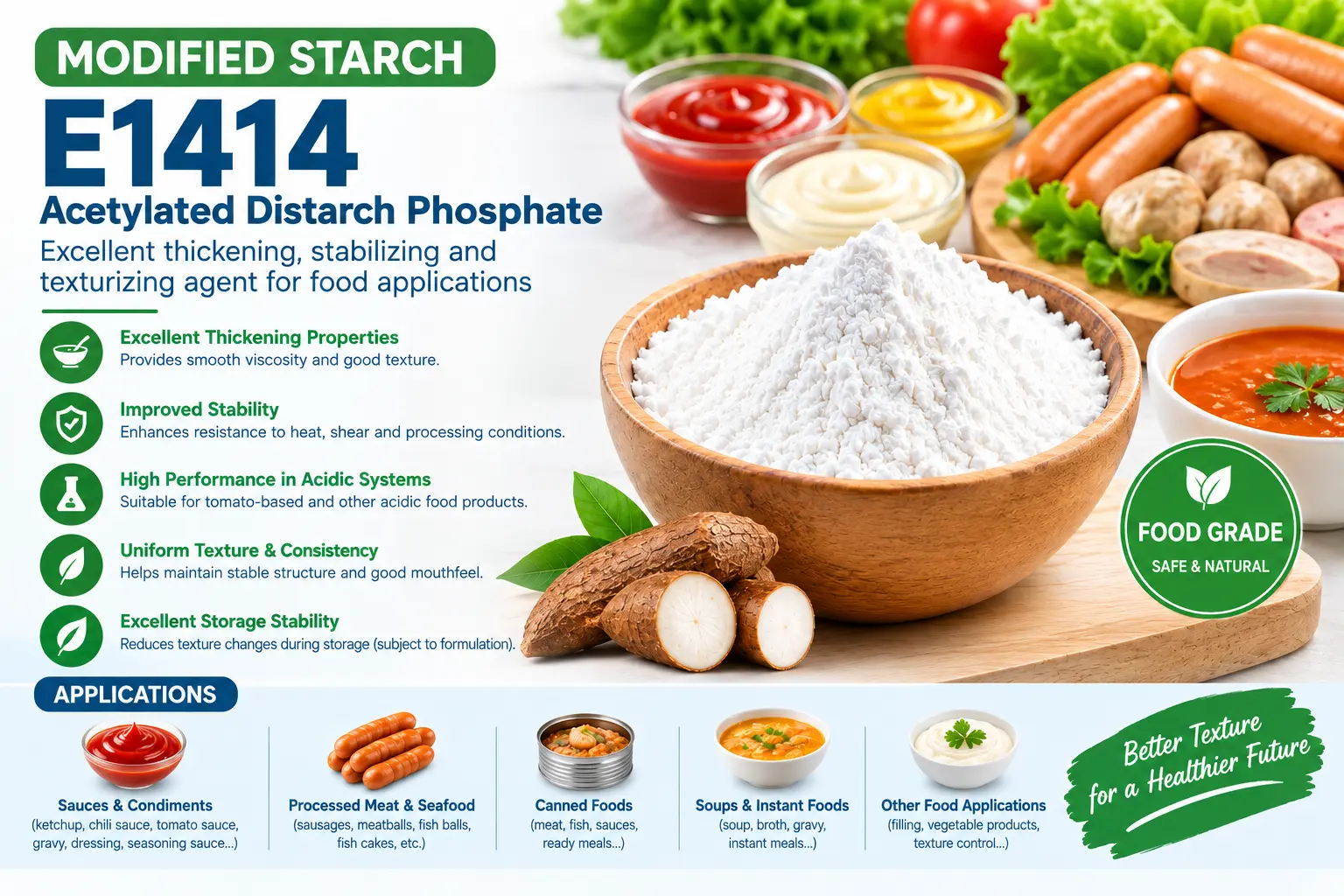
1. What Is E1414 Modified Starch?
E1414 is the international food additive code for Acetylated Distarch Phosphate.
It is a modified starch produced from suitable starch sources, including tapioca, corn, and potato starch.
Unlike native starch, E1414 undergoes controlled chemical modification involving two main processes:
- Phosphate cross-linking: Helps strengthen the starch structure and improve its resistance to certain processing conditions.
- Acetylation: Introduces acetyl groups into the starch structure, modifying its functional properties.
The combination of these modifications allows E1414 to perform effectively in food formulations that require thickening, texture control, and improved stability.
Basic Product Information
- Product name: Acetylated Distarch Phosphate.
- Food additive code: E1414 / INS 1414.
- Product category: Modified food starch.
- Raw materials: Tapioca, corn, potato, or other suitable starch sources.
- Main functions: Thickening, texture modification, and stabilization.
The performance of E1414 depends on its starch source, modification characteristics, product grade, and application conditions.
2. Key Properties of E1414 Modified Starch
2.1. Thickening Performance
E1414 can provide viscosity and improve the consistency of liquid and semi-liquid food products.
Typical applications include ketchup, chili sauce, gravies, soups, and other formulated sauces.
The appropriate grade should be selected according to the desired viscosity and processing conditions.
2.2. Improved Processing Stability
Phosphate cross-linking helps improve the resistance of starch to certain processing stresses.
Depending on the product grade, E1414 may be suitable for food processes involving heating, mixing, and mechanical shear.
2.3. Performance in Acidic Food Systems
E1414 can be considered for selected acidic food formulations, including certain tomato-based sauces.
Actual performance depends on pH, heating temperature, processing time, and the specific characteristics of the starch.
2.4. Texture Improvement
E1414 helps food manufacturers adjust texture and achieve a more consistent product structure.
It can be useful in applications where viscosity and mouthfeel are important quality attributes.
2.5. Storage Stability
In suitable formulations, E1414 may help reduce certain starch-related texture changes during storage.
The actual effect should be verified through product-specific stability testing.
3. Applications of E1414 Modified Starch
E1414 is used in various industrial food applications, depending on the applicable food regulations and product formulation.
3.1. Sauces and Condiments
E1414 can be used in formulations such as:
- Ketchup.
- Chili sauce.
- Meat sauces and gravies.
- Table sauces.
- Selected mayonnaise and dressing formulations.
- Seasoning sauces.
- Other processed condiments.
It helps improve viscosity, texture, and consistency.
3.2. Processed Meat and Seafood
In suitable formulations, E1414 can help improve texture and water retention in processed products such as:
- Sausages.
- Meatballs.
- Fish balls.
- Fish cakes.
- Other processed meat products.
- Selected processed seafood products.
The appropriate starch grade and usage level should be determined through formulation trials and in accordance with applicable food additive regulations.
3.3. Canned Foods
E1414 may be used in selected canned food products where maintaining viscosity and texture after heat processing is important.
Potential applications include canned meat, canned fish, canned sauces, and prepared meals.
3.4. Soups and Instant Foods
E1414 can help improve the consistency of soups, concentrated broths, gravies, and selected instant food products.
3.5. Other Food Applications
Depending on its functional characteristics, E1414 may also be evaluated for selected vegetable-based products, prepared fillings, and other food systems requiring texture control.
Manufacturers should conduct application tests before adopting a specific grade for commercial production.
4. E1414 Modified Starch Production Process
E1414 is manufactured by modifying native starch through a controlled industrial process.
The general production process includes the following stages.
Step 1: Raw Material Selection
Suitable starch is selected from sources such as tapioca, corn, or potatoes.
The raw material should meet the required quality specifications for purity, moisture, appearance, and other relevant parameters.
Step 2: Starch Slurry Preparation
The native starch is dispersed in water to form a uniform slurry.
This provides a suitable medium for the subsequent modification reactions.
Step 3: Phosphate Cross-Linking
The starch slurry is treated with an appropriate cross-linking agent under controlled processing conditions.
This stage forms links between starch chains and helps improve structural stability under certain processing conditions.
Step 4: Acetylation
The starch is subsequently acetylated using an authorized reagent suitable for E1414 production.
Acetylation introduces acetyl groups into the starch structure, modifying its functional characteristics.
Step 5: pH Adjustment and Washing
After the reactions are completed, the product is neutralized as required and thoroughly washed to remove unwanted soluble components and residual processing chemicals.
Step 6: Dewatering and Drying
The modified starch is dewatered and dried to meet the target moisture specification.
Step 7: Milling, Sieving, and Quality Control
The dried starch is milled or adjusted to the required particle size, sieved, and tested against the product specification.
Quality checks may include moisture content, viscosity, pH, color, fineness, microbiological parameters, and other applicable requirements.
Step 8: Packaging and Storage
The finished product is packed in suitable packaging, commonly 25 kg bags, depending on the supplier.
It should be stored in a dry, cool, and clean environment, protected from moisture and contamination.
Manufacturing note: Actual reaction conditions, reagent quantities, and operating parameters must be established through a validated manufacturing process that complies with applicable food additive specifications and regulations.
5. Typical Specifications of E1414 Modified Starch
Specifications vary by manufacturer, starch source, and product grade.
The following table presents illustrative commercial specification ranges. These values are not universal requirements for every E1414 product.
| Parameter | Illustrative Specification |
|---|---|
| Product name | Acetylated Distarch Phosphate |
| Food additive code | E1414 / INS 1414 |
| Appearance | White to off-white powder |
| Moisture | Commonly ≤ 14% |
| Starch content | May be ≥ 85% |
| pH | Grade-dependent; commonly around 4.5–7.0 |
| Viscosity | Depends on grade and test method |
| Packaging | Commonly 25 kg bags |
| Raw material source | Tapioca, corn, or other suitable starch |
Buyers should request a current Technical Data Sheet (TDS) and Certificate of Analysis (COA) to verify the exact specifications of the product offered.
Other relevant documentation may include a Safety Data Sheet (SDS), country-of-origin information, food safety certificates, and regulatory compliance documents.
6. E1414 Modified Starch Price Guide
The price of E1414 modified starch depends on several factors, including:
- Raw material source.
- Product grade and viscosity.
- Manufacturer and country of origin.
- Order quantity.
- Packaging requirements.
- Delivery location.
- Payment terms.
- Shipping and Incoterms conditions.
Based on selected wholesale listings in Vietnam reviewed in October 2026, indicative asking prices were approximately VND 16,000,000–16,800,000 per metric ton, equivalent to around VND 16,000–16,800 per kilogram.
These figures are market-listing references rather than verified transaction prices or binding quotations. Actual prices may differ.
Indicative Price Table
| Order Quantity | Price Information |
|---|---|
| Small or trial orders | Subject to packaging and supplier confirmation |
| From 1 metric ton | Approximately VND 16,000,000–16,800,000 per ton in selected listings |
| From 5–10 metric tons | Negotiable, depending on specifications and supplier terms |
| Export orders | Quotation based on destination, order volume, and agreed Incoterms |
The reference prices have not been confirmed to include VAT, inland transportation, export handling, or international freight.
Buyers should request a formal quotation specifying the applicable charges and delivery conditions.
Request a Customized E1414 Quotation
For an accurate quotation, buyers should provide:
- Required starch source.
- Product grade and target viscosity.
- Estimated order quantity.
- Packaging requirements.
- Delivery destination.
- Required quality documents.
- Preferred shipping terms, such as FOB or CIF.
- Expected delivery schedule.
A detailed quotation can then be prepared according to the actual purchasing requirements.
7. How to Choose an E1414 Modified Starch Supplier
Selecting the right supplier is important for maintaining consistent production quality.
Product Quality
Request a COA for each production batch and verify that the test methods are consistent.
Technical Documentation
Review the TDS, COA, SDS, and relevant food safety documentation before purchasing.
Raw Material Traceability
Confirm the starch source, manufacturer, and country of origin.
Application Testing
Conduct sample trials to evaluate viscosity, texture, processing stability, and compatibility with the intended food formulation.
Supply Reliability
Check production capacity, minimum order quantities, lead times, and long-term supply availability.
Regulatory Compliance
Confirm that E1414 is permitted for the intended food category and destination market, and comply with applicable usage limits and labeling requirements.
8. Where to Buy E1414 Modified Starch
Food manufacturers seeking E1414 modified starch should compare suppliers based on product specifications, application performance, documentation, and supply capacity.
Before placing a bulk order, buyers should request samples, technical specifications, and a formal quotation.
For international shipments, the quotation should clearly state packaging details, product origin, shipping arrangements, delivery terms, and required export documents.
Contact Us for an E1414 Price Quotation
If you are looking for E1414 Acetylated Distarch Phosphate for food manufacturing or international trade, prepare the following information when requesting a quotation:
- Product: E1414 Acetylated Distarch Phosphate.
- Raw material source: Tapioca or another specified starch source.
- Order quantity: Based on purchasing requirements.
- Packaging: As agreed.
- Destination market: Domestic or international.
- Delivery terms: Ex-warehouse, FOB, CIF, or another agreed Incoterm.
Contact our sales team to request a quotation based on your required specifications, order quantity, and delivery destination.
9. Frequently Asked Questions About E1414
What is the English name of E1414?
The English name is Acetylated Distarch Phosphate.
What raw materials are used to manufacture E1414?
E1414 can be manufactured from suitable starch sources, including tapioca, corn, and potato starch.
What is E1414 used for?
E1414 is used to improve viscosity, texture, and structural stability in selected food products, including sauces, ketchup, chili sauce, soups, and processed foods.
How much does E1414 modified starch cost?
The price depends on product specifications, supplier, origin, and order quantity. Selected Vietnamese wholesale listings reviewed in October 2026 indicated asking prices of approximately VND 16,000,000–16,800,000 per metric ton. Buyers should obtain a current formal quotation before ordering.
What is the difference between E1412 and E1414?
E1412 is Distarch Phosphate, while E1414 is Acetylated Distarch Phosphate.
E1414 combines phosphate cross-linking with acetylation. As a result, its functional properties may differ from those of E1412, depending on the product grade and application.
E1414 Acetylated Distarch Phosphate is a functional modified starch used in industrial food manufacturing to improve viscosity, texture, and product stability.
Selecting the appropriate grade, reviewing technical documentation, and conducting application trials are essential steps in achieving consistent product quality.
For bulk purchasing and export transactions, buyers should confirm the product specifications, applicable regulations, packaging, quotation terms, and shipping conditions before entering into a commercial agreement.