

E1422 MODIFIED STARCH: MANUFACTURING PROCESS, APPLICATIONS AND PRICE QUOTATION
1. What Is E1422 Modified Starch?
E1422 modified starch, also known as Acetylated Distarch Adipate, is a chemically modified starch designed to improve the functional properties of starch in food processing.
It is produced through a combination of acetylation and cross-linking reactions. These modifications help adjust starch swelling, viscosity, texture, and stability under suitable processing conditions.
Depending on the manufacturer and product specifications, E1422 can be produced from different starch sources, including tapioca starch, corn starch, and potato starch.
E1422 is used in selected food applications where manufacturers require suitable thickening properties, improved texture, and better product stability during processing and storage.
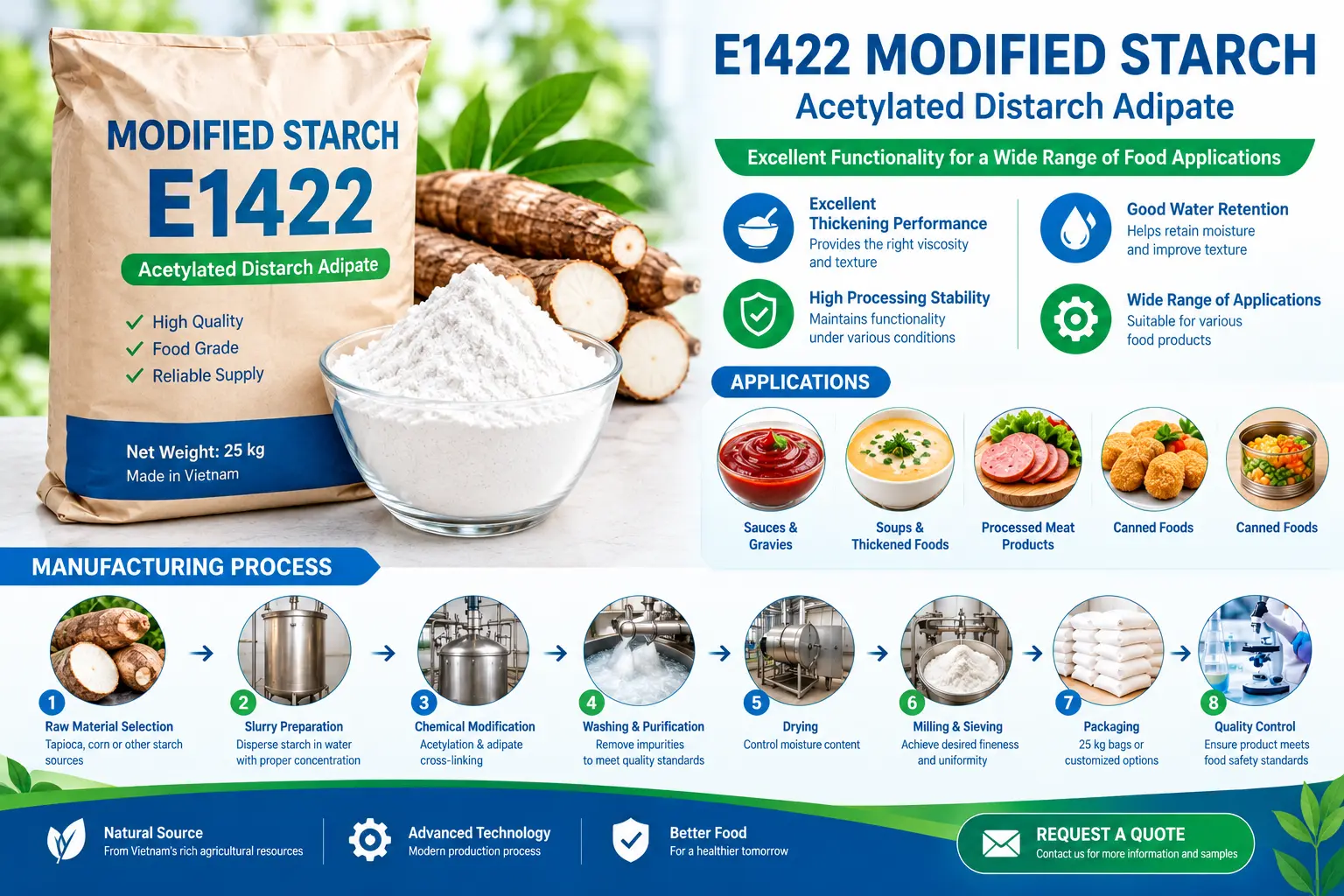
Basic Product Information
- Product name: E1422 Modified Starch.
- Chemical name: Acetylated Distarch Adipate.
- Food additive code: E1422.
- Raw materials: Tapioca, corn, potato, or other suitable starch sources.
- Appearance: Typically a white to off-white powder, depending on the product specification.
- Main functions: Thickening, texture modification, water management, and process stability.
- Applications: Sauces, soups, processed foods, selected frozen foods, and other suitable food products.
Actual product properties, including viscosity, moisture content, swelling behavior, and processing performance, depend on the starch source, manufacturing process, and technical specifications.
2. Key Properties of E1422 Modified Starch
E1422 is selected for specific food applications because of its functional characteristics.
2.1. Thickening Performance
E1422 can provide thickening and texture development when dispersed and heated under suitable conditions.
It may be used in sauces, soups, fillings, and other processed foods where viscosity control is important.
The final viscosity depends on the starch source, formulation, heating conditions, pH, and processing method.
2.2. Improved Processing Stability
Cross-linking modifies the starch structure and can help it maintain its functional properties under suitable processing conditions.
This characteristic may be useful in food manufacturing processes involving heating, mixing, and other forms of mechanical processing.
2.3. Water Management
E1422 can contribute to moisture retention and texture control in selected food formulations.
Its actual performance depends on the application, ingredient interactions, dosage, and processing conditions.
2.4. Texture Stability During Storage
Depending on the formulation, E1422 may help reduce certain undesirable changes in product texture during storage.
Food manufacturers should conduct application trials to verify performance under their actual production and storage conditions.
3. Applications of E1422 Modified Starch
3.1. Food Processing Industry
E1422 can be used in suitable food formulations to help control viscosity, texture, and processing stability.
Potential applications include:
- Sauces and gravies.
- Soups and thickened food products.
- Bakery fillings and processed food fillings.
- Selected processed meat products, where permitted.
- Certain frozen food products.
- Canned foods.
- Other industrial food formulations requiring viscosity control.
The suitability of E1422 depends on the product formulation and applicable food additive regulations.
3.2. Sausage and Processed Meat Manufacturing
Modified starches may be used in certain processed meat formulations to support water management and improve product texture.
E1422 may be considered for suitable applications, depending on the meat formulation, protein content, heating process, and other ingredients.
Manufacturers should conduct formulation trials to determine the appropriate usage level and confirm compliance with the applicable food additive regulations.
3.3. Frozen Food Products
Frozen food manufacturers often need to maintain acceptable texture through freezing, storage, and thawing.
E1422 may be evaluated in suitable formulations to support viscosity and texture stability.
Performance depends on the freezing and thawing cycle, formulation, and storage conditions.
3.4. Sauces and Canned Foods
Sauces and canned food products may require starch ingredients that provide suitable viscosity and structure during industrial processing.
E1422 can be considered for applications where its functional properties meet the product’s requirements.
Compatibility with processing temperature, heating time, pH, and other ingredients should be assessed before commercial production.
4. E1422 Modified Starch Manufacturing Process
The manufacturing process generally involves the following stages. Specific operating conditions depend on the manufacturer’s technology, raw materials, and product specifications.
Step 1: Starch Raw Material Selection
The manufacturer selects an appropriate starch source, such as tapioca starch, corn starch, or potato starch.
Incoming materials are assessed for relevant quality parameters, including purity, moisture content, appearance, and suitability for the intended application.
Step 2: Starch Slurry Preparation
The starch is dispersed in water to prepare a slurry with a suitable concentration.
Important process parameters may include starch concentration, temperature, pH, and slurry uniformity.
Step 3: pH Adjustment and Chemical Modification
The starch slurry is adjusted to suitable reaction conditions.
Appropriate processing agents are used to carry out acetylation and adipate cross-linking.
These two modifications give E1422 its characteristic functionality:
- Acetylation: Introduces acetyl groups into the starch structure, helping modify its functional behavior.
- Adipate cross-linking: Forms cross-links within the starch structure, helping control swelling and improve stability under suitable processing conditions.
The chemicals used, reaction limits, and residual levels must comply with applicable food additive regulations.
Step 4: Reaction Control
Once the desired degree of modification is achieved, the reaction is controlled and the slurry is brought to suitable conditions for subsequent processing.
Relevant quality parameters may include the degree of modification, pH, and other validated process-control requirements.
Step 5: Washing and Purification
The modified starch is washed to remove undesirable soluble components and meet the applicable purity requirements.
The washing process must be designed to satisfy the product’s quality and food safety specifications.
Step 6: Dewatering and Drying
The starch slurry is dewatered using suitable equipment.
The resulting material is then dried under controlled conditions to achieve the required moisture content while preserving the desired functional properties.
Step 7: Milling, Sieving, and Packaging
The dried starch is processed to achieve the required particle size and uniformity.
The finished product is packed in suitable packaging, such as 25 kg bags or other formats agreed upon with the customer.
Step 8: Quality Control and Product Release
Before shipment, the finished product is tested against its established technical specifications.
Depending on the product and applicable requirements, quality checks may include:
- Appearance and color.
- Moisture content.
- Viscosity or other functional properties.
- Slurry pH.
- Relevant purity and modification parameters.
- Microbiological and heavy metal limits, where applicable.
- Compliance with relevant food safety requirements.
Note: Acceptance limits must be based on the product specification, applicable regulations, and the relevant test methods. A single specification should not be assumed to apply to every E1422 product.
5. E1422 Modified Starch Price and Quotation
The price of E1422 modified starch depends on the starch source, product specifications, order volume, supplier, and delivery destination.
Key factors affecting the quotation include:
- Raw material source, such as tapioca, corn, or potato starch.
- Manufacturer and country of origin.
- Viscosity and functional performance requirements.
- Quality standards and supporting documentation.
- Order quantity.
- Packaging specifications.
- Delivery destination and trade terms.
- Raw material, energy, freight, and exchange rate fluctuations.
E1422 Price Quotation Information
| Item | Details |
|---|---|
| Product | E1422 Modified Starch |
| Chemical name | Acetylated Distarch Adipate |
| Raw material source | Tapioca, corn, potato, or another suitable source |
| Packaging | Commonly available in 25 kg bags, subject to supplier confirmation |
| Order quantity | Based on customer requirements |
| Unit price | Quoted according to specifications and order volume |
| Delivery terms | Domestic delivery or international shipment |
| Documentation | Subject to supplier availability and customer requirements |
Price information: A reliable, current market price cannot be confirmed without a supplier quotation and defined product specifications. Buyers should request quotations directly from qualified manufacturers or distributors.
For international transactions, quotations may be requested under EXW, FOB, or CIF terms. The quotation should specify the shipment port, destination port, packaging, order quantity, and quotation validity period.
How to Obtain an Accurate E1422 Quotation
To receive an appropriate quotation, buyers should provide the following information:
- Order quantity: Sample quantity, 1 metric ton, 5 metric tons, 10 metric tons, or container volume.
- Preferred starch source: Tapioca, corn, potato, or another suitable source.
- Final application: Sauces, sausages, frozen foods, or other products.
- Technical requirements: Viscosity, moisture content, and other relevant specifications.
- Delivery destination: Delivery address or destination port.
- Trade terms: EXW, FOB, CIF, or another agreed term.
Providing these details helps suppliers identify the appropriate grade and prepare a more accurate quotation.
6. Quality Standards and Food Safety
For E1422 intended for food applications, buyers should verify compliance with the regulations applicable in the destination market.
Depending on the supplier and transaction, the following documents may be requested:
- COA (Certificate of Analysis): Batch-specific quality analysis.
- TDS (Technical Data Sheet): Technical product specifications.
- SDS (Safety Data Sheet): Safety information.
- Country-of-origin documentation.
- Relevant food safety management documentation, where available.
- Documentation supporting compliance with applicable food additive requirements.
E1422 should not be assumed to be permitted in every food category or every country. Its use must comply with the applicable food category restrictions, usage limits, and labeling requirements.
7. Where to Buy E1422 Modified Starch
Food manufacturers and international buyers seeking E1422 should consider suppliers that can provide clear technical specifications, product samples, and appropriate quality documentation.
When evaluating a supplier, consider:
- Consistent quality between batches.
- Reliable long-term supply.
- Competitive pricing for the required volume.
- Technical support and product samples.
- Suitable packaging options.
- Export documentation and international shipping capabilities.
Food manufacturers should test the product in their actual formulations before placing large commercial orders.
E1422 modified starch, also known as Acetylated Distarch Adipate, is a functional starch ingredient used in suitable food applications to control viscosity, modify texture, and support processing stability.
Produced through acetylation and adipate cross-linking, E1422 can be considered for selected applications in sauces, soups, processed foods, and frozen products.
Choosing the right grade requires evaluating the technical specifications, conducting application trials, and confirming compliance with the regulations in the destination market.
If you are looking for E1422 modified starch for food manufacturing or international trade, contact a qualified supplier to request technical documentation, samples, and a quotation tailored to your requirements.