

MODIFIED STARCH E1420: PRODUCTION PROCESS, APPLICATIONS AND PRICE GUIDE
1. What Is Modified Starch E1420?
Modified starch E1420, also known as Acetylated Starch, is a chemically modified starch produced through an acetylation process to improve selected functional properties of native starch.
The raw materials used to manufacture E1420 may include tapioca starch, corn starch, potato starch, or other suitable starch sources.
During acetylation, some hydroxyl groups in the starch structure are replaced with acetyl groups. This modification changes the interactions between starch molecules and water, helping adjust functional characteristics such as texture, viscosity, and structural stability in suitable food applications.
E1420 is used in food processing where specific starch functionality is required. Its performance depends on the starch source, degree of substitution, processing conditions, and final product formulation.
Basic Information About E1420
- Product name: Acetylated Starch.
- Food additive code: E1420.
- Common name: Acetylated Modified Starch.
- Raw materials: Tapioca starch, corn starch, potato starch, and other suitable starch sources.
- Modification method: Chemical acetylation.
- Main applications: Texture modification, viscosity adjustment, and functional improvement in selected food products.
E1420 should not be confused with other modified starch codes, as each type has its own modification method and functional characteristics.
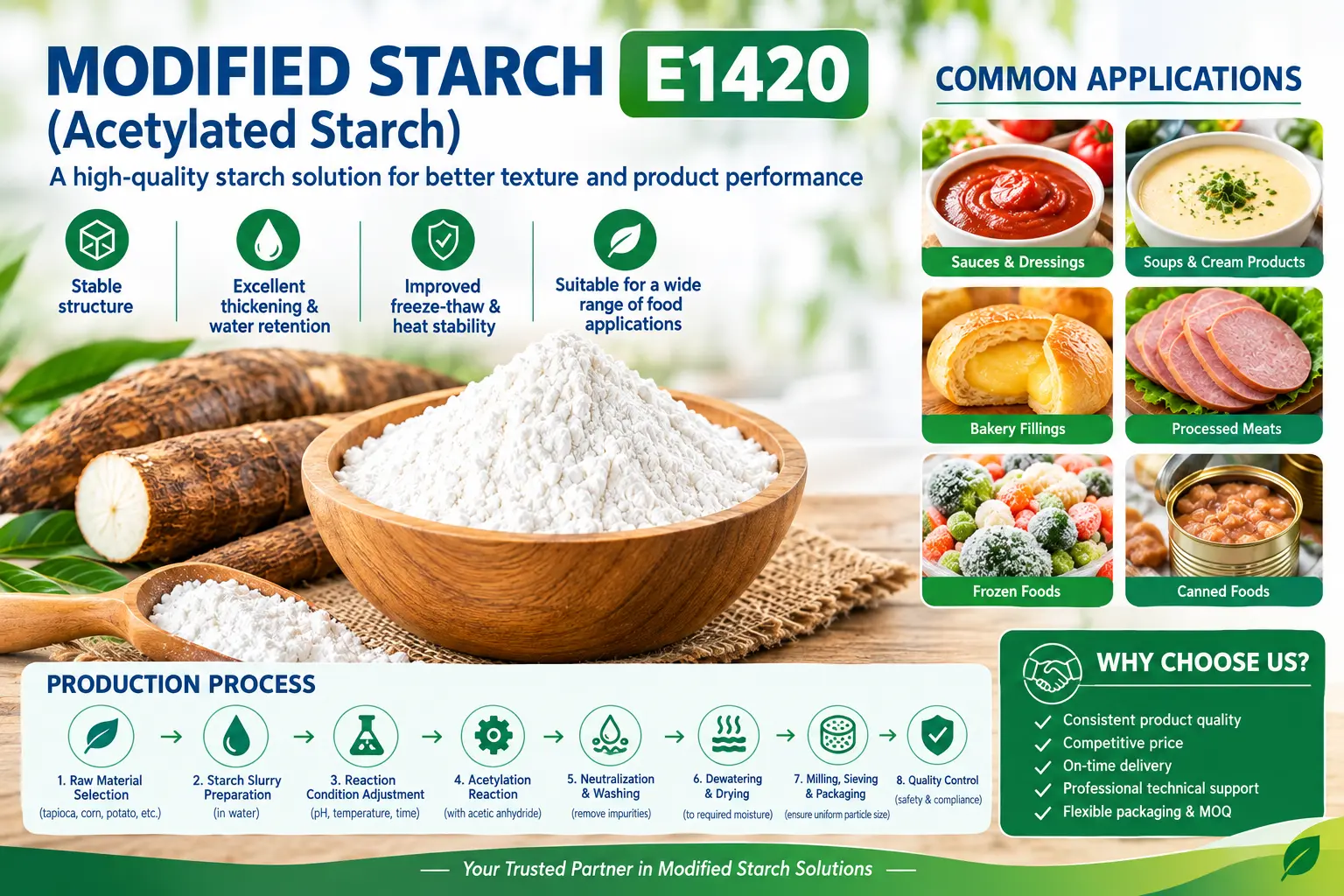
2. Key Properties of Modified Starch E1420
Modified starch E1420 offers several potentially useful functional properties, depending on its grade and application.
2.1. Improved Structural Stability
Acetylation changes interactions between starch molecules. In suitable formulations, this modification can help improve the ability of starch to maintain its structure during processing.
2.2. Viscosity and Texture Modification
E1420 can be used to adjust thickness, viscosity, and texture in certain food systems.
The actual performance depends on the starch source, formulation, processing temperature, pH, and interactions with other ingredients.
2.3. Support for Product Quality
In suitable applications, acetylated starch may help reduce certain undesirable changes in food texture during storage.
However, performance under freezing, thawing, high-temperature processing, or mechanical stress depends on the specific product grade. E1420 should not automatically be assumed to provide the same freeze-thaw or processing stability as dual-modified starches.
2.4. Formulation Flexibility
E1420 can be considered for a range of food formulations. Manufacturers should select the appropriate grade based on viscosity, acetyl content, moisture level, processing conditions, and finished-product requirements.
3. Applications of Modified Starch E1420
Modified starch E1420 may be used in various food-processing applications where its functional properties are suitable.
3.1. Food Processing Industry
Potential applications include:
- Sauces and dressings.
- Soups and cream-style products.
- Bakery fillings and selected food fillings.
- Suitable canned food formulations.
- Certain processed meat products.
- Other food products requiring specific texture or viscosity adjustment.
The suitability of E1420 must be assessed according to its intended technological function and the food additive regulations applicable in the target market.
3.2. Sauces and Condiments
In sauce manufacturing, modified starch can help achieve the desired thickness, mouthfeel, and product consistency.
The inclusion level should be established through formulation trials to obtain the target viscosity without making the product excessively thick or negatively affecting its sensory properties.
3.3. Processed Meat Products
Depending on the product grade and formulation, E1420 may be evaluated as a functional ingredient in certain processed meat applications.
Water retention, texture, and stability should be verified through practical trials. E1420 is not necessarily a direct replacement for every other modified starch used in meat processing.
3.4. Frozen Food Products
Selected frozen-food formulations may use acetylated starch to adjust texture. For products exposed to repeated freeze-thaw cycles, manufacturers should also evaluate starch grades specifically designed to provide stronger freeze-thaw stability.
3.5. Other Industrial Applications
Certain acetylated starch products may also be considered for specialized industrial applications. Their suitability depends on the starch source, product grade, and the technical requirements of the end user.
4. Modified Starch E1420 Production Process
The manufacturing process for E1420 generally involves several key stages. Specific operating parameters vary by manufacturer, production technology, and product specifications.
Step 1: Raw Material Selection
The manufacturer selects a suitable native starch, such as tapioca starch, corn starch, or potato starch.
Incoming materials are evaluated for relevant quality parameters, including moisture content, purity, appearance, and other technical characteristics.
Step 2: Starch Slurry Preparation
The starch is dispersed in water to prepare a slurry with a suitable concentration for the reaction system.
Uniform dispersion is important to support consistent processing and product quality.
Step 3: Reaction Condition Adjustment
The slurry is adjusted to appropriate pH, temperature, and reaction conditions.
These parameters influence the reaction efficiency and the functional properties of the finished starch.
Step 4: Acetylation Reaction
The starch is reacted with a suitable acetylating agent, commonly acetic anhydride, under controlled conditions.
This reaction introduces acetyl groups into the starch structure, producing acetylated starch E1420.
The manufacturer must control chemical usage, reaction conditions, process safety, and the degree of modification according to a validated manufacturing procedure.
Step 5: Neutralization and Washing
After the reaction reaches the required endpoint, the mixture is adjusted to suitable conditions.
The starch is washed to remove soluble substances and unwanted residues in accordance with the manufacturing process.
Step 6: Dewatering and Drying
The starch is separated from water using suitable equipment and then dried to meet the product’s moisture specifications.
Step 7: Milling, Sieving, and Packaging
The dried starch may be milled or sieved to obtain the required particle size and consistency.
The finished product is then packed in suitable packaging designed to maintain hygiene and protect the starch from moisture.
Step 8: Quality Control
Before release, the product should be tested against the manufacturer’s specifications. Relevant parameters may include:
- Appearance and color.
- Moisture content.
- Viscosity and functional properties.
- Acetyl content or degree of modification, where specified.
- Microbiological parameters and heavy metals.
- Chemical residues and other applicable safety requirements.
Food-grade E1420 must comply with the relevant food additive regulations and safety requirements in the intended market.
5. Modified Starch E1420 Price Guide
The price of modified starch E1420 is not fixed. It depends on the starch source, technical specifications, quality requirements, order quantity, origin, and delivery terms.
For an accurate quotation, buyers should request current pricing directly from manufacturers or suppliers based on their specific requirements.
Factors Affecting E1420 Prices
| Factor | Impact on Price |
|---|---|
| Starch source | Tapioca, corn, and potato starch may have different cost structures |
| Technical specifications | Viscosity, acetyl content, and functional performance affect pricing |
| Product grade | Food-grade requirements and certification needs may influence cost |
| Order quantity | Larger orders may qualify for volume-based pricing |
| Packaging | Common options may include 25 kg bags or other supplier-specific formats |
| Delivery terms | EXW, FOB, CFR, and CIF quotations may differ |
| Destination market | Freight, duties, and import procedures may affect the total landed cost |
How to Request an Accurate Quotation
To receive a suitable E1420 quotation, buyers should provide:
- Preferred starch source: tapioca, corn, or potato.
- Intended application: sauces, processed meat, frozen foods, or another use.
- Required technical specifications and quality standards.
- Estimated order quantity.
- Delivery destination.
- Preferred Incoterms, such as EXW, FOB, CFR, or CIF.
Providing these details helps suppliers select the appropriate grade and prepare a quotation that reflects the buyer’s actual requirements.
6. How to Choose a Reliable E1420 Supplier
When sourcing modified starch E1420, buyers should consider suppliers that can provide:
- A Technical Data Sheet (TDS).
- A Certificate of Analysis (COA) for the relevant batch.
- A Safety Data Sheet (SDS), where applicable.
- Product origin and traceability information.
- Documentation demonstrating compliance with relevant food additive regulations.
- Product samples for production trials.
- Consistent supply and technical support.
For international trade, buyers should also verify labeling requirements, certificates of origin, and import documentation applicable in the destination country.
Modified starch E1420, or Acetylated Starch, is produced through chemical acetylation to adjust the functional properties of native starch.
Depending on the grade and formulation, it may be suitable for sauces, soups, fillings, and selected processed food applications.
Choosing the right E1420 product requires careful evaluation of the starch source, functional specifications, manufacturing conditions, and applicable food regulations.
For manufacturers, distributors, and international buyers seeking modified starch E1420, clearly defining technical requirements and order quantities is an important step toward obtaining a competitive and accurate quotation.
Contact our sales team to discuss product specifications, request samples, and receive a quotation for modified starch E1420 tailored to your requirements.