

INSTANT NOODLE MANUFACTURING PROCESS AND THE APPLICATION OF TAPIOCA STARCH IN INSTANT NOODLE PRODUCTION
1. Introduction to Instant Noodles
Instant noodles are among the most popular convenience foods worldwide. Their popularity comes from their affordability, convenient preparation, long shelf life, and wide variety of flavors.
To produce high-quality instant noodles, manufacturers need to carefully select raw materials and control every stage of the manufacturing process. The main ingredient is wheat flour, which provides the gluten structure necessary for noodle elasticity and texture.
In addition to wheat flour, tapioca starch (cassava starch) and modified starch are widely used in food processing to improve noodle texture, softness, elasticity, cooking performance, and product quality.
Tapioca starch, extracted from cassava roots, is particularly valuable in the food industry because of its excellent gelatinization properties, neutral flavor, bright white appearance, and versatile applications.
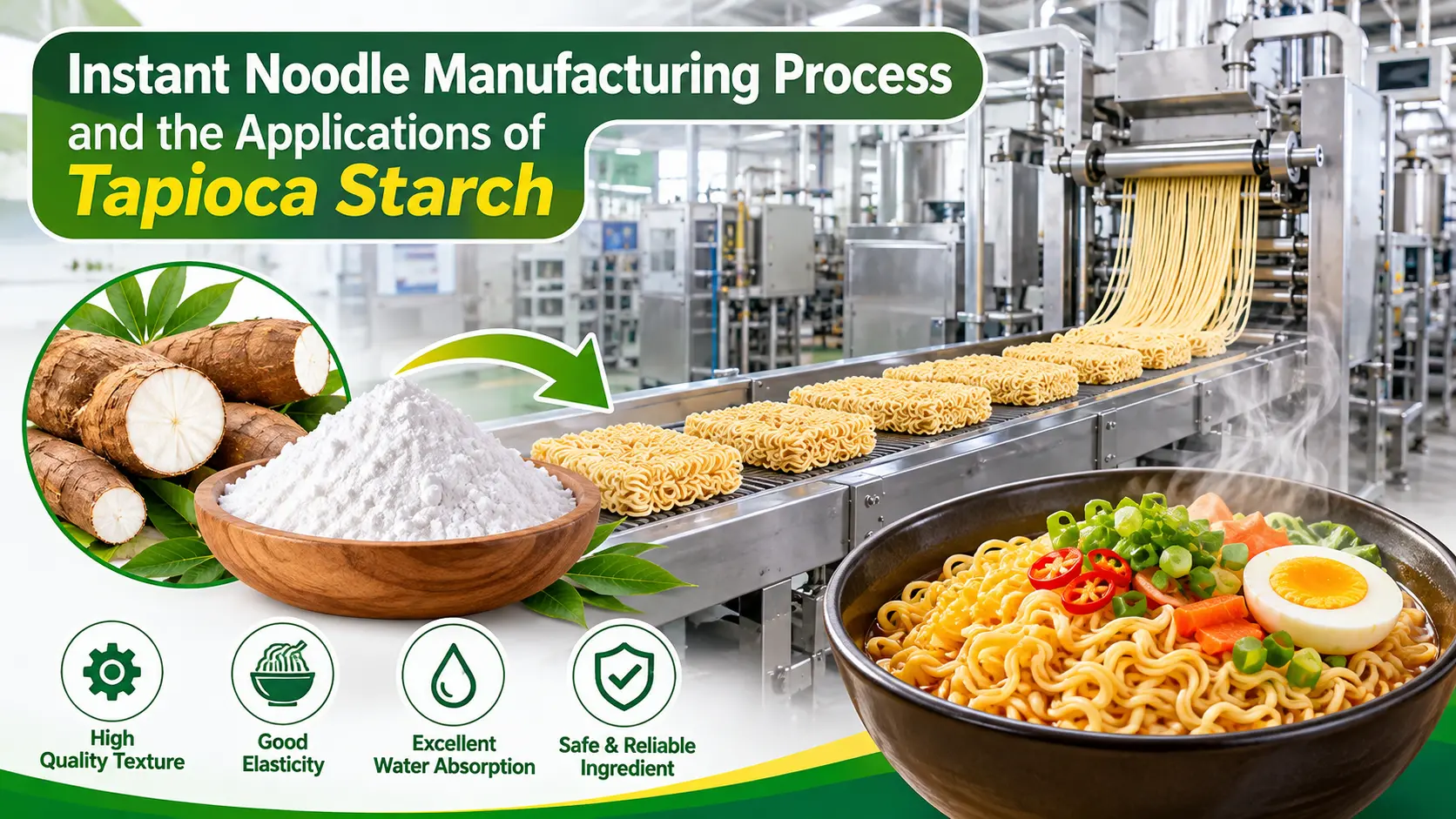
2. Main Ingredients Used in Instant Noodle Manufacturing
The quality of instant noodles depends on the selection and combination of several ingredients.
2.1. Wheat Flour
Wheat flour is the primary raw material used in instant noodle production.
Its main functions include:
- Providing protein and gluten to form the noodle structure.
- Improving elasticity and firmness.
- Maintaining noodle shape during steaming, frying, and cooking.
- Creating the characteristic texture of instant noodles.
The protein content and quality of wheat flour significantly affect the final noodle characteristics.
2.2. Tapioca Starch (Cassava Starch)
Tapioca starch, also known as cassava starch, is extracted from cassava roots and is widely used in the food manufacturing industry.
In instant noodle production, tapioca starch offers several technological benefits:
- Helps modify noodle texture and structure.
- Contributes to softness and elasticity.
- Provides good gelatinization properties.
- Helps improve the appearance and brightness of noodles.
- Influences water absorption and cooking characteristics.
- Supports the development of different noodle formulations.
When combined with wheat flour, tapioca starch can help manufacturers achieve the desired texture and sensory properties.
The appropriate inclusion rate depends on the noodle formulation, processing conditions, and required product characteristics.
2.3. Modified Starch
Modified starch is produced by physically, enzymatically, or chemically treating native starch to improve its functional properties.
Different types of modified starch can be used in instant noodle manufacturing.
E1412 – Distarch Phosphate
- Improves starch stability.
- Helps maintain product structure during processing.
- Provides resistance to certain processing conditions.
E1420 – Acetylated Starch
- Helps improve texture.
- Reduces starch retrogradation.
- Supports softness and stability.
E1422 – Acetylated Distarch Adipate
- Improves heat stability.
- Enhances water retention.
- Helps maintain noodle structure during processing.
E1442 – Hydroxypropyl Distarch Phosphate
- Improves freeze-thaw and processing stability.
- Helps maintain texture.
- Provides good resistance to processing conditions.
E1404 – Oxidized Starch
- Helps control viscosity.
- Provides useful film-forming properties.
- Can be used to modify the functional characteristics of food products.
The selection of modified starch depends on the production technology, product specifications, and applicable food additive regulations in the target market.
2.4. Other Ingredients
Other ingredients commonly used in instant noodle manufacturing include:
- Water: For dough preparation and hydration.
- Salt: Enhances flavor and influences dough properties.
- Alkaline salts (Kansui): Help develop the characteristic color, flavor, and texture of certain noodle products.
- Vegetable oil: Used in fried instant noodle production.
- Seasoning powders: Provide different flavors.
- Dried vegetables and flavoring ingredients: Improve taste and product variety.
- Approved food additives: Used when necessary to achieve specific product characteristics.
3. Industrial Instant Noodle Manufacturing Process
The industrial production of instant noodles involves several important stages. Each stage must be carefully controlled to ensure consistent product quality, texture, and shelf stability.
Step 1: Raw Material Preparation and Weighing
Wheat flour, tapioca starch, modified starch, salt, and other ingredients are inspected and weighed according to the production formulation.
Important quality requirements include:
- Consistent wheat flour quality.
- High-purity tapioca starch.
- Appropriate starch moisture content.
- No foreign materials or contamination.
- Compliance with food safety standards.
Accurate weighing ensures consistent quality between production batches.
Step 2: Ingredient Mixing
Wheat flour, tapioca starch, and modified starch are transferred into an industrial mixing system.
Water, salt solution, and other ingredients are added according to the formulation.
The purpose of mixing is to:
- Distribute ingredients evenly.
- Ensure uniform moisture throughout the mixture.
- Prepare the dough for kneading and rolling.
- Maintain consistent raw material quality.
Step 3: Dough Kneading
After mixing, the dough is transferred to an industrial kneading system.
During kneading, water is distributed throughout the flour mixture, while wheat proteins develop a gluten network.
This process creates a cohesive dough with suitable processing properties.
Tapioca starch contributes to the overall formulation by modifying the functional properties and texture of the dough.
Step 4: Dough Rolling and Noodle Cutting
The dough is passed through a series of industrial rollers to produce uniform dough sheets.
These sheets are then transferred to cutting machines to form noodles of the required thickness and width.
This stage determines several important product characteristics:
- Noodle thickness.
- Strand width and shape.
- Uniformity of noodle strands.
- Appearance and cooking performance.
Step 5: Noodle Steaming
The freshly cut noodle strands are transferred to a continuous steaming system.
Steam treatment gelatinizes the starch and helps develop the desired noodle structure.
During this stage, tapioca starch undergoes gelatinization, contributing to the structural characteristics of the finished noodles.
Proper steaming is essential for achieving consistent texture and cooking quality.
Step 6: Cutting and Portioning
After steaming, the noodle strands are cut into standard lengths and portioned into individual servings.
Depending on the production line, noodles can be formed into square, round, or other shapes.
Step 7: Frying or Hot-Air Drying
This is one of the most important stages in instant noodle manufacturing.
There are two common processing methods:
A. Fried Instant Noodles
Steamed noodle blocks are transferred into an industrial frying system using vegetable oil.
Frying helps:
- Reduce moisture content.
- Develop a porous noodle structure.
- Improve water absorption during preparation.
- Create the characteristic flavor and texture of fried instant noodles.
B. Non-Fried Instant Noodles
For non-fried instant noodles, the steamed noodle blocks are transferred into a hot-air drying system.
This method reduces moisture without deep-frying, resulting in a product with lower oil content.
Step 8: Cooling and Quality Inspection
After frying or drying, noodle blocks are cooled under appropriate hygienic conditions.
Finished products are inspected for:
- Moisture content.
- Color and appearance.
- Shape and uniformity.
- Texture and crispness.
- Fat content in fried noodles.
- Microbiological safety.
- Compliance with product specifications.
Step 9: Packaging
After passing quality inspection, instant noodles are transferred to automatic packaging systems.
Seasoning powders, seasoning oil, and dried ingredients are added to each package according to the product formulation.
Packaging materials should provide effective moisture protection and maintain product quality during storage and transportation.
4. Applications of Tapioca Starch in Instant Noodle Production
Tapioca starch is an important functional ingredient in the food processing industry.
Its excellent gelatinization characteristics, neutral taste, bright white color, and versatile functionality make it suitable for various noodle applications.
4.1. Improving Noodle Texture and Structure
Tapioca starch has the ability to gelatinize and form a gel structure when heated in the presence of water.
When combined with wheat flour at an appropriate ratio, it helps modify noodle structure and contributes to the desired softness and chewiness.
This is particularly important for manufacturers seeking to develop instant noodles with specific texture characteristics.
4.2. Enhancing Softness and Elasticity
Tapioca starch can influence the softness and textural properties of noodles after steaming.
Its functional properties help manufacturers adjust noodle formulations to achieve suitable elasticity, chewiness, and mouthfeel.
4.3. Improving Noodle Appearance
High-quality tapioca starch typically has a bright white appearance and good purity.
Its application in noodle formulations can contribute to a more uniform and attractive noodle appearance.
4.4. Modifying Water Absorption and Cooking Properties
The gelatinization characteristics of tapioca starch influence water absorption and the rehydration behavior of noodle products.
Selecting the appropriate starch type and formulation helps manufacturers control noodle cooking time and final texture.
4.5. Optimizing Instant Noodle Formulations
Tapioca starch can be combined with wheat flour and different modified starches to develop specialized noodle formulations.
Potential applications include:
- Traditional fried instant noodles.
- Non-fried instant noodles.
- Instant cup noodles.
- Premium instant noodles.
- Instant noodles with customized texture characteristics.
5. Why Choose Vietnamese Tapioca Starch for Instant Noodle Manufacturing?
Vietnam is one of the important cassava-producing countries in Southeast Asia, with an established cassava starch processing industry.
Vietnamese tapioca starch offers several advantages for food manufacturers.
Key advantages include:
1. Reliable Raw Material Supply
Vietnam has established cassava-growing regions and industrial starch processing facilities.
2. Bright White Appearance
High-quality tapioca starch provides a clean, bright appearance suitable for food applications.
3. Excellent Gelatinization Properties
Tapioca starch provides useful functional properties for food processing and formulation development.
4. Versatile Food Applications
It can be used in instant noodles, vermicelli, rice noodles, tapioca pearls, sauces, bakery products, and other processed foods.
5. Competitive Supply Options
Vietnamese manufacturers offer different product specifications and packaging options to meet domestic and international demand.
6. Export Opportunities
Vietnamese tapioca starch is supplied to various international markets, supporting the growing demand for plant-based starch ingredients.
6. How to Choose High-Quality Tapioca Starch for Instant Noodle Production
Selecting the right tapioca starch supplier is essential for maintaining stable production quality.
Food manufacturers should consider the following technical specifications:
| Quality Parameter | Recommended Requirements |
|---|---|
| Appearance | Fine, white powder |
| Moisture Content | Meets product specifications |
| Purity | Free from foreign materials |
| Viscosity | Consistent with application requirements |
| pH Value | Within the specified range |
| Odor | Neutral, without unusual odors |
| Microbiological Quality | Complies with food safety standards |
| Heavy Metals | Complies with applicable regulations |
Manufacturers should also request relevant quality and compliance documents, including:
- CO (Certificate of Origin).
- CQ (Certificate of Quality).
- COA (Certificate of Analysis).
- Food safety test reports.
- Relevant quality management certifications.
Conducting production trials is recommended before selecting a starch supplier for long-term industrial production.
7. Tapioca Starch Price for Instant Noodle Manufacturing
The price of tapioca starch depends on several factors, including product quality, origin, technical specifications, order quantity, packaging, and delivery conditions.
The main factors influencing tapioca starch prices include:
- Native tapioca starch or modified starch specifications.
- Whiteness and moisture content.
- Viscosity and functional properties.
- Order volume.
- Packaging requirements.
- Domestic or international delivery terms.
- FOB, CIF, or other applicable trade conditions.
For instant noodle manufacturers, choosing a reliable supplier with consistent product quality and stable supply capacity is essential.
Buyers are encouraged to evaluate product samples and conduct production trials before placing large-volume orders.
Tapioca starch (cassava starch) is a valuable functional ingredient in the instant noodle manufacturing industry.
With its excellent gelatinization properties, bright white appearance, and ability to modify noodle texture, tapioca starch can be combined with wheat flour and modified starch to develop different instant noodle formulations.
By selecting suitable starch specifications, optimizing ingredient ratios, and maintaining effective process control, manufacturers can improve product consistency and meet the changing demands of the global instant noodle market.
Vietnamese tapioca starch offers an attractive sourcing option for food manufacturers looking for quality cassava-based ingredients and reliable long-term supply.
Vietnamese Tapioca Starch – A Reliable Ingredient for the Global Food Processing Industry.