

CHILI SAUCE MANUFACTURING PROCESS – APPLICATIONS OF TAPIOCA STARCH, CASSAVA STARCH AND MODIFIED STARCH IN CHILI SAUCE PRODUCTION
1. Introduction to Chili Sauce Manufacturing
Chili sauce is one of the most popular condiments worldwide. It is widely used in the food processing industry, restaurants, fast-food businesses and household cooking.
To manufacture high-quality chili sauce, food manufacturers must carefully control several product characteristics, including color, flavor, spiciness, viscosity, texture, stability and shelf life.
Among the ingredients used in industrial chili sauce production, tapioca starch, also known as cassava starch, and modified starch play important roles in improving viscosity, texture, water retention and product stability.
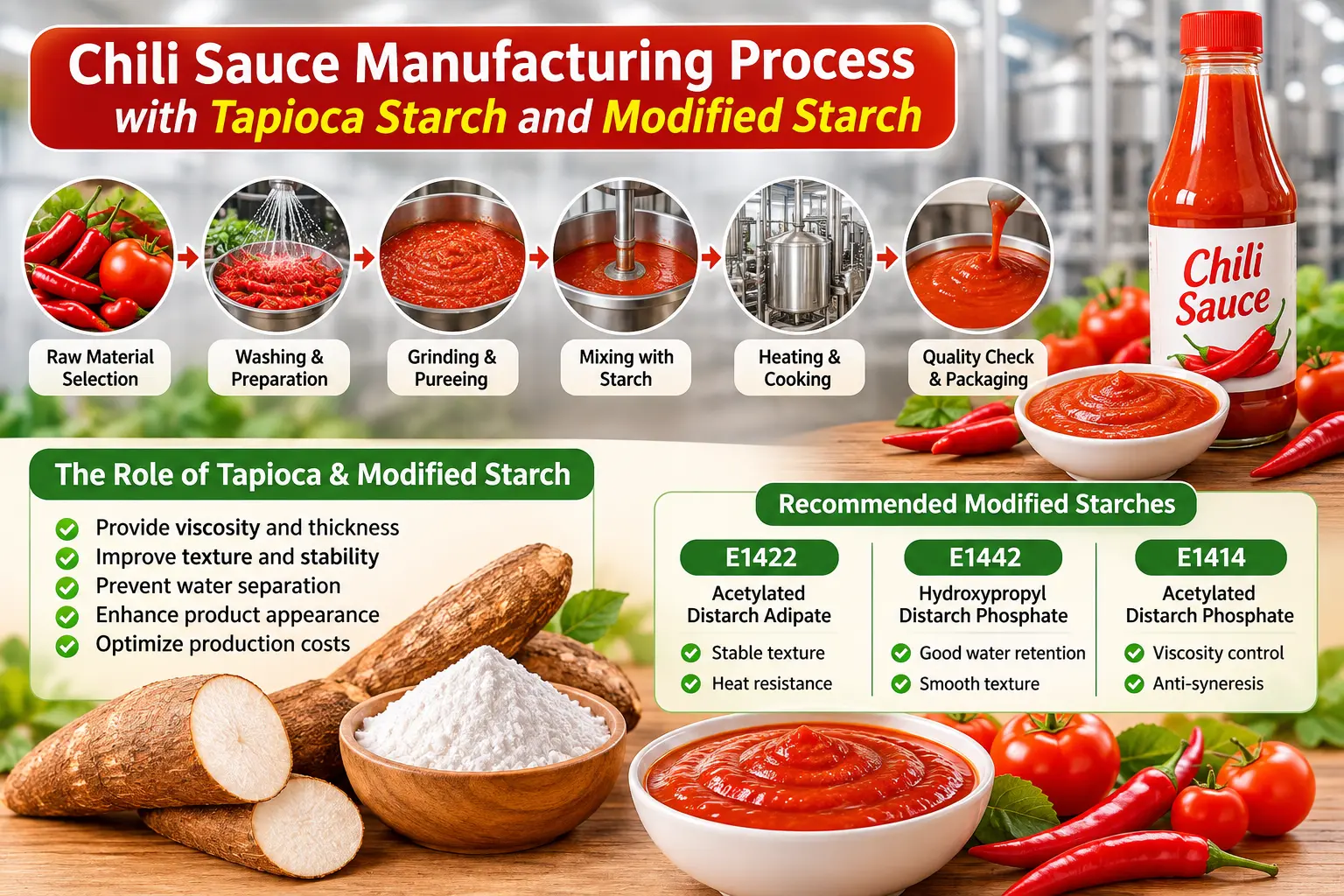
2. Main Ingredients Used in Chili Sauce Production
The common ingredients used in commercial chili sauce manufacturing include:
- Fresh chili peppers: The primary ingredient responsible for spiciness, color and characteristic flavor.
- Tomato paste or tomatoes: Provides color, flavor and body.
- Tapioca starch (cassava starch): Helps increase viscosity and improve texture.
- Modified starch: Improves viscosity stability, water retention and processing performance.
- Sugar: Balances the spicy and acidic flavors.
- Salt: Enhances flavor.
- Vinegar or food-grade acids: Adjusts acidity and pH.
- Garlic, onions and spices: Enhance aroma and flavor.
- Approved preservatives, when necessary: Help maintain product quality and shelf life in accordance with applicable regulations.
The ingredient formulation depends on the desired product characteristics, manufacturing technology and target market.
3. Industrial Chili Sauce Manufacturing Process
The chili sauce manufacturing process may vary depending on the manufacturer’s formulation, equipment and production technology.
The typical production process includes the following stages:
Step 1: Raw Material Selection and Inspection
Fresh chili peppers are carefully selected based on color, maturity, spiciness and overall quality.
Raw materials should meet food safety requirements and be free from spoilage and unwanted contaminants.
Step 2: Washing and Preparation
Fresh chilies are washed using industrial washing equipment to remove dirt, dust and foreign materials.
The stems are removed, and the chilies are sorted before further processing.
Step 3: Grinding and Pureeing
The prepared chilies are ground or pureed to produce a uniform mixture.
Depending on the desired product, manufacturers can adjust the particle size to produce either smooth chili sauce or chili sauce containing visible pepper pieces.
Step 4: Ingredient Mixing
The chili mixture is combined with other ingredients, including tomato paste, sugar, salt, vinegar, garlic and seasonings.
Tapioca starch or modified starch may be added according to the formulation to improve viscosity and product texture.
Step 5: Heating and Cooking
The mixture is transferred to an industrial cooking system equipped with temperature control and mixing functions.
During this stage, the ingredients are blended, the starch undergoes gelatinization, and the sauce develops its characteristic consistency.
Step 6: Homogenization and Texture Adjustment
Depending on the product requirements, the sauce may undergo homogenization to improve smoothness and consistency.
Manufacturers evaluate viscosity, appearance, flavor and other relevant quality parameters.
Step 7: Quality Control and Thermal Processing
The finished sauce is evaluated according to important quality and safety parameters, including:
- pH value.
- Viscosity.
- Color and appearance.
- Flavor and aroma.
- Microbiological quality.
- Storage stability.
Thermal processing conditions must be validated according to the product formulation, pH, packaging materials and food safety requirements.
Step 8: Filling and Packaging
After passing quality inspections, the chili sauce is filled into plastic bottles, glass bottles or other suitable food-grade packaging.
The products are sealed, labeled and marked with manufacturing and expiration dates before being transferred to finished-product storage.
4. Applications of Tapioca Starch and Cassava Starch in Chili Sauce Manufacturing
Tapioca starch and cassava starch are two common names for starch extracted from cassava roots.
Cassava starch is widely used in the food processing industry because of its thickening properties, texture-building capabilities and versatile functional characteristics.
4.1. Increasing Chili Sauce Viscosity
Tapioca starch absorbs water and gelatinizes during heating, increasing the viscosity of the chili sauce mixture.
This helps manufacturers achieve the desired consistency and improves the sauce’s ability to adhere to food surfaces.
4.2. Improving Product Texture
Cassava starch helps create a more uniform texture and reduces the likelihood of producing chili sauce that is excessively thin or inconsistent.
This characteristic is particularly important in large-scale industrial production.
4.3. Optimizing Manufacturing Costs
Appropriate use of cassava starch can help manufacturers optimize their formulations, adjust the amount of thickening ingredients and manage overall production costs.
4.4. Enhancing Appearance and Gloss
Tapioca starch can contribute to a smoother, glossier appearance when used at suitable levels.
Actual performance depends on the starch grade, processing conditions and formulation.
5. Applications of Modified Starch in Chili Sauce Production
Compared with native starch, modified starch undergoes physical, chemical or enzymatic treatments to improve specific functional properties.
In industrial chili sauce production, modified starch can provide several advantages:
- Improved viscosity stability.
- Better water retention.
- Reduced water separation.
- Improved heat-processing stability.
- Better product texture.
- Enhanced storage stability.
- Improved performance in industrial manufacturing systems.
5.1. Modified Starch E1422 – Acetylated Distarch Adipate
E1422 is a modified starch widely used in various food applications.
Key characteristics:
- Good thickening performance.
- Improved stability during heating.
- Helps reduce water separation.
- Suitable for certain products exposed to heating or chilled storage.
Applications include chili sauce, sauces, dressings, dips and processed foods.
5.2. Modified Starch E1442 – Hydroxypropyl Distarch Phosphate
E1442 is designed to improve starch stability under different food processing conditions.
Key characteristics:
- Good water retention.
- Reduced starch retrogradation.
- Improved viscosity stability.
- Better texture maintenance during storage.
Applications include chili sauce, sauces, soups, canned foods and other processed food products.
5.3. Modified Starch E1414 – Acetylated Distarch Phosphate
E1414 is a modified starch used to improve the stability and functional performance of starch-based food systems.
Key characteristics:
- Good thickening properties.
- Improved processing stability.
- Helps reduce water separation.
- Suitable for various semi-solid food applications.
Applications include chili sauce, dipping sauces, gravies and processed foods.
Important note: Modified starch selection must comply with the food additive regulations of the destination market. Different modified starches have different functional characteristics and are not necessarily interchangeable.
6. Comparison Between Native Cassava Starch and Modified Starch in Chili Sauce Production
| Criteria | Native Cassava Starch | Modified Starch |
|---|---|---|
| Thickening properties | Good | Good, depending on grade |
| Water retention | Depends on processing conditions | Can be improved |
| Heat stability | Limited | Often improved, depending on type |
| Resistance to water separation | Formulation-dependent | Often better with suitable grades |
| Storage stability | Formulation-dependent | Can be improved |
| Production cost | Generally lower | Generally higher |
| Applications | Standard chili sauce | Industrial sauces requiring improved stability |
7. How to Choose the Right Starch for Chili Sauce Manufacturing
Selecting the appropriate starch is important for achieving consistent product quality.
Manufacturers should consider the following factors:
- Desired sauce viscosity.
- Heating and processing conditions.
- Product pH.
- Required shelf life.
- Storage and transportation conditions.
- Raw material costs.
- Food additive regulations in the target market.
For standard chili sauce products, native cassava starch may offer an economical solution when its performance meets the required specifications.
For industrial chili sauces requiring improved viscosity and storage stability, manufacturers can evaluate modified starches such as E1422, E1442 and E1414 through formulation trials.
8. Price of Tapioca Starch and Modified Starch for Chili Sauce Production
The prices of tapioca starch and modified starch depend on several factors, including:
- Country of origin.
- Product quality and technical specifications.
- Starch type and E-number.
- Order quantity.
- Packaging specifications.
- Transportation costs.
- International trade and delivery terms.
To obtain an accurate quotation, buyers should provide the required starch type, order volume, technical specifications and delivery destination.
Tapioca starch, cassava starch and modified starch are important functional ingredients in the industrial chili sauce manufacturing industry.
Choosing the right starch helps manufacturers improve viscosity, texture, water retention and product stability.
Modified starches such as E1422, E1442 and E1414 offer additional formulation possibilities for industrial chili sauce manufacturers seeking consistent quality and improved processing performance.
Contact us for professional consultation and quotations for tapioca starch, cassava starch and modified starch for chili sauce manufacturing and other food processing applications.