

APPLICATIONS OF TAPIOCA STARCH IN TOMATO SAUCE PRODUCTION – MANUFACTURING PROCESS AND BENEFITS OF MODIFIED STARCH
1. Introduction to Tomato Sauce Production
Tomato sauce is one of the most widely used condiments in the food processing industry. It is commonly served with pasta, pizza, hamburgers, French fries, fast food, and various packaged food products.
To produce high-quality tomato sauce, manufacturers need to select suitable ingredients and maintain strict control over the manufacturing process.
Besides tomatoes, sugar, salt, vinegar, and seasonings, tapioca starch (cassava starch) is an important ingredient used to improve viscosity, texture, and product stability.
In particular, modified tapioca starch is widely used in industrial tomato sauce production because of its thickening properties, water-binding capacity, and ability to maintain a consistent product structure.
2. Main Ingredients Used in Tomato Sauce Manufacturing
The main ingredients commonly used in tomato sauce production include:
- Fresh tomatoes or tomato paste.
- Native tapioca starch.
- Modified tapioca starch.
- Sugar.
- Salt.
- Vinegar or food-grade acids.
- Onion, garlic, and other seasonings.
- Clean water.
- Permitted acidity regulators and food additives.
Among these ingredients, tapioca starch and modified starch play important roles in controlling viscosity, thickness, and product stability.
3. Industrial Tomato Sauce Manufacturing Process
The industrial tomato sauce production process generally involves the following steps.
Step 1: Raw Material Selection and Preparation
Fresh tomatoes are selected according to quality standards. Damaged tomatoes are removed, and the remaining tomatoes are thoroughly washed to eliminate dirt and impurities.
When tomato paste is used, manufacturers inspect its quality and prepare it according to the production formula.
Step 2: Tomato Crushing and Processing
The tomatoes are crushed or blended into a puree and then processed to remove skins, seeds, and unwanted materials.
This step produces a uniform tomato base for subsequent processing.
Step 3: Ingredient Mixing
The tomato puree is transferred into a mixing tank and blended with sugar, salt, vinegar, seasonings, and other ingredients.
Native tapioca starch or modified tapioca starch is added according to the formulation to adjust the thickness and texture of the sauce.
Step 4: Heating and Starch Gelatinization
The mixture is heated under suitable processing conditions to allow starch granules to absorb water, swell, and gelatinize.
This process develops the required viscosity, improves water retention, and creates a consistent sauce texture.
Step 5: Homogenization and Texture Adjustment
The mixture undergoes homogenization to distribute ingredients evenly, improve smoothness, and reduce phase separation.
Manufacturers can adjust viscosity, acidity, and other product specifications according to the requirements of different tomato sauce formulations.
Step 6: Pasteurization or Sterilization
The tomato sauce undergoes a validated thermal processing treatment to control microorganisms, ensure food safety, and extend shelf life.
Step 7: Filling and Packaging
The finished sauce is filled into bottles, jars, pouches, or other suitable food packaging under appropriate hygienic conditions.
The packaged products undergo quality inspections before distribution to the market.
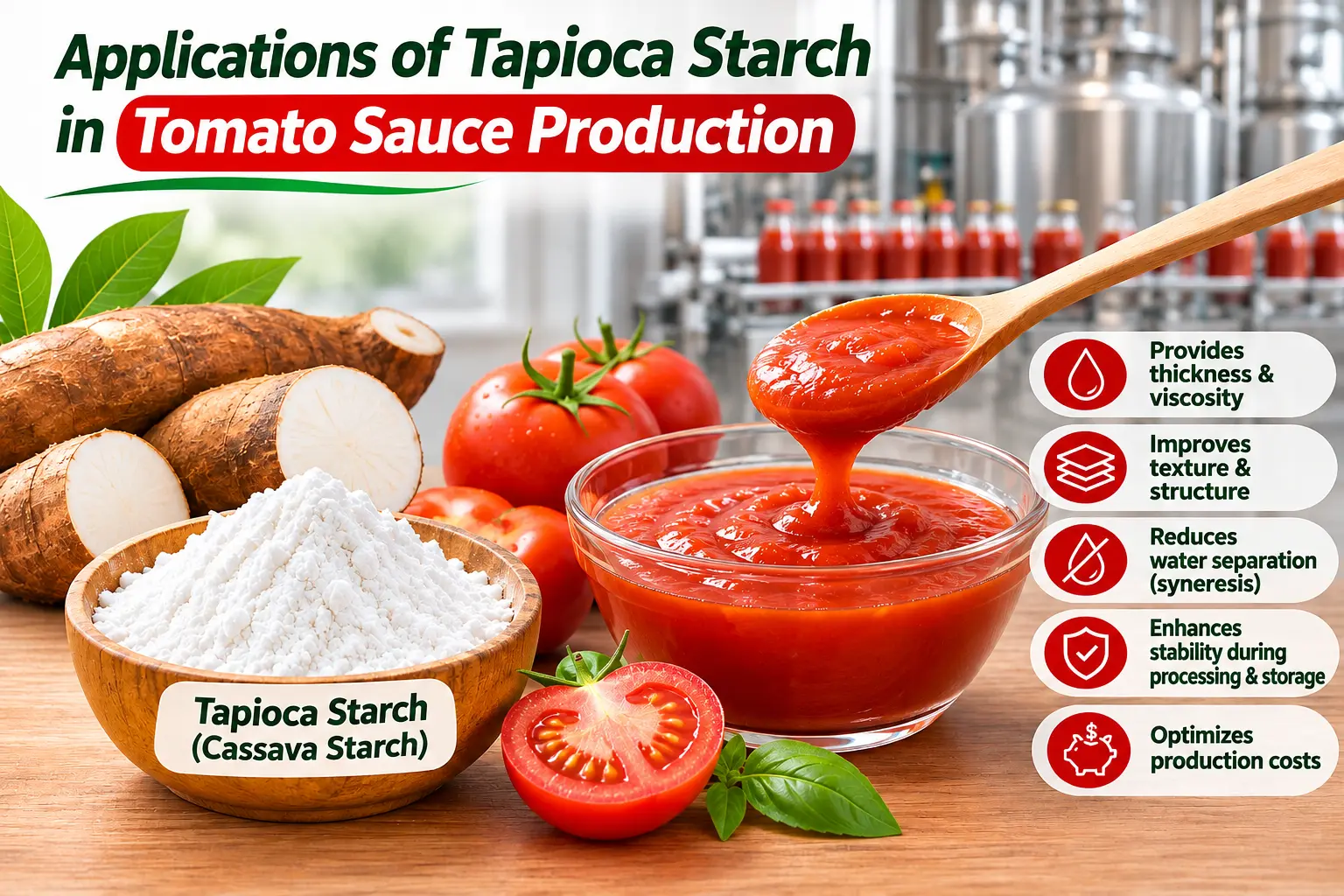
4. Applications of Tapioca Starch in Tomato Sauce Production
Tapioca starch is extracted from cassava roots and is widely used in the food processing industry because of its excellent thickening and texturizing properties.
4.1. Thickening and Viscosity Development
One of the most important functions of tapioca starch in tomato sauce production is viscosity development.
When heated in water, starch granules absorb moisture, swell, and gelatinize, helping the sauce achieve the desired thickness.
This produces a smooth and thick consistency that allows tomato sauce to adhere effectively to different food surfaces.
4.2. Improving Texture and Product Quality
Tapioca starch helps create a uniform texture and improves the overall sensory properties of tomato sauce.
It helps prevent the sauce from becoming excessively thin and contributes to a smooth, consistent mouthfeel.
These properties are particularly important for tomato sauces supplied to restaurants, fast-food chains, and packaged food manufacturers.
4.3. Reducing Water Separation
Water separation can occur during storage when the sauce formulation does not have sufficient structural stability.
Selecting the appropriate starch, particularly modified tapioca starch, can improve water retention and help maintain a homogeneous sauce structure.
4.4. Improving Processing Stability
Certain types of modified starch provide better viscosity stability than native starch under heating, mixing, and acidic processing conditions.
This helps manufacturers maintain consistent product quality throughout industrial production.
4.5. Optimizing Manufacturing Costs
Cassava is an important agricultural raw material in Vietnam and many Southeast Asian countries.
Using suitable tapioca starch in tomato sauce formulations can help manufacturers optimize ingredient costs while maintaining the desired product characteristics.
5. Native Tapioca Starch vs. Modified Tapioca Starch in Tomato Sauce
Depending on the formulation and product specifications, manufacturers can choose between native tapioca starch and modified tapioca starch.
Native Tapioca Starch:
- Provides good thickening properties.
- Suitable for certain basic tomato sauce formulations.
- Extracted from natural cassava roots.
- Its stability depends on heating conditions, mixing, and the product environment.
Modified Tapioca Starch:
- Can provide improved heat resistance.
- Offers better stability in acidic conditions.
- Helps reduce water separation.
- Can maintain viscosity and texture more effectively under certain processing conditions.
- Suitable for industrial tomato sauce manufacturing.
Some modified starch types that may be evaluated for tomato sauce applications include:
- E1422: Acetylated Distarch Adipate.
- E1442: Hydroxypropyl Distarch Phosphate.
- E1414: Acetylated Distarch Phosphate.
- E1420: Acetylated Starch.
The appropriate starch type should be selected based on the product formulation, processing conditions, applicable food additive regulations, and actual product testing.
6. How to Choose Tapioca Starch for Tomato Sauce Manufacturers
To ensure consistent product quality, food manufacturers should consider the following criteria when selecting tapioca starch suppliers:
- Starch whiteness and purity.
- Moisture content and starch content.
- Viscosity development.
- Heat and acid stability.
- Storage stability.
- Quality and food safety certifications.
- Reliable supply capacity and competitive pricing.
Manufacturers are also encouraged to conduct product trials using actual formulations before selecting ingredients for large-scale production.
Tapioca starch and modified tapioca starch are valuable ingredients in industrial tomato sauce manufacturing.
Selecting the appropriate starch helps improve viscosity, texture, water retention, and product stability. In particular, suitable modified starch products can better meet the technical requirements of modern food processing lines.
With its abundant cassava resources, Vietnam has significant potential to develop high-quality tapioca starch production and supply products to food manufacturers in both domestic and international markets.
Contact a Tapioca Starch Supplier
We aim to supply native tapioca starch and modified tapioca starch for various food processing applications, including tomato sauce, ketchup, chili sauce, instant noodles, sausages, and other processed food products.
Contact us for product consultation, samples, and competitive quotations based on your manufacturing requirements.