

MODIFIED STARCH MANUFACTURER AND SUPPLIER – HIGH-QUALITY MODIFIED STARCH FOR FOOD AND INDUSTRIAL APPLICATIONS
1. Introduction to Modified Starch Manufacturers and Suppliers
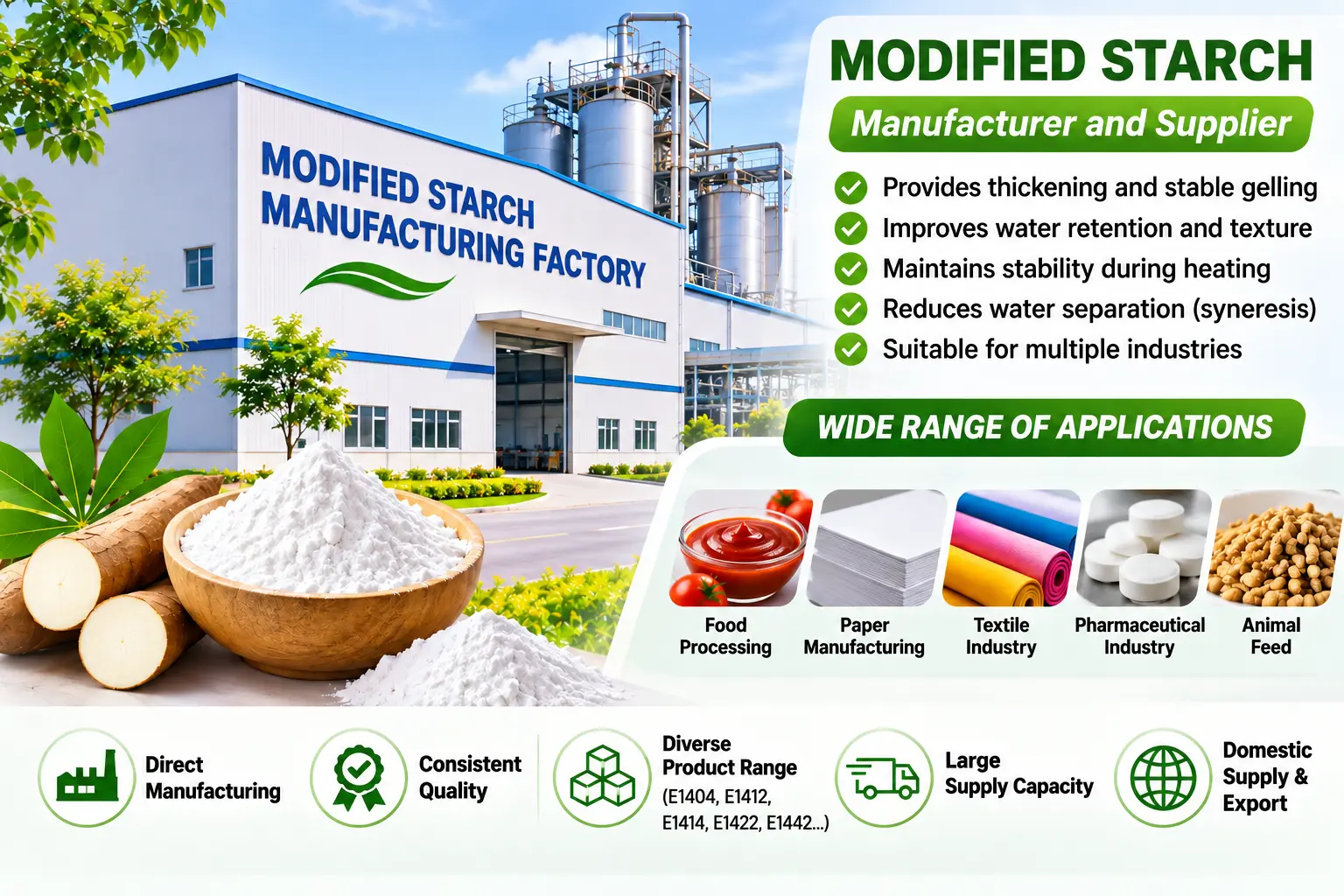
Modified starch is an important raw material widely used in the food processing, paper manufacturing, textile, pharmaceutical, animal feed, and other industrial sectors.
As global demand for high-quality starch ingredients continues to grow, finding a reliable modified starch manufacturer and supplier is essential for food processing companies and industrial manufacturers.
A professional modified starch factory focuses on producing, processing, and supplying different types of modified starch to meet specific industrial requirements.
Modified starch can be manufactured from various natural starch sources, including cassava starch (tapioca starch), corn starch, potato starch, and other plant-based starch materials.
Through physical, chemical, or enzymatic modification, natural starch can be developed with improved functional properties, including thickening, binding, water retention, texture stabilization, and processing performance.
2. What Is Modified Starch?
Modified starch is natural starch that has been physically, chemically, or enzymatically treated to improve or change its original functional properties.
Compared with native starch, modified starch can provide several advantages:
- Improved thickening and viscosity control.
- Better texture and structural stability.
- Enhanced water-binding capacity.
- Reduced syneresis in suitable applications.
- Improved heat-processing stability.
- Better freeze-thaw stability for selected products.
- More consistent performance in industrial manufacturing.
Different modification methods produce different starch properties, allowing manufacturers to develop products for specific food and industrial applications.
3. Types of Modified Starch Supplied by Manufacturers
A professional modified starch manufacturer may offer various product grades to serve different industries.
E1404 – Oxidized Starch
Oxidized starch is used in food and industrial applications. It can provide film-forming properties, viscosity control, and functional improvements depending on the formulation.
E1412 – Distarch Phosphate
E1412 is a cross-linked modified starch commonly used in food products requiring improved stability during heating, mixing, and processing.
Typical applications include sauces, soups, canned foods, and processed food products.
E1414 – Acetylated Distarch Phosphate
E1414 is an acetylated and cross-linked starch designed to improve functional stability, water retention, and food texture.
It is commonly used in sauces, frozen foods, processed meat products, and other food applications requiring stable texture.
E1420 – Acetylated Starch
E1420 is an acetylated starch that can help improve texture stability and reduce starch retrogradation in suitable food applications.
E1422 – Acetylated Distarch Adipate
E1422 is widely used in food manufacturing because of its ability to improve viscosity stability, water retention, and product texture.
E1442 – Hydroxypropyl Distarch Phosphate
E1442 is a modified starch commonly used in food products requiring stability during heating, cooling, and storage.
E1450 – Starch Sodium Octenyl Succinate
E1450 is used in selected food applications and emulsification systems, particularly where stabilization of flavor ingredients and oil-containing components is required.
In addition to these products, modified starch factories may develop other starch grades according to customer specifications and industrial requirements.
4. Industrial Applications of Modified Starch
4.1. Food Processing Industry
The food industry is one of the largest users of modified starch.
Modified starch is widely applied in:
- Chili sauce and tomato ketchup production.
- Sausage and processed meat manufacturing.
- Instant noodles, rice noodles, and other noodle products.
- Tapioca pearls and starch-based products.
- Dairy products and ice cream.
- Canned foods and frozen food products.
- Soups, dressings, and ready-to-eat meals.
Modified starch helps improve viscosity, texture, water retention, and product stability.
4.2. Paper Manufacturing Industry
Modified starch is used as a binder, surface sizing agent, and functional additive in paper production.
Its benefits may include:
- Improving paper surface strength.
- Enhancing fiber bonding.
- Improving printability.
- Supporting finished paper quality.
4.3. Textile Industry
Modified starch is used in textile sizing and fabric processing.
It helps form protective films around yarns, improves weaving performance, and supports more efficient textile manufacturing.
4.4. Pharmaceutical Industry
Certain modified starch grades are used as pharmaceutical excipients in tablet manufacturing and other suitable dosage forms.
Depending on their specifications, they may function as disintegrants, binders, or excipients supporting drug formulation performance.
4.5. Animal Feed Industry
Modified starch can be incorporated into selected animal feed formulations to support binding, pellet formation, and product processing characteristics.
5. How to Choose a Reliable Modified Starch Manufacturer
Selecting the right modified starch supplier is important for maintaining product quality and production efficiency.
Businesses should consider the following factors:
Stable Raw Material Supply: A reliable manufacturer should have consistent access to high-quality raw materials.
Modern Manufacturing Technology: Production systems and quality controls should meet the technical requirements of different modified starch grades.
Product Quality: Products should have clear technical specifications, consistent batch quality, and appropriate quality documentation.
Wide Product Range: A diverse portfolio allows customers to select suitable starch grades for different applications.
Production and Supply Capacity: The supplier should be able to meet bulk orders, delivery schedules, and packaging requirements.
Competitive Pricing: Transparent pricing and flexible supply arrangements help customers optimize procurement costs.
6. Modified Starch Price and Wholesale Quotation
Modified starch prices vary depending on several factors:
- Modified starch grade, such as E1404, E1412, E1414, E1422, and E1442.
- Raw material source.
- Product specifications and quality standards.
- Order quantity.
- Packaging requirements.
- Delivery destination and transportation costs.
For food manufacturers and industrial buyers purchasing in bulk, working directly with a manufacturer can help optimize procurement costs and establish a stable long-term supply.
To receive an accurate quotation, customers should provide the required starch grade, intended application, order quantity, and delivery location.
7. Modified Starch Manufacturer in Vietnam – Domestic and International Supply
Vietnam has a strong agricultural foundation and a significant cassava production industry, creating opportunities for the development of value-added cassava starch products.
Vietnamese modified starch manufacturers and suppliers can serve various industries, including food processing, paper manufacturing, textiles, pharmaceuticals, and animal feed.
International buyers looking for a modified starch supplier in Vietnam should evaluate product quality, manufacturing capabilities, supply capacity, technical support, and export experience.
Choosing the right manufacturing partner can help businesses maintain stable raw material supplies and improve production efficiency.
8. Contact a Modified Starch Manufacturer and Supplier
Are you looking for a reliable modified starch manufacturer or wholesale supplier for your food processing or industrial production?
Contact us to learn more about our modified starch product range and supply solutions.
We can provide information about:
- Modified starch product specifications.
- Technical data and product samples.
- Wholesale quotations.
- Packaging options.
- Domestic and international supply arrangements.
Contact us today to find the right modified starch products for your manufacturing requirements.