

TAPIOCA STARCH MANUFACTURING PLANT – PRODUCTION PROCESS, QUALITY STANDARDS AND SUPPLY
1. Introduction to Tapioca Starch Manufacturing Plants
Tapioca starch, also known as cassava starch, is an important agricultural-based raw material widely used in the food processing industry and various industrial applications.
Extracted from fresh cassava roots, tapioca starch is valued for its natural white appearance, high starch content, thickening properties, binding ability, and excellent gel-forming characteristics.
A modern tapioca starch manufacturing plant plays an essential role in supplying raw materials to food manufacturers, animal feed producers, paper mills, textile factories, and other industrial sectors.
With increasing demand from international markets, including China, South Korea, Japan, Taiwan, Southeast Asia, and Europe, the tapioca starch industry continues to develop through technological improvements and more efficient manufacturing systems.
Modern production facilities focus on optimizing starch extraction, improving product quality, reducing production losses, and meeting international customer requirements.
2. Raw Materials for Tapioca Starch Production
Fresh cassava roots are the primary raw material used in tapioca starch manufacturing.
Cassava is an important tropical crop containing a high percentage of natural starch, making it suitable for industrial starch extraction.
Several factors affect the quality of cassava raw materials:
- Cassava varieties with high starch content.
- Fresh and healthy cassava roots.
- Low levels of soil, sand, and foreign materials.
- Proper harvesting and transportation.
- Stable raw material quality throughout the production season.
The quality of fresh cassava directly affects starch extraction efficiency, final product color, purity, and overall manufacturing performance.
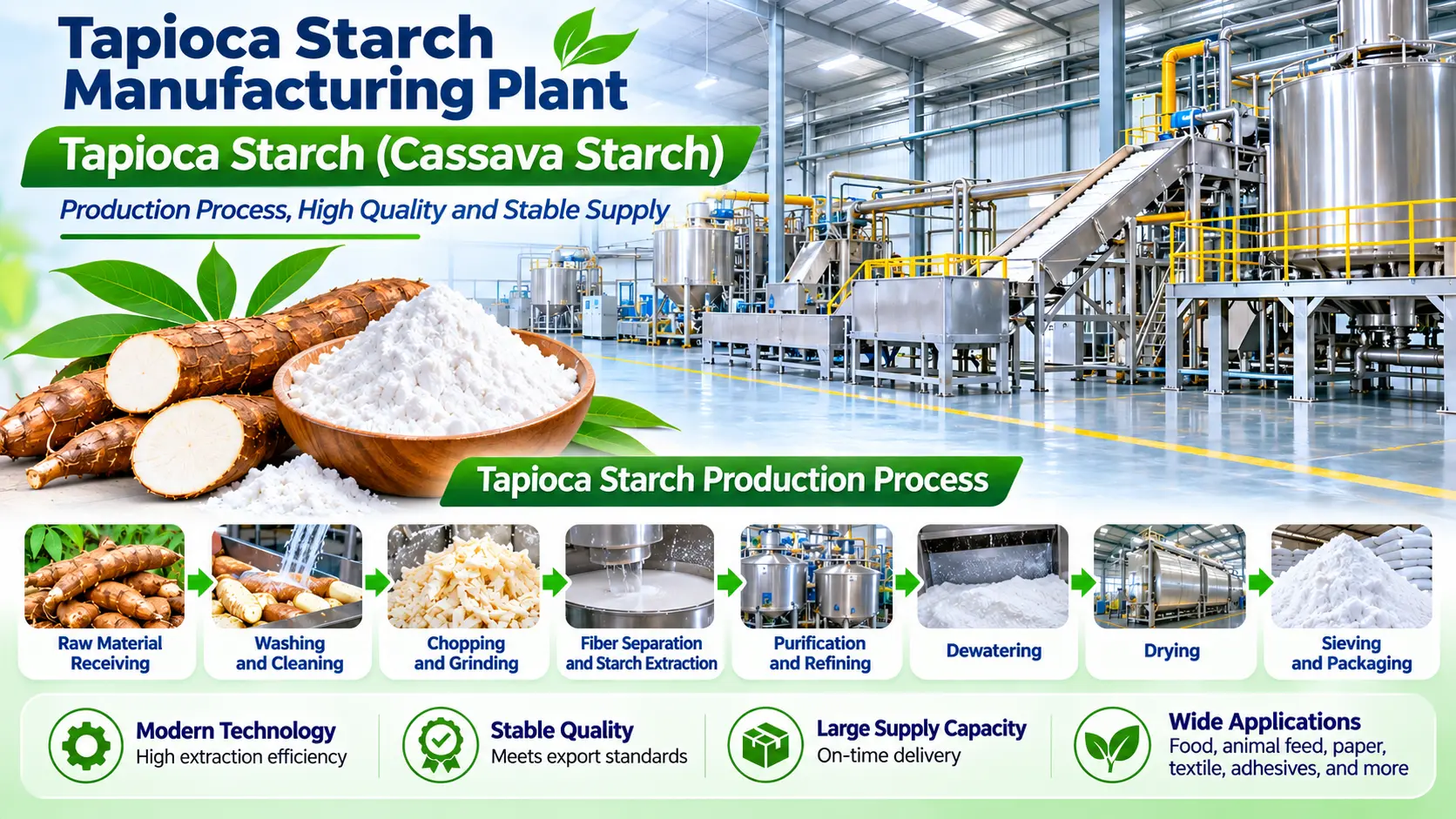
3. Tapioca Starch Manufacturing Process
A modern cassava starch factory generally operates an integrated production line designed to maximize starch recovery and maintain consistent product quality.
Step 1: Raw Material Receiving and Inspection
Fresh cassava roots are transported to the manufacturing plant after harvesting.
At the receiving area, cassava is weighed and inspected for freshness, foreign materials, and starch content.
Step 2: Cassava Washing and Cleaning
The fresh cassava roots pass through industrial washing systems to remove soil, sand, roots, and other surface impurities.
This process ensures that the raw materials are sufficiently clean before entering the grinding stage.
Step 3: Cassava Chopping and Grinding
After washing, cassava roots are chopped into smaller pieces and processed through specialized grinding equipment.
The grinding process breaks down the cassava cell structure and releases starch granules from the root tissues.
Step 4: Fiber Separation and Starch Extraction
The ground cassava mixture passes through screening and fiber separation systems.
The released starch is transferred into the water phase and separated from fibrous materials and other insoluble components.
Step 5: Starch Purification
Centrifugal separators and purification equipment are used to remove remaining impurities and improve starch purity.
This is an important stage in determining the final product’s whiteness, cleanliness, and quality.
Step 6: Starch Dewatering
The purified starch slurry is transferred to dewatering equipment to reduce moisture content before drying.
Step 7: Starch Drying
Wet starch is processed through an industrial drying system, commonly using flash drying technology.
The drying process must be carefully controlled to achieve the required moisture level while maintaining the functional properties of the starch.
Step 8: Sieving and Packaging
After drying, tapioca starch passes through a sieving system to ensure consistent particle size.
The finished product is then transferred to automatic weighing and packaging equipment.
Common packaging options include:
- 25 kg bags.
- 50 kg bags.
- Jumbo bags.
- Customized packaging according to customer requirements.
4. Machinery and Equipment in a Tapioca Starch Factory
An industrial tapioca starch production line generally includes the following equipment:
- Cassava receiving and feeding systems.
- Industrial cassava washing machines.
- Cassava chopping machines.
- Cassava grinding equipment.
- Fiber screening and separation systems.
- Starch extraction equipment.
- Centrifugal purification systems.
- Starch dewatering machines.
- Industrial starch drying systems.
- Finished product sieving machines.
- Automatic weighing and packaging systems.
- Wastewater treatment and by-product recovery systems.
Selecting suitable industrial equipment helps manufacturers improve starch extraction efficiency, reduce production costs, and maintain consistent product quality.
5. Tapioca Starch Quality Standards
Tapioca starch quality is evaluated based on several physical, chemical, and functional properties.
Important quality parameters include:
| Parameter | Typical Requirement |
|---|---|
| Appearance | Natural white powder |
| Moisture | Commonly ≤ 13% |
| Starch content | High, depending on testing method |
| Ash content | Controlled according to specifications |
| pH | According to customer requirements |
| Viscosity | Depending on application and testing method |
| Particle size | Uniform |
| Foreign matter | Low |
The above specifications are general references. Actual requirements depend on product grade, testing methods, and customer specifications.
Manufacturers supplying international markets may implement food safety and quality management systems such as HACCP, ISO 22000, or FSSC 22000, depending on their certification scope.
6. Applications of Tapioca Starch in Different Industries
Tapioca starch is a versatile ingredient used in various manufacturing processes because of its functional properties.
6.1. Food Processing Industry
Tapioca starch is widely used in the production of:
- Rice noodles and vermicelli.
- Instant noodles.
- Tapioca pearls and bubble tea ingredients.
- Sausages and processed meat products.
- Chili sauce and tomato sauce.
- Bakery products.
- Confectionery.
- Frozen food products.
- Canned food.
In food manufacturing, tapioca starch functions as a thickener, stabilizer, binder, and texture enhancer.
6.2. Animal Feed Industry
Tapioca starch is used as a carbohydrate source in animal feed formulations.
It can also function as a binding agent during the production of pelletized animal feed.
6.3. Paper Manufacturing Industry
In paper manufacturing, tapioca starch is used as a binding agent and surface-strengthening material.
It helps improve paper properties, surface quality, and production performance.
6.4. Textile Industry
Tapioca starch can be used in textile sizing applications.
It helps improve yarn strength and reduce yarn breakage during weaving operations.
6.5. Adhesive Manufacturing Industry
Due to its binding and paste-forming properties, tapioca starch is an important raw material in the production of paper adhesives, carton adhesives, and other industrial bonding products.
7. Difference Between Native Tapioca Starch and Modified Tapioca Starch
Native tapioca starch and modified tapioca starch are both derived from cassava roots. However, they have different functional characteristics and industrial applications.
Native Tapioca Starch
- Extracted directly from cassava roots.
- Has a natural white appearance.
- Provides thickening and gel-forming properties.
- Used in food processing and various industrial applications.
Modified Tapioca Starch
- Produced through appropriate physical, enzymatic, or chemical modification processes.
- Can provide improved heat, acid, and shear stability.
- Can improve product performance during processing and storage.
- Designed for applications requiring specific functional properties.
Common modified starch types include:
- E1404 – Oxidized Starch.
- E1412 – Distarch Phosphate.
- E1414 – Acetylated Distarch Phosphate.
- E1420 – Acetylated Starch.
- E1422 – Acetylated Distarch Adipate.
- E1442 – Hydroxypropyl Distarch Phosphate.
- E1450 – Starch Sodium Octenyl Succinate.
- E1451 – Acetylated Oxidized Starch.
These modified starches are widely used in food processing, sauces, frozen foods, bakery products, and other industrial applications, subject to applicable regulations.
8. Advantages of a Modern Tapioca Starch Manufacturing Plant
A professional tapioca starch factory should focus on several important operational factors.
Advanced Manufacturing Technology
Modern production lines improve extraction efficiency, purification performance, and product consistency.
Stable Raw Material Supply
A reliable cassava supply helps maintain continuous production and consistent product quality.
Quality Control Systems
Raw materials, intermediate products, and finished starch are inspected through established quality control procedures.
Production Capacity
A well-equipped factory can support large-volume orders and maintain reliable delivery schedules.
Export Capabilities
Manufacturers supplying international markets should be able to provide appropriate product specifications, quality documents, traceability information, packaging, and export documentation.
9. Tapioca Starch Price and Supply
The market price of tapioca starch depends on several factors:
- Country of origin.
- Starch content and moisture level.
- Product whiteness and quality grade.
- Order quantity.
- Packaging specifications.
- Market conditions.
- Domestic or international delivery terms.
For an accurate quotation, buyers should provide their required specifications, order quantity, packaging preferences, and delivery destination.
Manufacturers and suppliers can then recommend suitable product grades and provide quotations based on actual purchasing requirements.
Tapioca starch manufacturing plants play an important role in supplying raw materials to the global food processing industry and various industrial sectors.
With abundant cassava resources, improving manufacturing technology, and growing international demand, tapioca starch remains an important agricultural processing product with significant development potential.
Choosing a reliable tapioca starch manufacturer with modern production facilities, effective quality management, and stable supply capacity helps businesses secure high-quality raw materials for their long-term manufacturing operations.
CONTACT US FOR TAPIOCA STARCH SUPPLY AND QUOTATIONS
We are ready to support businesses looking for reliable sources of tapioca starch, cassava starch, and modified tapioca starch for food processing and industrial applications.
Contact us for product information, technical specifications, samples, and competitive quotations based on your order quantity.