
FROZEN FOOD MANUFACTURING PROCESS AND APPLICATIONS OF TAPIOCA STARCH (CASSAVA STARCH)
1. Overview of the Frozen Food Manufacturing Industry
Frozen food is one of the fastest-growing sectors in the global food processing industry. With modern freezing technologies, products such as frozen fish balls, beef balls, shrimp, sausages, spring rolls, dumplings, French fries, and ready-to-cook meals can be stored for extended periods while maintaining their quality and nutritional value.
In frozen food manufacturing, selecting suitable raw materials and food ingredients is essential to achieving consistent product quality. Among these ingredients, tapioca starch, also known as cassava starch, plays an important role due to its binding properties, water retention capacity, texture improvement, and thickening functionality.
In addition to native tapioca starch, modified tapioca starch is widely used by food manufacturers to improve product stability during freezing, frozen storage, and thawing.
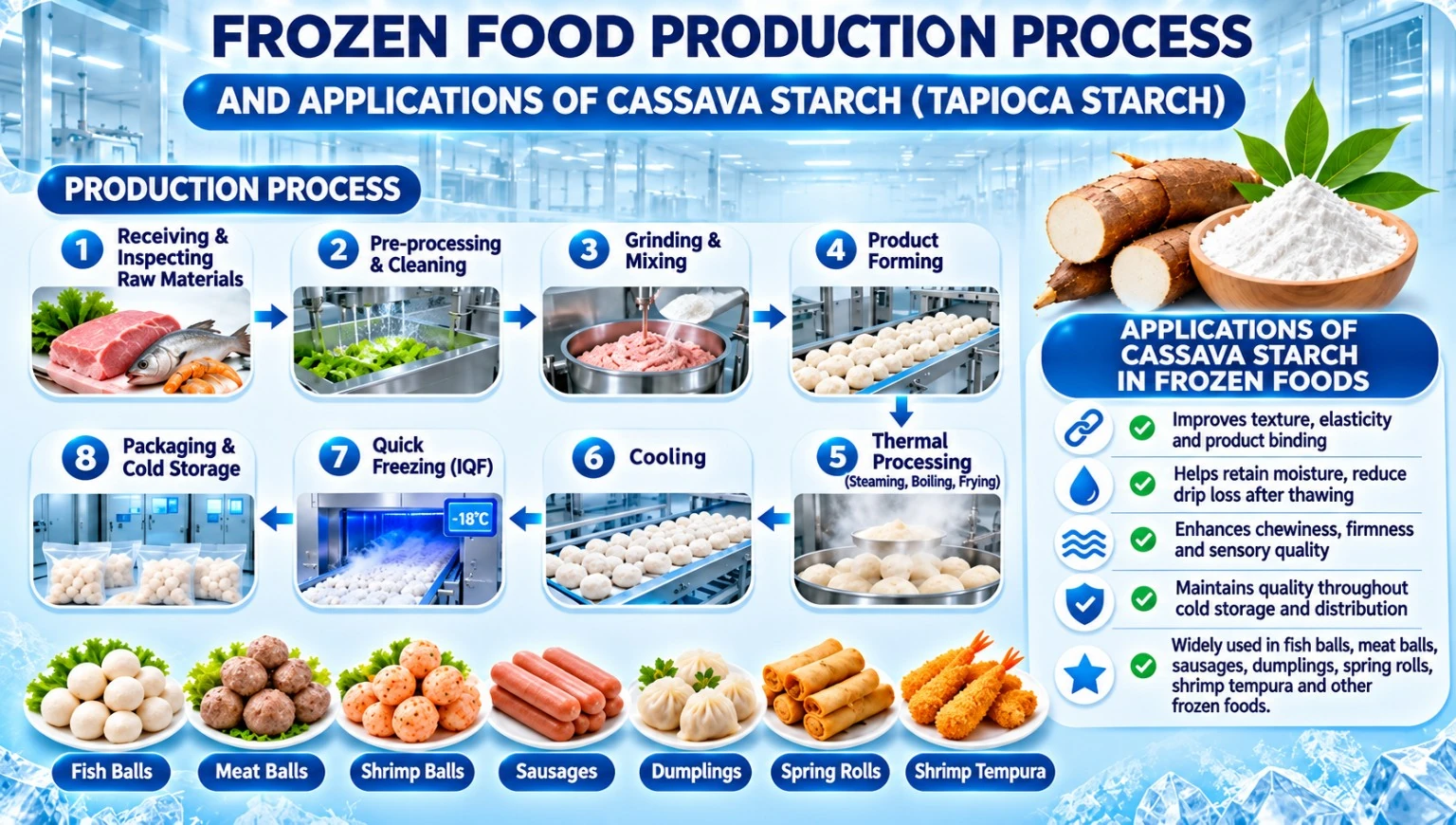
2. Frozen Food Manufacturing Process
The manufacturing process varies depending on the product category, including frozen seafood, meat products, breaded foods, and ready-to-eat meals. However, a typical industrial frozen food manufacturing process includes the following stages.
Step 1: Raw Material Receiving and Inspection
The main raw materials may include:
- Pork, beef, and chicken.
- Fish, shrimp, squid, and other seafood.
- Vegetables and fruits.
- Wheat flour, tapioca starch, and modified starch.
- Seasonings, vegetable oils, and permitted food additives.
All incoming materials should be inspected for origin, freshness, quality, temperature, and food safety compliance before entering the production line.
Step 2: Raw Material Preparation and Cleaning
Raw materials are sorted, cleaned, and prepared according to the requirements of each product.
For meat and seafood products, this stage may involve deboning, skin removal, peeling, cleaning, and cutting.
For vegetables, the preparation process may include washing, peeling, cutting, and blanching, depending on the product formulation.
Step 3: Grinding, Mixing, and Formulation
This is one of the most important stages in frozen food manufacturing because it directly affects the final product’s texture and quality.
Meat, fish, or seafood ingredients are ground to the required particle size and mixed with other ingredients according to the production formula.
Common ingredients include:
- Native tapioca starch.
- Modified cassava starch.
- Wheat flour.
- Plant proteins.
- Seasonings and flavoring ingredients.
- Water or ice flakes.
Tapioca starch helps improve ingredient binding, create a more uniform texture, and support water retention in processed food products.
Step 4: Product Forming
After mixing, the formulation is transferred to forming equipment to create products with specific shapes and sizes.
Common frozen food products include:
- Fish balls, beef balls, and shrimp balls.
- Fish cakes and squid cakes.
- Sausages and meatballs.
- Dumplings, steamed buns, and pastries.
- Spring rolls and breaded food products.
Tapioca starch and modified starch contribute to product binding and help maintain shape and structural integrity during processing.
Step 5: Cooking, Steaming, Boiling, or Heat Treatment
Depending on the product type, manufacturers may apply steaming, boiling, pre-frying, or other heat treatment methods.
For fish balls and beef balls, heat treatment helps proteins coagulate and develop the desired product structure.
For spring rolls, French fries, and breaded products, preliminary frying may be performed before freezing.
Selecting the appropriate starch helps manufacturers control softness, elasticity, and product structure after heat treatment.
Step 6: Product Cooling
After heat treatment, products are cooled under controlled temperature and hygienic conditions.
This stage helps limit microbial growth and prepares the products for the freezing process.
Step 7: Quick Freezing
Freezing is a critical stage in frozen food production.
Products are transferred to industrial freezing systems, such as:
- IQF (Individual Quick Freezing).
- Air blast freezing.
- Conveyor belt freezing.
- Contact freezing.
Rapid freezing helps reduce the formation of large ice crystals, contributing to better product texture and quality.
Step 8: Packaging and Frozen Storage
After freezing, products are packed using suitable moisture-resistant packaging materials to protect product quality.
Frozen foods are stored in cold storage facilities at temperatures appropriate for each product, commonly at -18°C or below according to technical and regulatory requirements.
Maintaining an uninterrupted cold chain is essential to minimizing temperature fluctuations and preserving product quality.
3. Applications of Tapioca Starch (Cassava Starch) in Frozen Food Manufacturing
Tapioca starch, also known as cassava starch, is extracted from cassava roots. Due to its thickening, binding, water absorption, and texture-forming properties, it is widely used in frozen food manufacturing.
3.1. Improving Binding Properties
In the production of fish balls, beef balls, shrimp balls, fish cakes, and processed meat products, tapioca starch helps bind different ingredients together.
It contributes to a more uniform formulation and helps reduce crumbling or structural breakdown during forming and processing.
3.2. Enhancing Elasticity and Chewiness
Tapioca starch has excellent paste-forming properties, relatively high clarity, and good viscosity characteristics.
When used at suitable levels in combination with meat or seafood proteins, tapioca starch can help improve chewiness, elasticity, and mouthfeel.
These characteristics are particularly important in products such as:
- Frozen fish balls.
- Frozen beef balls.
- Shrimp balls.
- Fish cakes.
- Sausages.
- Surimi-based products.
3.3. Improving Water Retention
One of the main challenges in frozen food manufacturing is minimizing moisture loss during frozen storage and thawing.
When gelatinized, tapioca starch can absorb and retain water, helping manufacturers:
- Improve product moisture content.
- Reduce liquid loss during storage.
- Maintain softness and juiciness.
- Improve product texture after thawing and cooking.
Actual performance depends on starch type, formulation, heat treatment, and freezing conditions.
3.4. Applications in Breaded and Frozen Fried Foods
Cassava starch is also used in coating and batter formulations for products such as:
- Frozen fried chicken.
- Breaded shrimp.
- Breaded fish fillets.
- French fries.
- Frozen spring rolls.
- Ready-to-fry food products.
Tapioca starch helps adjust coating adhesion, crispiness, and texture. Depending on the formulation, it can be combined with wheat flour, corn starch, or modified starch.
3.5. Reducing Syneresis After Thawing
Syneresis, or water separation, is a common challenge in frozen food manufacturing.
This phenomenon can cause products to become dry, lose their desirable texture, and experience reduced sensory quality.
Certain modified starches offer improved freeze-thaw stability compared with native starch. They help retain moisture and maintain product structure during frozen storage and thawing.
4. Applications of Modified Tapioca Starch in Frozen Food Products
In addition to native cassava starch, modified tapioca starch is an important functional ingredient in frozen food processing.
Modified starches are produced through physical, chemical, or enzymatic treatments to improve specific functional properties for industrial food applications.
Some commonly used modified starch types include:
E1412 – Distarch Phosphate
E1412 is a cross-linked phosphate starch designed to improve starch stability during heating and under certain processing conditions.
Applications:
- Fish balls and beef balls.
- Frozen food fillings.
- Processed ready-to-cook foods.
- Products requiring improved structural stability after heating.
E1414 – Acetylated Distarch Phosphate
E1414 is a cross-linked and acetylated starch used to improve functional stability and product texture.
Applications:
- Frozen sauces and fillings.
- Processed seafood products.
- Breaded food products.
- Products requiring controlled viscosity and stability.
E1422 – Acetylated Distarch Adipate
E1422 is a widely used modified starch in the food industry due to its ability to improve the stability of starch-based systems.
Applications:
- Frozen food products.
- Dumpling and steamed bun fillings.
- Processed meat and seafood.
- Frozen sauces and food fillings.
E1442 – Hydroxypropyl Distarch Phosphate
E1442 is used to help maintain viscosity, texture, and water retention in certain food systems subjected to freezing and thawing.
Applications:
- Frozen bakery fillings.
- Frozen sauces.
- Processed meat products.
- Foods requiring improved structural stability.
Note: The selection and use of modified starch must comply with food additive regulations in the destination market and the specific technical requirements of each product.
5. Benefits of Using Tapioca Starch in Frozen Food Manufacturing
Using native tapioca starch and modified cassava starch offers several advantages for frozen food manufacturers:
- Improved texture: Supports binding, chewiness, and elasticity.
- Enhanced water retention: Helps minimize moisture loss during frozen storage and thawing.
- Better product stability: Supports structural integrity during food processing.
- Improved sensory properties: Contributes to desirable softness, juiciness, and mouthfeel.
- Formulation optimization: Can be combined with proteins, flour, and other starches to achieve specific product characteristics.
- Reliable raw material options: Tapioca starch is sourced from various countries, with Vietnam being a notable producer and exporter.
6. How to Choose a Reliable Tapioca Starch Supplier for Frozen Food Manufacturing
Choosing a reliable tapioca starch supplier is essential for frozen food manufacturers seeking consistent product quality and stable production operations.
Important factors to consider include:
- Product quality: Moisture content, whiteness, viscosity, purity, and microbiological specifications.
- Raw material origin: Clear information about sourcing and manufacturing processes.
- Quality documentation: COA, TDS, MSDS, and relevant certifications.
- Supply capacity: Ability to provide stable supply volumes for industrial production.
- Technical support: Expertise in recommending suitable starch grades for different frozen food applications.
- Competitive pricing: A balance between cost efficiency and consistent quality.
Tapioca starch, cassava starch, and modified tapioca starch play important roles in frozen food manufacturing. Their binding, thickening, water retention, and texture-enhancing properties make them valuable ingredients in the production of fish balls, beef balls, fish cakes, sausages, breaded foods, dumplings, steamed buns, and many other processed frozen food products.
Selecting the appropriate starch type, formulation, and processing conditions helps manufacturers improve product quality, optimize production costs, and meet the growing demands of the frozen food market.
Are you looking for a reliable supplier of tapioca starch, cassava starch, or modified tapioca starch for frozen food manufacturing? Choose a professional supplier that can provide suitable starch solutions based on your production requirements and technical specifications.