

SAUSAGE MANUFACTURING PROCESS AND APPLICATIONS OF CASSAVA STARCH, TAPIOCA STARCH AND MODIFIED STARCH IN SAUSAGE PRODUCTION
1. Introduction to the Sausage Manufacturing Industry
Sausages are among the most popular processed meat products worldwide. Thanks to their delicious flavor, convenience, versatility and easy preparation, sausages are widely consumed in food manufacturing, restaurants, supermarkets and food distribution channels.
In industrial sausage production, manufacturers use various ingredients, including pork, beef, chicken, seasonings, proteins, functional ingredients and food starches.
In particular, cassava starch (tapioca starch) and modified starch play important roles in improving product texture, water retention, binding properties and structural stability.
Selecting the appropriate starch helps food manufacturers optimize production processes, improve finished product quality and meet the requirements of different sausage formulations.
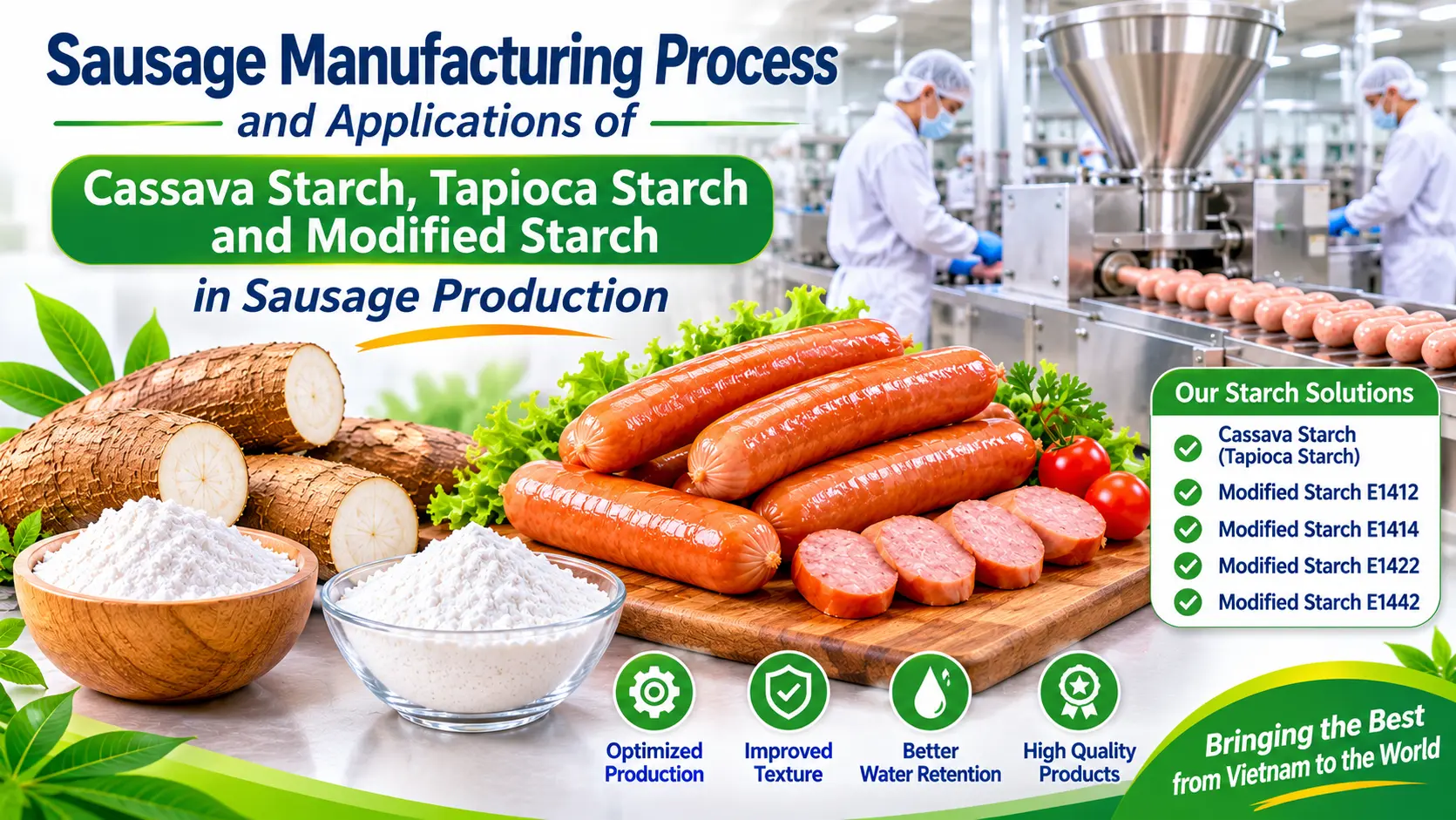
2. Main Ingredients Used in Sausage Production
Industrial sausage manufacturing typically involves the following ingredient groups.
2.1. Meat Ingredients
- Pork.
- Beef.
- Chicken.
- Animal fat.
Meat provides proteins, fats and the characteristic flavor of sausage products.
2.2. Starches and Functional Ingredients
Common starch ingredients include:
- Native cassava starch.
- Tapioca starch.
- Modified starch E1412.
- Modified starch E1414.
- Modified starch E1422.
- Modified starch E1442.
- Other food-grade starches.
These ingredients help improve texture, water retention, viscosity and product stability.
2.3. Other Supporting Ingredients
- Salt and sugar.
- Food seasonings.
- Soy protein.
- Food-grade phosphates, where permitted.
- Approved stabilizers and food additives.
- Ice or chilled water.
All ingredients and additives must comply with applicable food safety regulations.
3. Industrial Sausage Manufacturing Process
The sausage manufacturing process varies depending on product type, production technology and factory scale.
A typical industrial process includes the following stages.
Step 1: Raw Material Inspection
Pork, beef or chicken is received and inspected before entering the production line.
Quality checks generally include:
- Raw material origin.
- Meat freshness and quality.
- Storage temperature.
- Microbiological and food safety requirements.
Step 2: Meat Preparation and Grinding
The meat is cleaned, trimmed and cut into smaller pieces.
It is then processed using industrial grinding equipment to achieve a suitable particle size for further mixing.
Step 3: Ingredient Mixing and Emulsification
Ground meat is transferred to industrial mixers or emulsifying equipment.
Other ingredients are incorporated, including:
- Salt and seasonings.
- Cassava starch or modified starch.
- Vegetable proteins.
- Chilled water or ice.
- Approved food additives.
Starch is evenly dispersed throughout the meat mixture to support water retention, improve texture and enhance product stability.
Step 4: Sausage Stuffing
The prepared meat mixture is transferred to an industrial sausage filling system.
The mixture is filled into suitable food-grade casings according to the required product size and weight.
Step 5: Forming and Portioning
Sausages are shaped and portioned to ensure consistent dimensions and weight.
Step 6: Thermal Processing
Depending on the product type, sausages undergo steaming, boiling or other controlled thermal processing methods.
During heating, meat proteins coagulate and starch gelatinizes, contributing to the characteristic structure and texture of the finished product.
Thermal processing conditions must be properly controlled and validated to ensure food safety.
Step 7: Cooling
After thermal processing, sausages are cooled under hygienic conditions to maintain product quality and minimize microbiological risks.
Step 8: Packaging and Storage
Finished products undergo quality inspection before being packed in suitable food-grade packaging.
They are then stored under appropriate temperature conditions before distribution to supermarkets, restaurants and other markets.
4. Applications of Cassava Starch and Tapioca Starch in Sausage Production
Cassava starch, also known as tapioca starch, is extracted from cassava roots and widely used in the food processing industry.
Its thickening, gelatinization and structure-forming properties make it a valuable ingredient in various sausage formulations.
4.1. Improving Water Retention
Cassava starch absorbs water and swells during heating.
In sausage production, it helps retain moisture within the product structure, supporting yield and reducing moisture loss under suitable processing conditions.
4.2. Improving Texture and Elasticity
Cassava starch can form a gel when heated under appropriate conditions.
This property helps improve product binding, elasticity and structural uniformity.
4.3. Enhancing Viscosity and Smoothness
Tapioca starch contributes to the viscosity of meat mixtures and helps develop a smoother and more uniform texture in finished sausages.
4.4. Optimizing Production Costs
Using cassava starch in a properly formulated recipe can help manufacturers optimize product structure and ingredient utilization.
However, the inclusion rate must be determined according to product specifications, applicable regulations and labeling requirements.
5. Applications of Modified Starch in Sausage Manufacturing
Unlike native starch, modified starch is processed through physical, chemical or enzymatic methods to improve specific functional properties.
In sausage manufacturing, modified starch is valued for its potential to improve structural stability, water retention and product consistency during processing and storage.
5.1. Modified Starch E1412 – Distarch Phosphate
E1412 is cross-linked distarch phosphate.
Applications:
- Improving water retention.
- Increasing thermal stability.
- Supporting structural integrity during processing.
- Maintaining product viscosity and binding properties.
E1412 can be considered for sausage formulations requiring good structural stability.
5.2. Modified Starch E1414 – Acetylated Distarch Phosphate
E1414 is acetylated cross-linked distarch phosphate.
Applications:
- Improving water retention.
- Enhancing stability during heating.
- Supporting product texture and softness.
- Helping maintain product quality during storage.
E1414 is suitable for evaluation in sausage formulations requiring consistent texture and moisture retention.
5.3. Modified Starch E1422 – Acetylated Distarch Adipate
E1422 is acetylated distarch adipate.
Applications:
- Improving starch system stability.
- Enhancing water retention.
- Supporting viscosity and texture development.
- Improving resistance to processing conditions.
It is one of the modified starches of interest in processed food applications.
5.4. Modified Starch E1442 – Hydroxypropyl Distarch Phosphate
E1442 is hydroxypropyl distarch phosphate.
Applications:
- Improving gel stability.
- Supporting water retention.
- Reducing water separation under certain storage conditions.
- Maintaining product softness and consistency.
5.5. Other Modified Starch Types
Besides E1412, E1414, E1422 and E1442, other modified starches may also be evaluated in sausage manufacturing, depending on formulation requirements.
- E1404: Oxidized Starch.
- E1420: Acetylated Starch.
- E1450: Starch Sodium Octenyl Succinate.
- E1451: Acetylated Oxidized Starch.
Each modified starch has different functional properties. Selection should be based on application trials, product specifications and applicable food regulations.
6. Comparison Between Native Cassava Starch and Modified Starch in Sausage Production
| Criteria | Native Cassava Starch | Modified Starch |
|---|---|---|
| Thickening properties | Good | Depends on type |
| Water retention | Available | Can be enhanced depending on type |
| Heat stability | Depends on processing conditions | Some types offer improved stability |
| Structural stability | Has certain limitations | Can be improved |
| Applications | General sausage formulations | Specialized food formulations |
| Cost | Generally more economical | Depends on type and manufacturer |
7. How to Choose the Right Starch for Sausage Manufacturing
Selecting the appropriate starch depends on several factors:
- Sausage type: cooked sausages, sterilized sausages, fresh sausages or frozen sausages.
- Meat and fat content.
- Desired firmness, softness and elasticity.
- Water retention requirements.
- Heating and storage conditions.
- Raw material costs.
- Product quality standards and food safety regulations.
Food manufacturers should conduct formulation trials with different starch types before implementing large-scale production.
Cassava starch (tapioca starch) and modified starch are valuable ingredients in the industrial sausage manufacturing sector.
While native cassava starch supports thickening, texture development and water retention, modified starches such as E1412, E1414, E1422 and E1442 provide specialized functional properties that can improve product stability.
Selecting the right starch can help manufacturers improve sausage quality, optimize production efficiency and meet the increasingly diverse requirements of the global food processing industry.
Vietnamese cassava starch represents a promising raw material source for both domestic and international food manufacturers.