

What Is E1404 Modified Starch? Manufacturing Process, Applications and Price Guide
E1404 modified starch, also known as oxidized starch, is a type of starch that undergoes controlled oxidation to modify its physicochemical and functional properties. Depending on the intended application, it can be manufactured from different botanical sources, including cassava (tapioca), corn, and potato starch.
Oxidized starch is used in various industrial formulations because its viscosity, film-forming properties, and processing characteristics can be tailored to specific requirements.
In this article, we explain what E1404 is, how it is manufactured, its major applications, and the key factors that influence its market price.
1. What Is E1404 Modified Starch?
E1404 is the international food additive code commonly used for oxidized starch.
Oxidized starch is produced by treating native starch with a suitable oxidizing agent under controlled conditions. This treatment modifies some of the chemical groups in the starch molecules and may alter their molecular structure.
During oxidation, some hydroxyl groups can be converted into carbonyl and carboxyl groups. Depending on the processing conditions, molecular chains may also undergo changes that affect viscosity and other functional properties.
Compared with native starch, oxidized starch can offer characteristics that are better suited to selected industrial applications, particularly those requiring controlled viscosity and film formation.
Common raw materials used to manufacture E1404 include:
- Cassava starch, also known as tapioca starch.
- Corn starch.
- Potato starch.
- Other suitable botanical starch sources.
The final product’s performance depends on its raw material, manufacturing process, oxidation level, and quality specifications.
2. Key Properties of E1404 Oxidized Starch
E1404 is valued for its adjustable functional properties in a range of industrial formulations.
2.1. Adjustable Viscosity
Oxidation can reduce starch molecular weight and modify the viscosity of starch paste. This can be useful in applications that require controlled flow, spreading, or coating performance.
2.2. Film-Forming Properties
Certain oxidized starch grades can form relatively uniform films after gelatinization and drying. This characteristic can be beneficial in paper manufacturing, textile processing, and selected surface-coating applications.
2.3. Improved Processing Characteristics
Depending on the formulation, oxidized starch can support more uniform distribution across a material’s surface and help improve processing performance in coating, sizing, or bonding applications.
2.4. Formulation Compatibility
E1404 can be incorporated into suitable formulations with other ingredients to achieve the desired performance. Compatibility should be evaluated under actual operating conditions because pH, temperature, formulation composition, and processing methods can affect the results.
2.5. Performance Depends on the Starch Source
Oxidized cassava, corn, and potato starch may differ in viscosity, film formation, and processing behavior. Buyers should therefore select products based on technical specifications and application testing rather than relying solely on the E1404 code.
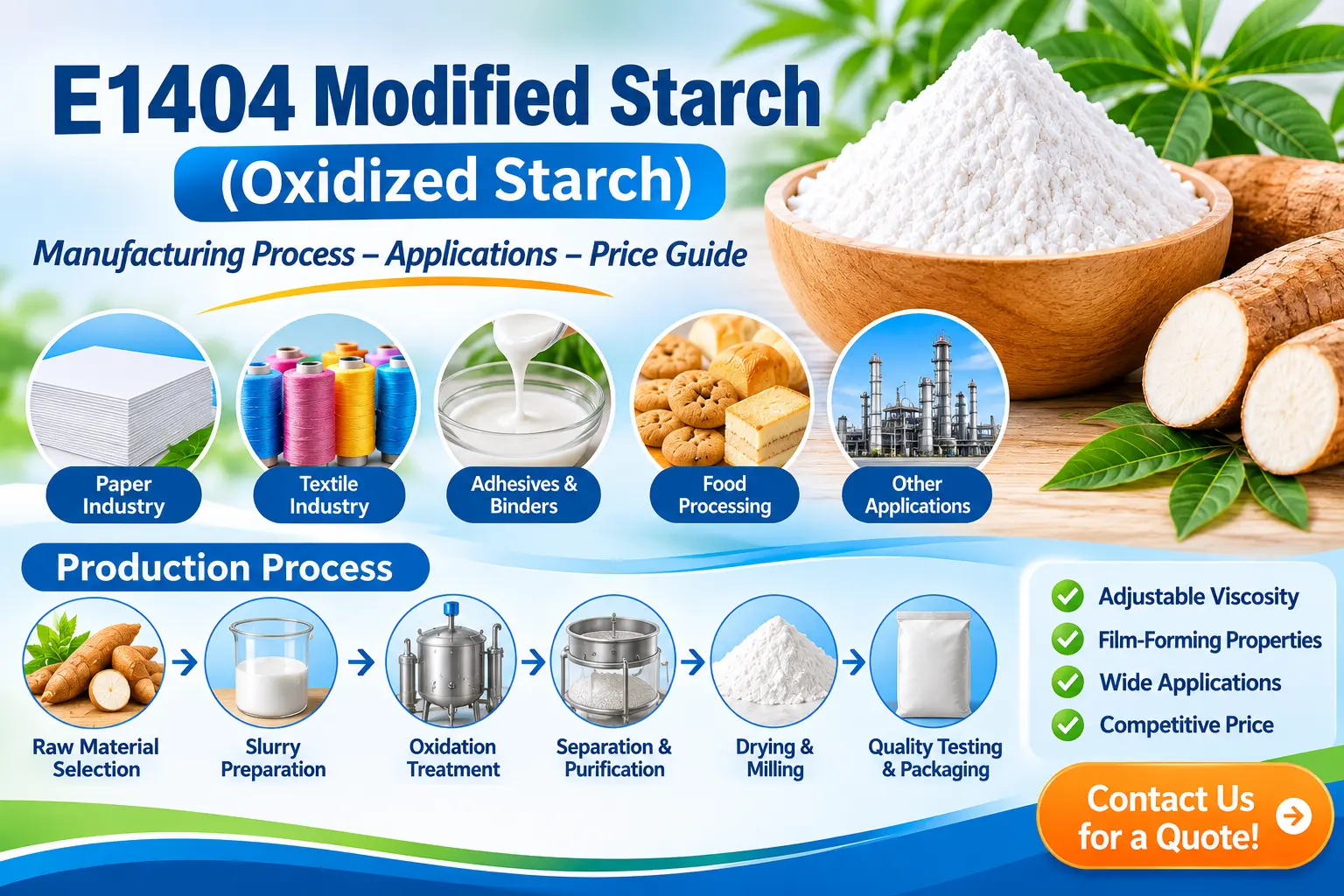
3. E1404 Modified Starch Manufacturing Process
The manufacturing process for oxidized starch involves several controlled stages to ensure consistent quality and suitability for the intended application.
Step 1: Raw Material Selection
The process begins with a suitable starch source, such as cassava, corn, or potato starch.
Incoming materials are evaluated for relevant quality characteristics, including moisture content, purity, appearance, and consistency.
Step 2: Starch Slurry Preparation
The starch is dispersed in water to prepare a slurry with a concentration appropriate for the production system.
Proper dispersion helps maintain uniform processing conditions throughout the subsequent modification stage.
Step 3: Controlled Oxidation
The starch slurry is treated with a suitable oxidizing agent under controlled manufacturing conditions.
This treatment changes part of the starch’s chemical structure and can modify its viscosity, film-forming characteristics, and other functional properties.
The oxidizing agent, processing conditions, and degree of oxidation must be selected according to the manufacturing technology, product specifications, and applicable safety requirements.
Step 4: Reaction Control and Termination
Once the target product characteristics have been achieved, the reaction is terminated and the material is processed to meet the required specifications.
Relevant control parameters may include viscosity, pH, oxidation level, and other product-specific quality indicators.
Step 5: Separation, Washing, and Purification
The modified starch is separated from the liquid phase. Washing and purification may be used to remove unwanted soluble components and help ensure that the final product meets the relevant quality requirements.
Step 6: Drying and Milling
The starch is dried to the specified moisture level and then milled or processed to obtain a suitable particle size for its intended application.
Step 7: Quality Testing and Packaging
The finished product undergoes quality testing before packaging.
Depending on its intended use, quality parameters may include:
- Moisture content.
- pH.
- Viscosity.
- Whiteness and color.
- Gelatinization characteristics.
- Degree of oxidation.
- Applicable purity and safety parameters.
Products that meet the required specifications are packaged, stored, and transported under suitable conditions.
Note: Actual operating parameters depend on the manufacturer’s technology, equipment, raw materials, and product specifications.
4. Applications of E1404 Oxidized Starch
Due to its adjustable viscosity and film-forming characteristics, E1404 can be considered for several industrial applications.
4.1. Paper Manufacturing
Oxidized starch can be used as a surface-sizing agent or as a component in selected paper-coating formulations.
Potential benefits include:
- Supporting improved paper surface strength.
- Contributing to ink holdout and print quality in suitable formulations.
- Helping control surface characteristics.
- Improving the processing properties of certain coating systems.
Actual performance depends on the paper grade, manufacturing process, and formulation.
4.2. Textile Industry
Oxidized starch may be used in selected textile-sizing formulations to form a film around yarns and support subsequent processing operations.
Product selection should consider the fiber type, film strength, desizing requirements, and operating conditions of the textile mill.
4.3. Adhesives and Industrial Binders
Certain oxidized starch grades can be used in starch-based adhesives and other industrial bonding formulations.
Depending on the application, they may help adjust viscosity, adhesive spreading, and film formation.
Bond strength and overall performance should be evaluated using the actual materials and production conditions.
4.4. Food Processing
Oxidized starch may be used as a food additive in applications where its use is permitted and where the product complies with the applicable food-grade requirements.
Depending on the formulation, it may contribute to viscosity control, texture, or film formation.
Manufacturers must verify the applicable regulations in their target markets before using E1404 in food products. Industrial-grade oxidized starch should not automatically be considered suitable for food applications.
4.5. Other Industrial Applications
Depending on its technical properties, E1404 may also be evaluated for selected coating, surface-treatment, and material-processing formulations.
Its suitability should be confirmed through product specifications and application testing.
5. E1404 Oxidized Starch vs. Native Starch
| Feature | Native Starch | E1404 Oxidized Starch |
|---|---|---|
| Chemical structure | Naturally occurring starch structure | Chemically modified through oxidation |
| Viscosity | Depends on the starch source and gelatinization conditions | Can be adjusted through the modification process |
| Film formation | Depends on the starch source and application | May suit formulations requiring specific film properties |
| Applications | Food processing and various industries | Paper, textiles, adhesives, and other suitable applications |
| Cost | Depends on raw materials and quality | Depends on raw materials, processing, and specifications |
| Product selection | Based on native functional properties | Based on technical specifications and intended use |
The choice between native starch and E1404 should be based on application performance, quality requirements, and total production costs.
6. E1404 Modified Starch Price Guide
The market price of E1404 oxidized starch is not fixed. It depends on raw material costs, product specifications, order volume, packaging, and delivery conditions.
Key Factors Affecting E1404 Prices
1. Raw Material Source
Cassava, corn, and potato starch may have different cost structures depending on availability, origin, and product characteristics.
2. Quality Specifications
Requirements for viscosity, whiteness, moisture, oxidation level, and testing can influence manufacturing costs.
3. Intended Application
Products designed for paper, textile, adhesive, or food applications may require different technical and quality standards. Food-grade products must meet the applicable regulatory requirements.
4. Order Quantity
Bulk purchases may qualify for different pricing arrangements compared with smaller orders, depending on the supplier’s commercial policy.
5. Packaging Requirements
Standard 25 kg bags, bulk packaging, or customized packaging can affect the overall price.
6. Delivery Terms
Ex-warehouse prices, delivered prices, and export prices under trade terms such as FOB or CIF may differ considerably.
How to Request an Accurate E1404 Price Quotation
To receive a quotation that matches your requirements, provide the following information:
- Preferred starch source: cassava, corn, potato, or another source.
- Intended application: paper, textiles, adhesives, food, or another industry.
- Required technical specifications.
- Estimated order quantity.
- Packaging requirements.
- Delivery location or destination port.
- Required quality certificates and product documentation.
Contact a qualified supplier for a quotation based on your product specifications and purchasing requirements. The selling price, minimum order quantity, lead time, and payment terms should be confirmed at the time of purchase.
Note: This article does not state a specific market price because actual quotations depend on product grade, raw materials, order volume, and delivery conditions. Buyers should obtain an updated quotation directly from the supplier.
7. How to Choose an E1404 Modified Starch Supplier
Selecting a reliable supplier is important for maintaining product consistency and production efficiency.
Consider the following factors:
- Clear technical specifications: The supplier provides a technical data sheet (TDS) describing the product’s relevant characteristics.
- Quality documentation: A certificate of analysis (COA) is available for the applicable product batch.
- Transparent origin: The manufacturer, raw material source, and country of origin can be identified.
- Product samples: Samples are available for evaluation under actual production conditions.
- Supply capability: The supplier can meet the required volume, packaging, and delivery schedule.
- Regulatory compliance: Product documentation is appropriate for the intended application and destination market.
For export transactions, buyers should also confirm labeling, shipping documents, packaging standards, and delivery terms.
8. Frequently Asked Questions About E1404
What is the English name for E1404?
E1404 is known as oxidized starch.
What raw materials are used to produce E1404?
E1404 can be manufactured from various botanical starch sources, including cassava, corn, and potato starch.
Can E1404 be used in food products?
It may be used in certain food applications where permitted by applicable regulations and when the product meets the required food-grade specifications. Buyers should verify the product documentation and relevant regulatory requirements.
Is E1404 the same as E1412 or E1422?
No. E1404 is oxidized starch. E1412 is distarch phosphate, while E1422 is acetylated distarch adipate. These modified starches differ in their modification methods and functional properties.
How much does E1404 modified starch cost?
The price depends on the starch source, product specifications, intended application, order quantity, packaging, and delivery terms. Buyers should request a quotation based on their actual requirements.
E1404 oxidized starch is a modified starch with potential applications in paper manufacturing, textile processing, adhesives, and selected food applications where permitted.
Its adjustable viscosity and film-forming properties make it a useful option for industrial formulations requiring specific processing characteristics.
To select the right E1404 product, businesses should identify their application requirements, technical specifications, quality standards, and delivery conditions. Testing samples before placing a large order can help confirm product suitability and optimize production costs.
Looking for an E1404 oxidized starch supplier? Prepare your technical requirements and estimated order quantity to obtain product recommendations and a quotation tailored to your needs.