

FOOD ADDITIVES: TYPES, MANUFACTURING PROCESS, AND PRICE GUIDE
1. What Are Food Additives?
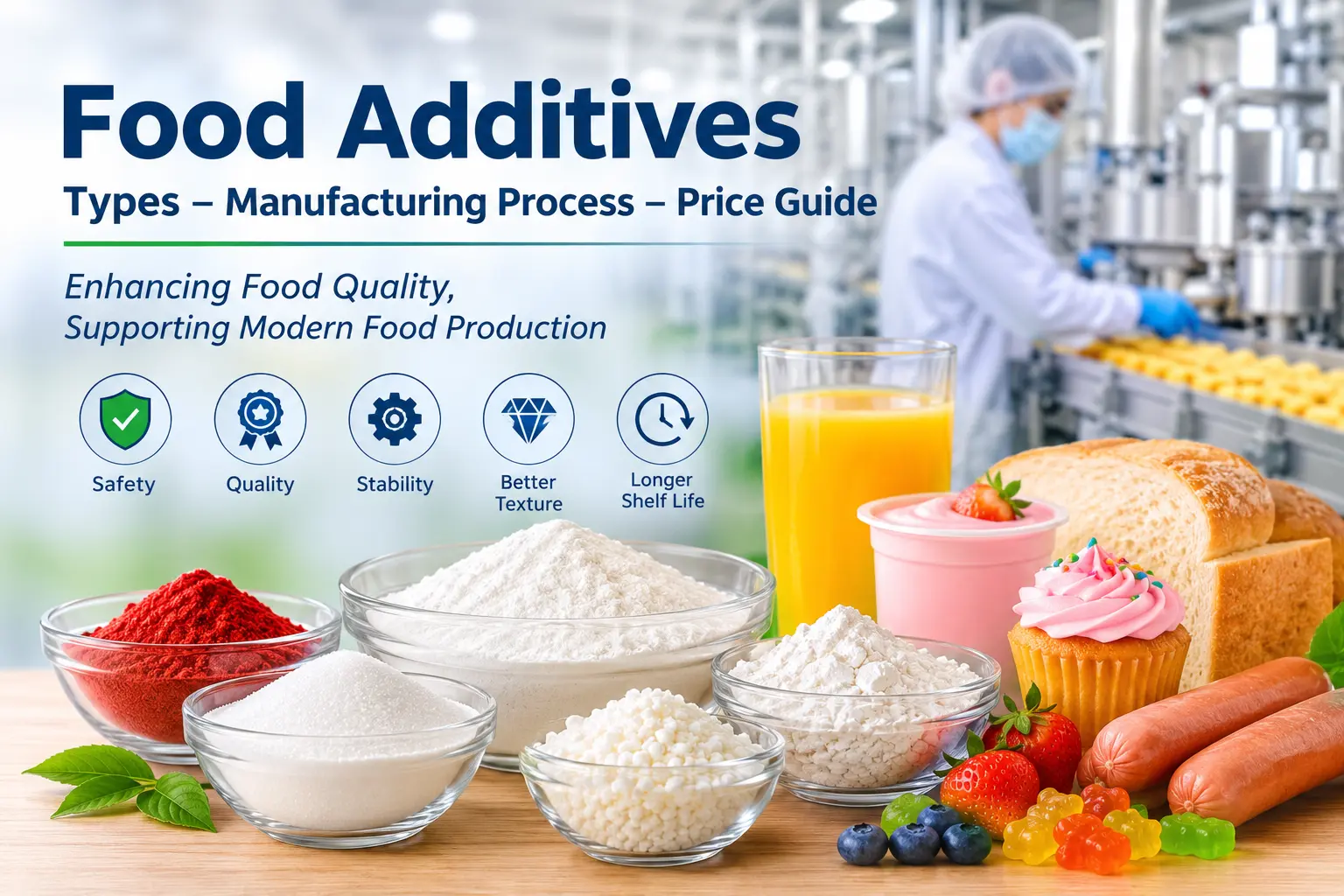
Food additives are substances added to food during manufacturing, processing, packaging, storage, or transportation to perform specific technological functions. They can improve texture, maintain product quality, stabilize color, regulate acidity, provide sweetness, or extend shelf life when used appropriately and in compliance with applicable food safety regulations.
Food additives are widely used in various food processing industries, including meat processing, seafood processing, confectionery, noodle production, beverages, dairy products, frozen foods, and sauces.
Depending on their intended function, food additives may be derived from natural sources, produced by modifying naturally occurring ingredients, or manufactured through industrial processes.
Selecting the right food additive requires consideration of the food product’s characteristics, processing conditions, permitted usage levels, and applicable food safety regulations.
2. Common Types of Food Additives
Food additives are classified into different categories according to their technological functions.
2.1. Thickeners and Stabilizers
Thickeners and stabilizers help control viscosity, improve texture, and reduce water separation or phase separation in food products.
Common examples include:
- Modified starch.
- Xanthan gum.
- Guar gum.
- Carrageenan.
- Pectin.
- Other permitted stabilizing agents.
Applications: Sauces, soups, ice cream, yogurt, canned foods, and processed food products.
2.2. Emulsifiers
Emulsifiers help stabilize mixtures of ingredients that would otherwise separate, such as oil and water.
Common examples include lecithin, mono- and diglycerides of fatty acids, and other permitted emulsifying agents.
Applications: Bread, cakes, ice cream, margarine, and various industrial food products.
2.3. Preservatives
Preservatives help inhibit the growth of certain microorganisms or slow down food spoilage.
Common examples include sorbic acid and sorbates, as well as benzoic acid and benzoates in applications where their use is permitted.
Preservation effectiveness depends on the food’s characteristics, pH, packaging conditions, and processing methods.
Preservatives must be used in accordance with the applicable limits for each food category. They must not be added in excess of the permitted levels.
2.4. Acidity Regulators
Acidity regulators help control pH, adjust sourness, and maintain the desired characteristics of food products.
Common examples include:
- Citric acid.
- Lactic acid.
- Malic acid.
- Citrate salts suitable for specific applications.
Applications: Soft drinks, jams, jellies, sauces, and various processed foods.
2.5. Sweeteners
Sweeteners are used to provide sweetness or partially or completely replace sugar in certain food products.
Common examples include steviol glycosides, sucralose, and other sweeteners permitted under applicable regulations.
The selection of a sweetener depends on the desired sweetness level, heat stability, flavor profile, and food labeling requirements.
2.6. Food Coloring Agents
Food coloring agents are used to impart or restore the characteristic color of food products.
They may be derived from natural sources or manufactured synthetically, depending on the specific substance and applicable regulations.
Applications: Confectionery, beverages, ice cream, jellies, and other food products in which their use is permitted.
2.7. Modified Starch for Food Applications
Modified starch is an important ingredient in the food processing industry. Starch can be treated through physical, enzymatic, or chemical processes to improve specific functional properties.
Common modified starch codes include:
- E1404: Oxidized starch.
- E1412: Distarch phosphate.
- E1414: Acetylated distarch phosphate.
- E1420: Acetylated starch.
- E1422: Acetylated distarch adipate.
- E1442: Hydroxypropyl distarch phosphate.
- E1450: Starch sodium octenyl succinate.
- E1451: Acetylated oxidized starch.
Each type has different characteristics in terms of viscosity, texture formation, stability during heating or freezing, and resistance to mechanical processing.
Modified starch is used in sauces, sausages, frozen foods, soups, confectionery, processed meat products, and many other food applications.
Note: The use of these additives must comply with the applicable regulations and permitted food categories in the target market.
3. Food Additive Manufacturing Process
Food additives encompass a wide range of substances, so there is no single manufacturing process applicable to every type. Each product requires a specific process based on its raw materials, desired properties, and quality standards.
A typical food additive manufacturing process may include the following stages.
Step 1: Raw Material Selection and Inspection
Raw materials are selected according to the technical requirements of the final product.
Depending on the type of additive, raw materials may include starch, plant-derived ingredients, sugars, organic acids, mineral salts, or other substances permitted for food additive manufacturing.
Incoming materials are inspected for purity, moisture content, impurities, microbiological quality, and other relevant parameters.
Step 2: Raw Material Preparation
Raw materials are cleaned, sorted, dissolved, dispersed, or otherwise prepared according to the manufacturing process.
For starch-based additives, preparation may involve dispersing starch in water and adjusting the processing conditions as required.
Step 3: Processing or Modification
This is the key stage that determines the functional properties of the final product.
Depending on the type of additive, processing methods may include:
- Extraction of functional components.
- Microbial fermentation.
- Enzymatic treatment.
- Physical modification.
- Chemical modification under controlled conditions.
- Blending of permitted additive ingredients.
For modified starch, the selected treatment method is designed to produce functional properties suitable for the intended application.
Manufacturing must comply with applicable safety requirements, chemical-use controls, residual limits, and relevant technical standards.
Step 4: Purification and Impurity Removal
After processing, the product may undergo purification to remove impurities or unwanted components.
Depending on the technology, purification methods may include filtration, washing, separation, crystallization, or other suitable techniques.
The objective is to ensure that the product meets the required purity and quality specifications.
Step 5: Drying and Product Finishing
For powdered additives, the product may be dried, milled, or classified according to particle-size requirements.
For liquid or other forms of additives, the finishing process is designed according to the product’s physical and chemical properties.
Processing parameters must be controlled to preserve product quality and stability.
Step 6: Quality Control
Finished products are tested against established technical specifications.
Depending on the additive, quality parameters may include:
- Moisture content.
- Purity.
- Viscosity or gel-forming properties, where applicable.
- Active ingredient content.
- Microbiological parameters.
- Heavy metals and relevant contaminants.
- Chemical residues, where applicable.
- Product-specific technical parameters.
The test results are used to determine whether each batch meets the required specifications before release to the market.
Step 7: Packaging and Storage
Food additives are packed in suitable packaging materials according to their properties. Common packaging options include multilayer bags, industrial sacks, and specialized containers.
Product labels should provide the information required by applicable regulations, including product name, ingredients, additive code where applicable, net weight, batch number, expiration date, storage conditions, and manufacturer or supplier details.
Products must be stored under appropriate conditions to maintain their quality throughout their intended shelf life.
4. Quality Standards and Food Safety Requirements
Quality and safety are essential considerations when selecting food additives for manufacturing.
Businesses should prioritize products with traceable origins, complete technical documentation, and compliance with the regulations applicable to their target markets.
Important documents to review include:
- COA (Certificate of Analysis): Provides analytical test results for a specific product batch.
- TDS (Technical Data Sheet): Describes technical specifications and product characteristics.
- SDS (Safety Data Sheet): Provides safety information where applicable.
- Origin and Traceability Documents: Identify the manufacturer, country of origin, and relevant batch information.
- Food Regulatory Compliance Documents: Support the assessment of compliance with applicable food safety requirements.
Additional certificates or documents may be required depending on the product and target market.
In Vietnam, the selection and use of food additives must comply with current food safety regulations, permitted additive lists, applicable food categories, and relevant usage limits.
Not every food additive is permitted for use in every type of food.
5. Food Additive Prices and Quotation Guide
Food additive prices vary depending on the product category, quality, origin, brand, and order quantity.
Because food additives cover a broad range of products, there is no single price that applies to all types.
5.1. Factors Affecting Food Additive Prices
Type of additive: Thickeners, preservatives, emulsifiers, sweeteners, and modified starches have different prices due to differences in raw materials and manufacturing technologies.
Country of origin: Imported products may be affected by transportation costs, import duties, exchange rates, and related expenses.
Quality standards: Products with specialized technical requirements or comprehensive quality documentation may have different prices from standard products.
Order quantity: Wholesale prices generally depend on purchase volume, packaging specifications, and delivery terms.
Purchase timing: Raw material costs, logistics expenses, and market fluctuations can affect quotations over time.
5.2. Price Quotations for Modified Starch Used in Food Processing
For businesses sourcing modified starch, pricing should be determined separately for each product code.
| Product | Typical Applications | Quotation Basis |
|---|---|---|
| Modified Starch E1404 | Texture modification and functional improvement in suitable applications | Technical specifications and order quantity |
| Modified Starch E1412 | Texture formation and stability in suitable applications | Origin and application requirements |
| Modified Starch E1414 | Sauces, processed foods, and other suitable applications | Product grade and packaging specifications |
| Modified Starch E1420 | Improvement of selected starch functional properties | Product specifications |
| Modified Starch E1422 | Processed foods, sauces, and products requiring suitable stability | Technical requirements |
| Modified Starch E1442 | Applications requiring viscosity control and stability | Application and product origin |
| Modified Starch E1450 | Emulsification and stabilization in suitable food systems | Functional properties and packaging |
| Modified Starch E1451 | Food applications compatible with its functional properties | Quality standards and order quantity |
The table above outlines the factors used to determine prices. It is not a verified retail price list or a confirmed commercial quotation.
5.3. How to Obtain an Accurate Food Additive Quotation
To receive a suitable quotation, buyers should provide the following information:
- Name or code of the required food additive.
- Intended application and type of food product.
- Required technical specifications.
- Preferred country of origin or brand.
- Estimated order quantity.
- Packaging requirements.
- Delivery location and shipping terms.
Based on this information, suppliers can recommend suitable products and provide quotations according to current market conditions.
Note: Actual prices should be confirmed directly with the manufacturer or supplier. A general reference price should not be applied to different food additive products without verification.
6. How to Choose a Reliable Food Additive Supplier
For food processing businesses, choosing the right supplier helps maintain product quality and ensure a stable manufacturing operation.
Important selection criteria include:
- Clear product origin and manufacturer information.
- Appropriate technical documentation and quality test results.
- Consistent product specifications and quality.
- Reliable supply capacity to meet production requirements.
- Transparent pricing, packaging details, and delivery terms.
- Technical support for product applications.
- Compliance with relevant regulations governing food additives, importation, distribution, and use.
For large-volume orders, businesses should consider requesting samples, evaluating product performance, and confirming quality specifications before placing a commercial order.
7. Trends in Food Additives for the Food Processing Industry
The food processing industry increasingly focuses on product quality, processing stability, and manufacturing efficiency. As a result, food additives designed to meet specific processing requirements remain an important area of interest.
Key trends include the following.
Texture Optimization
Thickeners, stabilizers, and modified starches are selected to help control viscosity, improve texture, and manage water retention.
Growth of Convenience Foods
Frozen foods, instant meals, sauces, and ready-to-eat products create demand for ingredients that maintain suitable stability during processing and storage.
Greater Focus on Raw Material Traceability
Manufacturers increasingly value traceable sourcing and comprehensive regulatory documentation.
Stronger Quality Control
Incoming material inspection, process monitoring, and batch documentation help reduce the risk of inconsistent product quality.
To respond to these trends, businesses should select additives based on their actual functional performance rather than price alone.
8. Frequently Asked Questions About Food Additives
Are Food Additives Safe?
Food additives that are authorized for use can meet safety requirements when the correct substance is used in the appropriate food category and within the permitted limits. Safety also depends on product quality, manufacturing conditions, and proper application.
Is Modified Starch a Food Additive?
Certain modified starches are classified as food additives and carry corresponding INS or E-numbers under applicable regulatory systems. However, classification, permitted uses, and labeling requirements must be determined according to the regulations of the relevant market.
What Raw Materials Are Used to Manufacture Food Additives?
Depending on the product, raw materials may include starch, plant-derived ingredients, sugars, organic acids, mineral salts, and other materials suitable for the manufacturing process.
How Are Food Additive Prices Determined?
Prices depend on the product type, origin, technical specifications, order quantity, packaging, and delivery terms. For an accurate quotation, buyers should identify the specific additive or product name.
Can Food Additives Be Purchased in Bulk?
Many manufacturers and distributors offer food additives in different packaging formats and order quantities. Actual supply availability must be confirmed for each product.
Food additives play an important role in modern food processing by helping manufacturers control texture, maintain product quality, and meet specific technological requirements.
To select suitable additives, businesses need to understand their functions, manufacturing processes, quality standards, and applicable food safety regulations.
For companies using modified starch, selecting the correct product code and evaluating its practical performance can help optimize food formulations and manage ingredient costs.
When purchasing food additives or modified starch, buyers should provide the product name, technical specifications, and estimated order quantity to obtain a quotation that matches their requirements.